Manistique East Breakwater Light — Manistique, Michigan

In June, 2001, I decided to take a short vacation.  I drove up to Rhinelander to meet my nephew, and we took off on a trip through Michigan and Ohio.

We drove east through the Upper Peninsula of Michigan along the north shore of Lake Michigan. We stopped briefly in Manistique to stretch and take a look at the lighthouse. We couldn’t get close because the breakwater was undergoing repairs. I managed to keep the construction equipment out of my photos.

Manistique Breakwater Light - Manistique, Michigan - June, 2001

I thought this sign was funny. It’s amazing what some people need to be warned about.

Manistque Breakwater Light - Manistique, Michigan - June, 2008

Posted in Michigan | Comments Off on Manistique East Breakwater Light — Manistique, Michigan

Bird #401 — Curlew Sandpiper

calidris (speckled water bird) ferruginea (rusty red)

Monday, June 11, 2001 — 3:35 pm

Great Lakes, Illinois — Naval Training Center — Lake Michigan

When I turned on my computer at work this morning, I had a message that a Curlew Sandpiper was discovered yesterday at Great Lakes Naval Training Center. That was frustrating. If I had known about it yesterday, I would have gone to see it. And so I worked. And as the day went on, reports kept coming in. 9:00 a.m. The Curlew Sandpiper is still there. 11:30 a.m. The Curlew Sandpiper is still there. 1:00 p.m. The Curlew Sandpiper is still there. I couldn’t take it any more.

I left at 2:05 and got to Great Lakes at 3:15. I had to stop in the office and show my driver’s license, insurance card and registration to get a visitor’s pass. I knew all I needed to know to get in because I was there, for my first time ever, about three weeks ago. I also knew how to get to where I needed to go to see the bird. There’s a harbor on the base created by two rock breakwaters. Inside the harbor, along the north breakwater, a sand spit has formed. The end of the spit is separated from the rest by a channel of very shallow water and an electric fence. The fence is in place to protect nesting Common Terns, but it also creates a haven for other terns, gulls and shorebirds. The center of the island is covered with low, scrubby vegetation but the edges are flat sand.

Two other birders were there when I arrived. I asked them if the Curlew Sandpiper was still there. One of them said, “Yes — wait, there it goes.” But then he immediately said, “Just kidding. Wouldn’t that be an awful thing to do to someone?” He had the bird in his scope, and he let me look at it in case it flew off before I could get mine set up.

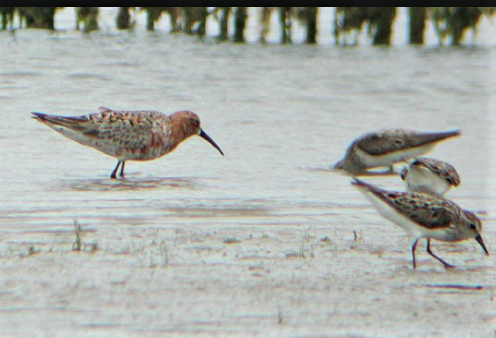
This was an easy one. It was out in the open and distinctly different. It was walking about, constantly moving, on the sand about 60 yards from where I stood behind the electric fence. After about five minutes, it flew toward me, landing on a point of sand about 40 yards away. It waded out into the water and foraged around belly-deep, probing below the surface with its bill.

I began looking around the area. I heard one of the other birders say, “Where’s the bird?” We finally found it a lot closer to us, right on the other side of the water channel, about 25 yards away. It was walking rapidly along the sand, picking occasionally. Then it flew off to the west and landed on the sand at the other side of the island. I wandered up that way and got to a point where I was separated from it by only 15 feet, on the other side of the channel. I watched it for another five minutes. It moved about quickly, picking at the sand at times and running along the water’s edge at other times. It was still there when I left at 4:10.

Here’s a photo of the very bird that I stole off the Internet.
Posted in Wildlife | Comments Off on Bird #401 — Curlew Sandpiper

Lincoln-Tallman Restorations — Janesville, Wisconsin

Lincoln-Tallman Restorations is a fancy name for a big house where Abraham Lincoln spent two nights in 1859. I visited it with a group from work. It was interesting, particularly because 75% of the furnishings are original. Our guide was an old retired man who tried very hard and didn’t do too bad, even though several members of our group were very rude — wandering off and opening doors and drawers. The most interesting feature was a porthole from the entryway to the upstairs hallway.

The porthole

Posted in Wisconsin | Comments Off on Lincoln-Tallman Restorations — Janesville, Wisconsin

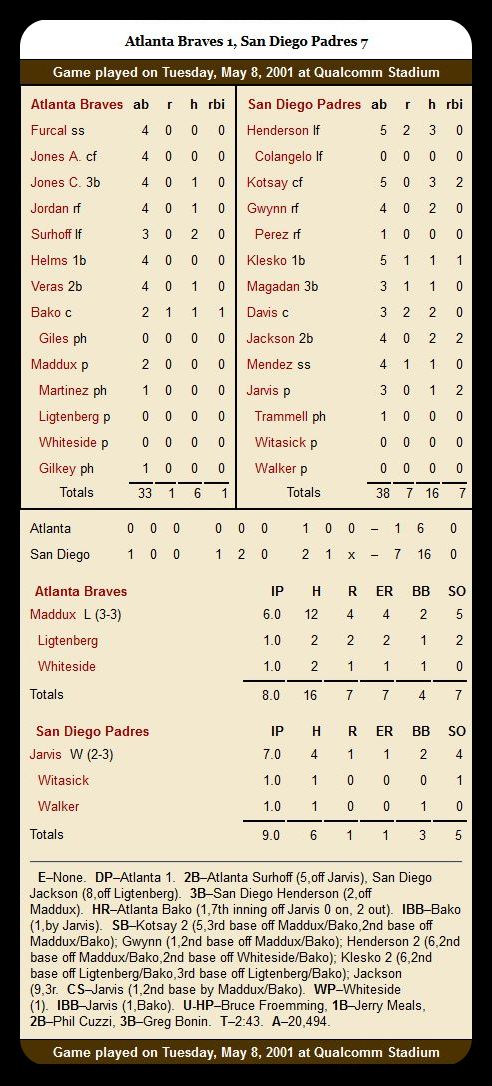
Padres vs. Braves — Qualcomm Stadium

I was in San Diego for a convention. We had a free evening, so two coworkers and I decided to go to the Padres game at the nearby Qualcomm Stadium. If going to a baseball game was always this easy, I’d go all the time. We caught the trolley across the street from our hotel and paid $3.50 for a round-trip ticket. After a 10-minute ride, we were dropped off right in front of the stadium.

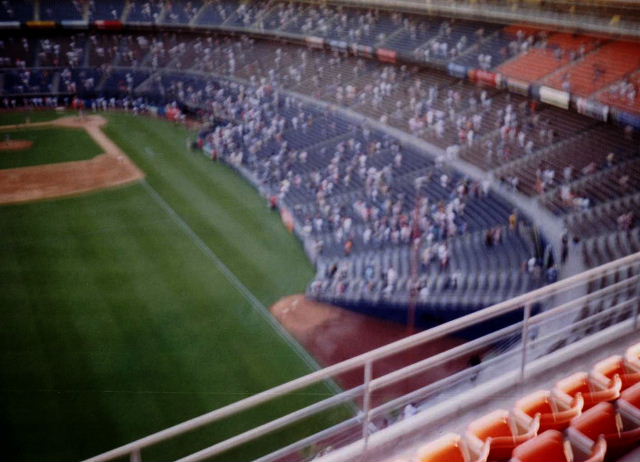
At the ticket window, we asked for upper-deck seats between the bases. We ended up in $9.00 seats in the second row of the upper deck right behind home plate. We had a fantastic view. Before the game started, I wandered around the stadium. I wanted to walk around the upper deck to take pictures, but an usher yelled at us because nobody was being seated in the upper deck in the outfield. I explained what I wanted to do and he (told us to take the pictures quickly and come right back.

I bought a hot dog and a Coke for $7.00. (My total expenses for the night — trolley, ticket and supper — were $19.50.

The Padres played the Braves and beat them 7-1. We saw three future hall-of-famers: Greg Maddox pitched for the Braves, and Tony Gwynn and Ricky Henderson played outfield for the Padres. I also got to watch White-throated Swifts flitting overhead and a pair of Western Kingbirds that hung out on a cable right in front of us.

The evening was relaxing, cool and fun. We stayed to the end and were back at the hotel 20 minutes after the final out.

qualcom2

Unfortunately, the film in my cheap camera was suffering from the heat and my photos came out lousy.

Padres vs. Braves - May 8, 2001

Posted in Baseball | Comments Off on Padres vs. Braves — Qualcomm Stadium

Bird #400 — Wrentit

chamaea (dwarf) fasciata (striped)

Tuesday, May 8, 2001 — 11:45 am

San Diego, California — Mission Trails Regional Park

I left the hotel at 10:00, after my first session. I planned on going to the Padres game in the evening with my coworkers, so I had seven hours to bird. I originally planned on heading 40 miles east into the mountains, but the weather forecast called for 90+ temperatures there, so instead I went to Mission Trails Regional Park about 10 miles east of the hotel. It’s a large park that contains a stretch of the San Diego River where it cuts through some dry hills. There’s an old dam constructed by friars and Indians in the early 1800s and a small lake tucked into the scrub.

I asked a lady in the visitor center to direct me to good birding places. She didn’t know much about birds, but she was very friendly. She showed me how to find the trail that ran around the visitor center and told me to watch out for rattlesnakes. The area looked a lot different from the other places I birded in San Diego, but I was seeing the same birds; Spotted Towhee, Lazuli Bunting, California Thrasher, California Towhee, Black-headed Grosbeak. At one point, I saw two small, long-tailed birds moving through a tree below me in a depression. I was pretty sure they were Wrentits, but I couldn’t get a good look at an entire bird at any one point.

The trail cut around the side of a hill then down toward the river. I was disappointed that I couldn’t walk along the river channel, but the trail stayed above the trees except for one spot where another trail crossed over. After leaving the valley, the trail climbed a steep hill covered with bushes and small trees. I spotted two birds in a tree about 20 yards off to the side. One was a Bushtit. The other was a Wrentit. It moved quickly through the branches with its long tail always cocked up. It was almost twice as large as the Bushtit.

I wandered all over the park for another three hours and saw some interesting birds, but no more lifers. The most unusual was a singing male Northern Parula near the dam. This is a rare bird in California.

I drove back to Point Loma and spent an hour on the grounds of Point Loma Nazarene College, on the cliffs above the ocean. But the Wrentit was my final lifer on the trip.

Posted in Wildlife | Comments Off on Bird #400 — Wrentit