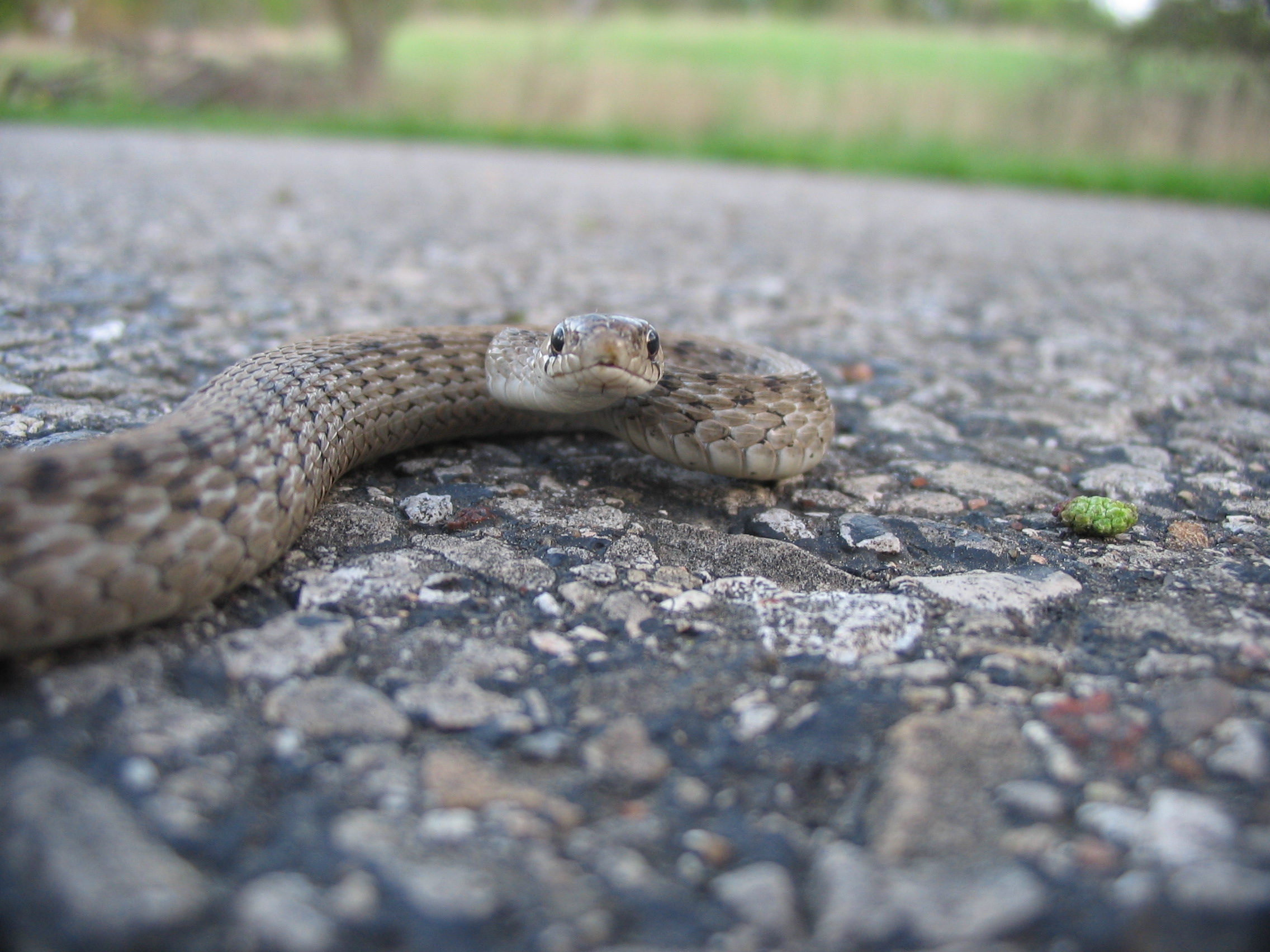
Reptile-Amphibian #9 — Brown Snake

storeria dekayi

Sunday, April 29, 2001 — 4:30 pm

Kane County, Illinois — Burnidge Forest Preserve

I was exploring three Kane County forest preserves that I’d never been to before. Burnidge was the third and, potentially, the best for birds, although things were very slow today.

I was walking a trail through brushy woods along the edge of a brush field. I saw this snake lying motionlessly on the trail. It was tiny, maybe six inches long. It was a pale flat brown overall with a dark brown head and a wide stripe down the center of its back that was a shade lighter than the sides. There was a double row of tiny dark triangle spots along the edges of this center stripe, with thin dark lines connecting some of the dots. Its underside was creamy white.

When I bent over to look at it, it moved toward the side of the trail. I put my foot in front of it to get a better look. It flattened out and coiled the front half of its body into a severe “S”. I tried to flip it over gently with a stick to get a look at its underside. It tried to get away when it saw a chance, and coiled when it didn’t, but it never struck. I was finally able to lift it by one of the coils and see the underside. At about that time, I heard two people and a dog coming along the trail, so I let it get away. As soon as it reached the side of the trail, it crawled beneath the leaves and disappeared.

Posted in Wildlife | Comments Off on Reptile-Amphibian #9 — Brown Snake

Bird #385 — Monk Parakeet

myiopsitta (from myia, a fly, and psitta, a parrot) monachus (a monk)

Saturday, March 31, 2001 — 12:15 pm

Elmhurst, Illinois — Parker Street

Last December, there was a message on IBET about this colony of Monk Parakeets. I printed it off and waited for an opportunity. Today I was looking for something to do with my daughter. I determined on a multi-purpose trip. We visited a used bookstore in Palatine, toured the new library in Des Plaines, and searched for the parakeets.

It wasn’t much of a search. I drove to the spot, a power-line clearing through a middle-class neighborhood, and stopped the car. We saw a huge stick nest in a nearby electrical tower. It was about the size of a refrigerator. Within a minute, we saw a parakeet fly to the nest. I got out of the car and saw three more fly by at eye-level about 30 yards off to the right, across a field. Then a strange, harsh cry penetrated my consciousness. I turned around and saw six more Monks in a small tree 30 feet away. They were systematically breaking off small branches and twigs. Whenever one would break off a branch, it would fly with it to the tower. The twigs were slender, but some were as long as the birds.

Some birds flew to a second tower where I saw four or five smaller branch nests, each about the size of a bushel basket. There was also a smaller bundle in the original tower. Parakeets were flying everywhere around the area. Some headed out over a row of trees on the other side of the clearing. Their calls were constantly ringing around the neighborhood.

We spent about 10 minutes watching them, then headed for home, stopping at Einstein Brothers for bagel dogs for lunch.

Posted in Wildlife | Comments Off on Bird #385 — Monk Parakeet

Bird #384 — Iceland Gull (Thayer’s)

larus (ravenous seabird) thayeri (for John E. Thayer of Boston)

Friday, January 5, 2001 — 2:15 pm

La Salle County, Illinois — Starved Rock Lock and Dam — Illinois Waterway Visitor Center

NOTE: When I saw this bird, Thayer’s Gulls were considered a separate species from Iceland Gulls. The two have since been lumped, making this my lifer Iceland Gull and reducing my March, 2002, sighting of a (Kumlien’s) Iceland Gull from a lifer to a subspecies and causing me a great deal of frustration.

After I identified my lifer Lesser Black-backed Gull, I was reinvigorated. The flock of gulls on the strip between the lock and river was getting slowly larger. In addition, the huge flock of gulls that had spent the morning on the mid-river ice well above the dam had now flown down to the open water below the dam. Many of these were wheeling around over the turbulent water just below the dam. Far more gulls were doing this now than at any other time since I’d arrived.

I started at one end of the group on the strip, taking care with each adult to see if it had black tail feathers (I was hoping for an Iceland or Glaucous Gull) and  a yellow eye. I spotted one that seemed to have a dark eye and concentrated on it, hoping it was my lifer Thayer’s. For a number of reasons, primarily because even the experts have difficulty with Thayer’s Gulls, I wasn’t able to convince myself that it was or wasn’t my bird.

But as I watched it through my scope, another gull floated through my  vision. I had a good, but brief view of the undersides of its wings, and they looked very pale with the only black being a thin line on the tips of the primaries. I lost sight of it momentarily as I scrambled for my binoculars, but spotted it as it landed on the snow near the end of the flock. I found it in the scope again and immediately noticed it had dark eyes. I concentrated on this feature for a long time to make sure it wasn’t a trick of the light and compared it to nearby Herrings for the same reason. The eye was definitely dark. Now what?

The bird settled in, head into the wind (as were all the other gulls) and began preening. I checked my Sibley and National Geographic guides for other marks.

It was very close in size to the Herring Gulls around it. An adult Herring stood just behind it, perhaps a foot away, giving me a good comparison. The Thayer’s smooth gray mantle looked very slightly darker than the mantles of some of the Herrings, but the same color as others. The sun was low and bright, behind the bird but off to the right, and clouds were passing occasionally, so the lighting was changing constantly. Its head was white with fewer streaks than on the nearby Herrings. The head was more rounded. This feature helped me relocate the bird when I would pan the flock to compare Herring Gull traits. Its bill was more greenish/yellow, a bit shorter and perhaps a bit thinner. It had a red spot on the lower mandible, near the tip. Its legs were pink. At times, they looked darker pink than the Herrings’ legs, but at other times they looked to be the same shade.

After 10 minutes, the bird finished preening and closed its eye. For the next half hour, it mostly slept, occasionally opening its eyes briefly. Most of the time, it sat on the ice. Oddly, every so often, it would stand up, then immediately tuck its bill into its back feathers and close its eye again. Then, a few minutes later, it would sit down again. Whether sitting or standing, its eye was almost always closed and its bill was almost always tucked into its back feathers. It only deviated from this behavior once. It stood up, stretched one of its legs out while spreading the near wing, then spread the far wing before sitting down again. When it did this, I got good, albeit short, looks at the wing surfaces. The upper wing was the same gray as the mantle. The primaries had black on them, but only on the outer webs, giving the wing tip a lined look. It had white windows near the tips, but I couldn’t count them in the brief time available. After I saw this section of the wing, I watched Herring Gulls until I saw one do the same thing. The Herring’s wing tip was  more extensively black, forming a black triangle on the primaries, except for the white widows at the tips. The stretched under-wing was gray with long white windows near the primary tips. The only dark was a thin line at the very tips of the primaries. Here again, I compared it to the hundreds of nearby Herrings, which had obvious dark undersides on the primaries.

The mark that sealed the identification for me was one I learned about on my gull identification video last night. While the Thayer’s Gull was standing, I could see the underside of its outermost primary on the far wing. This feather was light gray to within two inches of the tip. Then there was a large white window that covered the rest of the length of the feather except for a thin terminal line of darker gray. On several nearby Herring Gulls, I could see this same feather. In their case, the feather was black within an inch and a half of the tip. A smaller white window covered the next inch. The final half inch was black. The pattern on both species matched exactly with what I saw in the video.

Until today, I was sure the Thayer’s Gull was mythical. I now know why I never just happened upon one. I also understand why I never found one, even when I was looking for one. Identifying a bird by the pattern on one particular feather is a level of birding I don’t often get to, although I thoroughly enjoyed accomplishing it today. I left at 3:00 to be home in time for supper. The Thayer’s Gull was still sleeping on the snow.

Posted in Wildlife | Comments Off on Bird #384 — Iceland Gull (Thayer’s)

Bird #383 — Lesser Black-backed Gull

larus (ravenous seabird) fuscus (dusky)

Friday, January 5, 2001 — 1:30 pm

La Salle County, Illinois — Starved Rock Lock and Dam — Illinois Waterway Visitor Center

During the week between Christmas and New Years, seven or eight species of gulls were reported from Starved Rock Lock and Dam on the Illinois River southwest of Chicago. Most of them were would-be lifers, so although gulls frustrate me to tears, I had to go. An additional inducement was the location. The US Army Corps of Engineers maintains the Illinois Waterway Visitor Center right next to the lock. The gulls reportedly make a habit of hanging around on the narrow strip of grass between the lock and the river, right in front of the visitor center. Viewers can stand inside or outside on two levels. The inside is heated, with huge plate glass windows and bathrooms.

I arrived at the lock a little before 9:30, after a two-hour drive through blowing snow on a very windy day. As I walked up the steps to the second level, I was met by an exuberant fellow who informed me that there were seven in sight. He didn’t seem the sort to be sorting through gulls, so I did some quick thinking and asked, “Eagles?” Sure enough, there were several in view all day, adults and immatures, usually sitting in trees downstream but occasionally flying over the open section of the river below the dam.

There were gulls everywhere — except on the strip of grass in front of the windows. Many were swimming below the dam. Others flew in circles along the dam walls. Several were scattered on the ice down channel. A huge flock rested on the ice above the dam and out of identification range. The visitor center windows face south, so the sun was a factor all day except for a few periods when bands of clouds passed across the area. Starved Rock, in the state park, was directly across the river.

After 20 minutes or so, a small group gathered on the strip on the other side of the lock, about 40 yards away. These were mostly first-year birds, with a few other ages mixed in, all Herrings. At 10:30, a local birder came in and asked if I’d seen anything interesting. I told him no, but that I was no expert. He told me about the six species seen the day before, then said the gulls were so spread out today it wasn’t worth his while to stay around, and he left. This was discouraging. I hung around for another 45 minutes, then drove over to the state park.

I returned to the visitor center around 12:30. Not much had changed. The sun had moved west, giving me a better look at the small group of gulls in front of the windows. The group had gotten a bit larger, perhaps 200 gulls, but again, they were all Herrings as far as I could tell. I settled in, pointed out eagles to several people who wandered in to see them (and who were very grateful).  I also began resigning myself to another failed day of gull watching.

In what might well have been my final scan of the local group, I saw a gull with a decidedly darker mantle. It was in the middle of the flock, so I couldn’t see any other details, but it certainly wasn’t a Herring Gull. It was, in fact, a Lesser Black-backed Gull. I kept looking and soon spotted another one. This one stood on the edge of the flock in plain view. It was noticeably smaller and more slender=looking than the Herring Gulls. Twenty minutes after I spotted it, it took off and dropped below the edge over the river. I soon found it again as it banked and headed toward the dam. Now it really looked slimmer than the Herrings, with longer-looking, more pointed wings. It circled around by the base of the dam, then dove into the river and came up with a small fish. It was immediately chased by a second-year Herring Gull. As it dove to escape the gull, I lost sight of it again.

When I lost sight of this bird, I scanned the flock in front of the windows for other species. Later, when I checked back, I could see three gulls with darker backs in among the Herrings, and one was in clear view and identifiable as a Lesser Black-back. I assume the other two were there also. There were still there when I left at 3:00.

Posted in Wildlife | Comments Off on Bird #383 — Lesser Black-backed Gull

Captain Video

Captain Video was a television serial that aired on the DuPont Television Network from 1949 to 1955. Most episodes have been destroyed, but there are a few online.

One I watched had an exciting title: Captain Video Prepares to Visit Regus. Apparently, Captain Video had helped a coalition of planets defeat Terson, an evil planet. Captain Video convinced the planet leaders to be lenient with the defeated foe and was preparing to visit Terson with his sidekick, the Video Ranger, to let them know the terms. The leader of Terson determined to greet Captain Video causally but then spring a trap and kill him. The entire episode involved men in funny costumes standing and talking in front of scenes painted on cardboard. Twice, the action was halted to show Captain Video’s other agents in action. These interludes consisted entirely of short clips from random, cheap western movies. There were also two messages reminding viewers to fight for freedom and to end prejudice (by making friends). The acting, the props, and the script were all … terrible.

I watched a second episode, I think part of the 1951 serial Master of the Stratosphere. Captain Video in his rocket car rushes to the aid of the Video Ranger who is being chased by bad guys. The uniforms, lab equipment, and weapons are all space age (by 1950s standards), but the chase takes place in very mundane 1950s cars and trucks (except, of course, for the rocket car) in a western-movie setting of rocks and trees. And the bad guys are dressed like gangsters. Captain Video’s weapons include a “cosmic vibrator” and a “paralysis ray.” The episode then segues into a story of a scientist who is controlling the weather in cahoots with somebody from another planet. The episode ends with Captain Video and the Video Ranger in their spaceship about to be squished between two “reactivated comets” controlled by the bad guys.

Supposedly Captain Video was popular with kids and adults, proving that the past is a different planet.

Posted in Pop Culture | Comments Off on Captain Video