Bond Swamp

The Swainson’s Warbler is a little brown bird that can usually only be seen in southern swamps between April and July. I’ve wandered the swamps of Arkansas and never seen a hint of one. They can occasionally be found in thickets in the mountains of North Carolina, but I didn’t find one there either.

They aren’t very common, and even when they’re around, they skulk in the underbrush most of the time. I dug around on the Internet and discovered that they can be found in Bond Swamp, south of Macon. I e-mailed the headquarters of the National Wildlife Refuge and received a very helpful reply. I was told that Bond Swamp “has a very good population of Swainson’s Warblers and at this time of year you have a very good chance of hearing them and possibly seeing them.” I was also told where to look on a trail in the refuge and on dirt roads north and south of the refuge.

As I read up on Bond Swamp I discovered it had more than Swainson’s Warblers. It had Cottonmouths, Copperheads, Timber Rattlesnakes (and 23 species of non-venomous snakes), deer ticks (the ones that transmit Lyme Disease), chiggers, poison ivy, Black Bears, wild hogs and the occasional Alligator.

I arrived a little before 3:00 and began walking the trail to Stone Creek. At first, the trail was a track wide enough to drive on. The woods looked like this.

But once I got to Stone Creek and began walking the “trail” that paralleled it, I was pretty much just walking through the swamp. Every couple hundred yards there was a sign to indicate that another human, at some distant point in the past, had been there before me.

I took my time and looked for snakes before every step while also looking and listening for birds. I thought at one point that I heard a Swainson’s Warbler singing, but it was on the other side of the creek and I had no way to get to it without wading, which I was not about to do. Here’s where I heard it.

I stood and listened for several minutes, but it didn’t sing again. The creek began looking more and more swamp-like.

I finally came to a proper dirt road and, for the first time since I’d gotten there, relaxed. There were birds around, like this male Hooded Warbler.

I was disappointed that I didn’t see a Swainson’s Warbler in the refuge, but according to the e-mail I received, Bondview Road, north of the refuge seemed like my best shot anyway. Here’s what I’d been told: “This is a county road that starts out paved but quickly becomes a dirt road. It floods several times a year and can be a very rough ride — to the point of causing damage to vehicles. If the road is dry, you can usually make it to the first bend, but from this point the average person’s vehicle will have to park and you will have to walk the road. The landowners are very sensitive to anyone trespassing for any reason so make sure you stay on the roadway. The best Swainson’s habitat is closer to the river near the railroad tracks, so you probably have a mile to walk after you park your car.”

I found the road and had no trouble identifying the spot beyond which I shouldn’t attempt to drive my rental compact.

I parked, hung my camera and binoculars around my neck and tucked my i-Pad under my right arm. (I wasn’t terribly comfortable with leaving my car and decided not to leave anything of value inside. Of course this meant that I was carrying a lot of stuff. I got about 50 yards from the car, stepped on a slippery slope along the first puddle and ended up flat on my back and side. My shoes, my right pants leg, my back and my left hand were coated with half an inch of sticky mud. Somehow I managed to keep my camera and binoculars out of the mud and water and hang on to my i-Pad, but at the sacrifice of my right elbow which got banged and scraped up quite a bit. The impact jarred my i-Pad somehow and it began playing, I kid you not, “Swanee River Boogie.”

You can see my impact mark in the mud on the right side of the puddle. That’s the Ocmulgee River just visible through the bushes on the right.

I came very close to quitting at that moment. My elbow hurt and I was filthy. But I figured I’d come this far and, based on what the e-mail said, was almost certain to see my bird. I kept walking. After a while, the mud dried and I was able to scrape most of it off.

The “landowners” consisted of several places along the river that had been decked out with plastic chairs and grills, probably as fishing camps. I can’t imagine anything more enjoyable than camping in humid 90° weather in a snake- and mosquito- and tick-infested swamp.

The road kept getting worse and worse, and in several places there were large rut marks through the woods where trucks had driven around the largest puddles. I had no choice but to go off the road to get around these spots. Apparently I’m still not allergic to poison ivy.

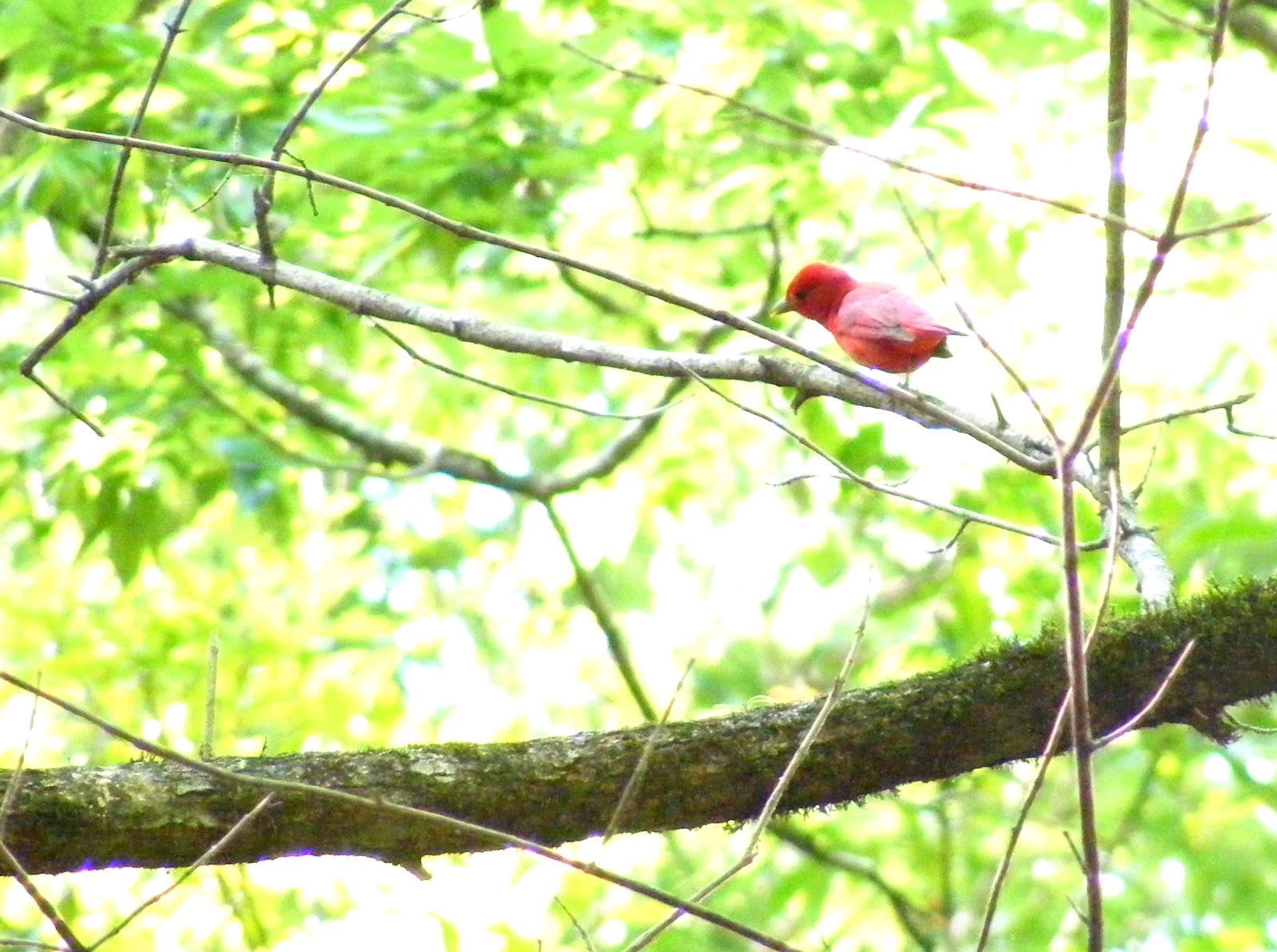
I finally got to the area where I was led to expect Swainson’s Warblers. I wandered back and forth and stood still for several minutes listening, and saw and heard a lot of stuff, but no Swainson’s Warblers. A Summer Tanager showed up and kept me company for a while.

It began to feel very much like I’d struck out again. I hung around for probably 45 minutes, but with little sense of expectation. I walked back to the car, stopping every 100 feet to listen, but heard nothing. I ran into a couple of the locals — complete with pickups, gun racks and camouflage clothing. They looked at me a bit strangely but gave me no problems. (I have several relatives in the south who would fit right in with these guys, so I wasn’t really too worried.) I was happy to find the car where I left it. I’m pretty sure it would have been completely submerged in a few of those puddles if I had tried to drive it down that road.

It was now 6:00 and too late to do much else with the day. Besides, I was sore and sweaty and muddy and very much wanted to quit, but I decided to try once more at the spot where I’d thought I heard the first one. When I got there, I saw several guys fishing along the creek. I got out and looked around for a few minutes, but decided I wasn’t up to that trail again.

That left one more option, Reids Station Road south of the refuge. I received the same warnings about trespassing, but the road itself was supposed to be much better. It was. This was more like it — a well-maintained dirt road through a swamp with nobody else around. I could do my birding from the car and not worry about snakes or getting shot. I did get out a few times in likely-looking spots like this one.

But mostly I drove along slowly with the windows open listening carefully. I drove and drove and drove until I came to the gate for a private hunting club. It was a bit of a trick to get the car turned around, but I managed. The day was fading fast and the mosquitoes were getting lively. I decided I’d missed the bird — again.

Posted in Georgia | Comments Off on Bond Swamp

“I” Before “E” Except After “W”

It all began two weeks ago when my boss stopped me in the hallway and said, “When you get a chance, I’d like to see you in my office.” He’s not usually that formal, and while I had no fear of getting in trouble, it did sound like something serious.

He said, “Someone signed up months ago to go to a conference in Atlanta next week, but she can’t go. The boss suggested that you might be a good person to send instead.”

I’m usually up for a trip, so I said sure.

I was to fly down on Tuesday, and the conference started on Wednesday. I immediately began thinking “Hey, if I fly down really early on Tuesday, I can have half a day to explore Georgia.”

But where to go? Five options popped into my head.

  • The Coca-Cola Museum — The last time I was in Atlanta, in 1990, I intended to visit, but I was a little early. As in a week early. As in a week before the museum was open to the public. But admission is $16 and that’s too much to pay to be advertised to by a product I don’t like.
  • Jimmy Carter National Historic Site — I visit presidential sites, but this was just Jimmy Carter and besides, he’s still living in his house so you can’t tour that. Which leaves his high school and his brother’s gas station. (Don’t you chuckle when you hear people say that Carter is a better ex-President than he was a President? That’s not setting the bar very high, is it?)
  • Andersonville National Historic Site — I’d like to see it sometime, but there isn’t enough there for a special trip.
  • Roosevelt’s Little White House Historic Site — The place where FDR was hanging out with his mistress when he died. I’d like to see it sometime, but so would my wife, so …

I’m kidding of course. When I realized I could spend half a day in Georgia doing whatever I wanted, I immediately decided to try again to see a Swainson’s Warbler. I toyed for a bit with trying to see Roosevelt’s house and the bird, but that would have been pushing things. (More on the bird in future posts.)

The closest spot to see the bird was south of Macon, which is about 80 miles south of Atlanta. I got to the airport a little before noon and collected my rental car — a Toyota Yaris. “Yaris” is Japanese for “we put the speedometer in the wrong place.” It’s not behind the wheel where it’s supposed to be. It’s off in the middle of the dashboard in its own little hump. For the five days I drove the stupid car, I kept looking at a blank dashboard and rarely had any idea how fast I was going.

Otherwise it wasn’t a bad car. It was really quick in the low gears, although it labored once I got it up around 80 40.

Once I decided I was heading to Macon, I looked on line for a good place to eat lunch. That’s how I ended up at Nu-Way Weiner Stand.

It wasn’t a large place, and even though it was almost 2:00 when I arrived, there was a steady flow of customers. It’s been in this same spot since it opened in 1916.

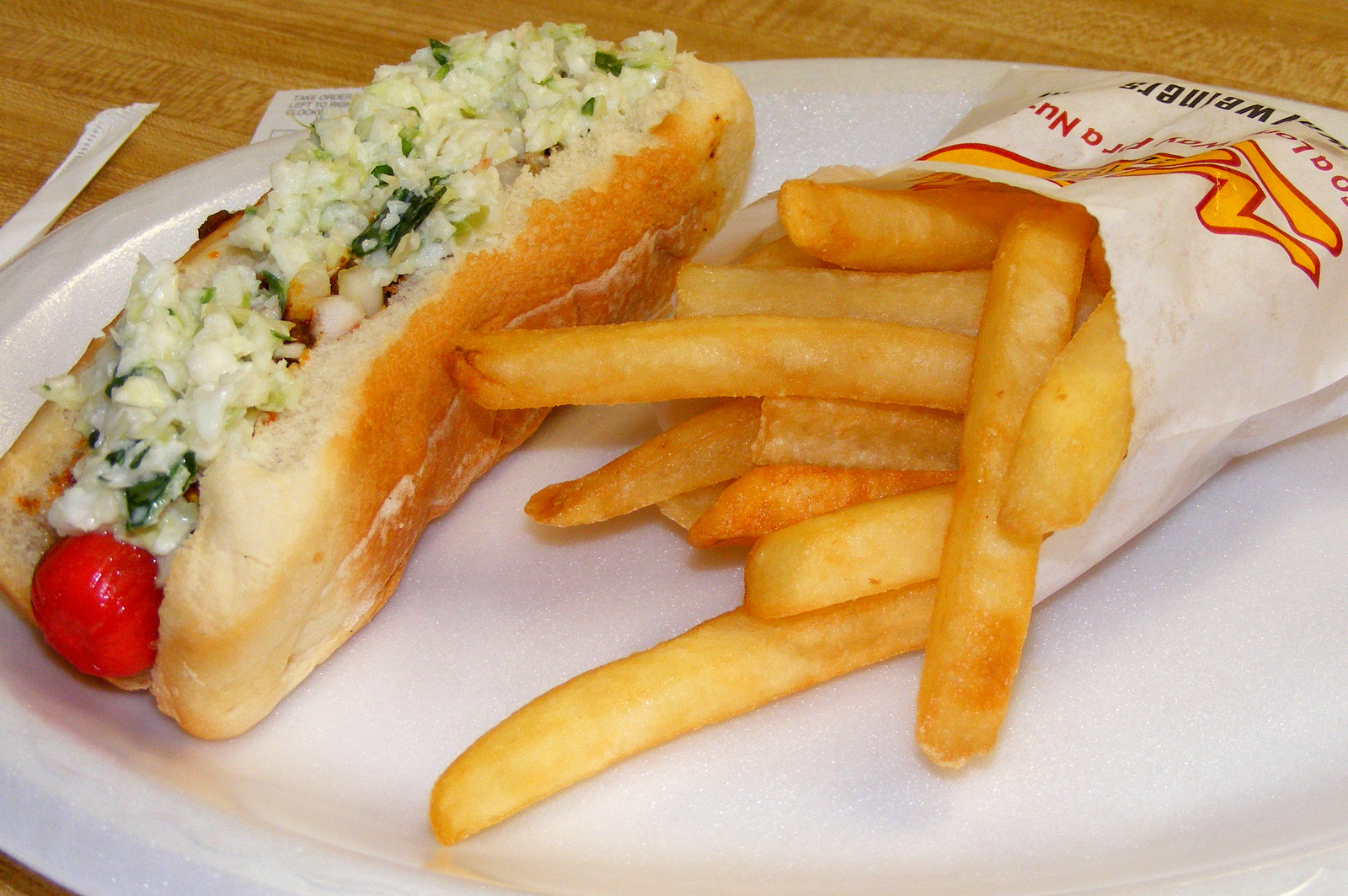
A very friendly young woman (that’s her on the right with my “medium” Diet Coke.) told me the specialty of the house was the Chili-Slaw Dog, so that’s what I ordered, along with crispy French fries. What I got was not-very-crispy French fries and a tiny hot dog died an alarming pink color not usually associated with adult food.

It wasn’t bad, but it wasn’t great either. If you’re ever in Macon and in the mood for friendly service, a hot pink “weiner,” mediocre fries and a glass of Coke that could double as a wading pool …

Posted in Georgia | Comments Off on “I” Before “E” Except After “W”

Bird #450 — Small-billed Elaenia

Elaenia (olive) parvirostris (from parvus, small, and rostrum, beak)

Sunday, April 22, 2012 — 4:40 pm

Chicago, Illinois — Douglas Park

I was flipping through the Chicago Tribune this morning when I happened upon this article.

Having recently decided to actively pursue 500 (or more) birds on my life list, I was definitely interested. But first there were more important things to do:

  1. Go to church so my wife could sing in the choir.
  2. Stop at the new Mariano’s in Palatine to see if they had smoked string cheese. (They did, which made the day wonderful for my wife.)
  3. Eat lunch at Panera and buy asiago cheese bagels for our daughters.

By the time I got home, it was 12:30. I looked on the Internet and saw that the bird had been spotted again today, between 10 and 11. But I also saw that there was disagreement in the birding community about whether this was a White-crested Elaenia, as reported in the article, or a Small-billed Elaenia. Before that was an issue for me, I had to see it.

I located Douglas Park (I’d never heard of the place) on a map and took off. I told my wife I wouldn’t be gone long. “It’s easy. With a bird like this, you just look for a group of people staring through binoculars and look where they’re looking.”

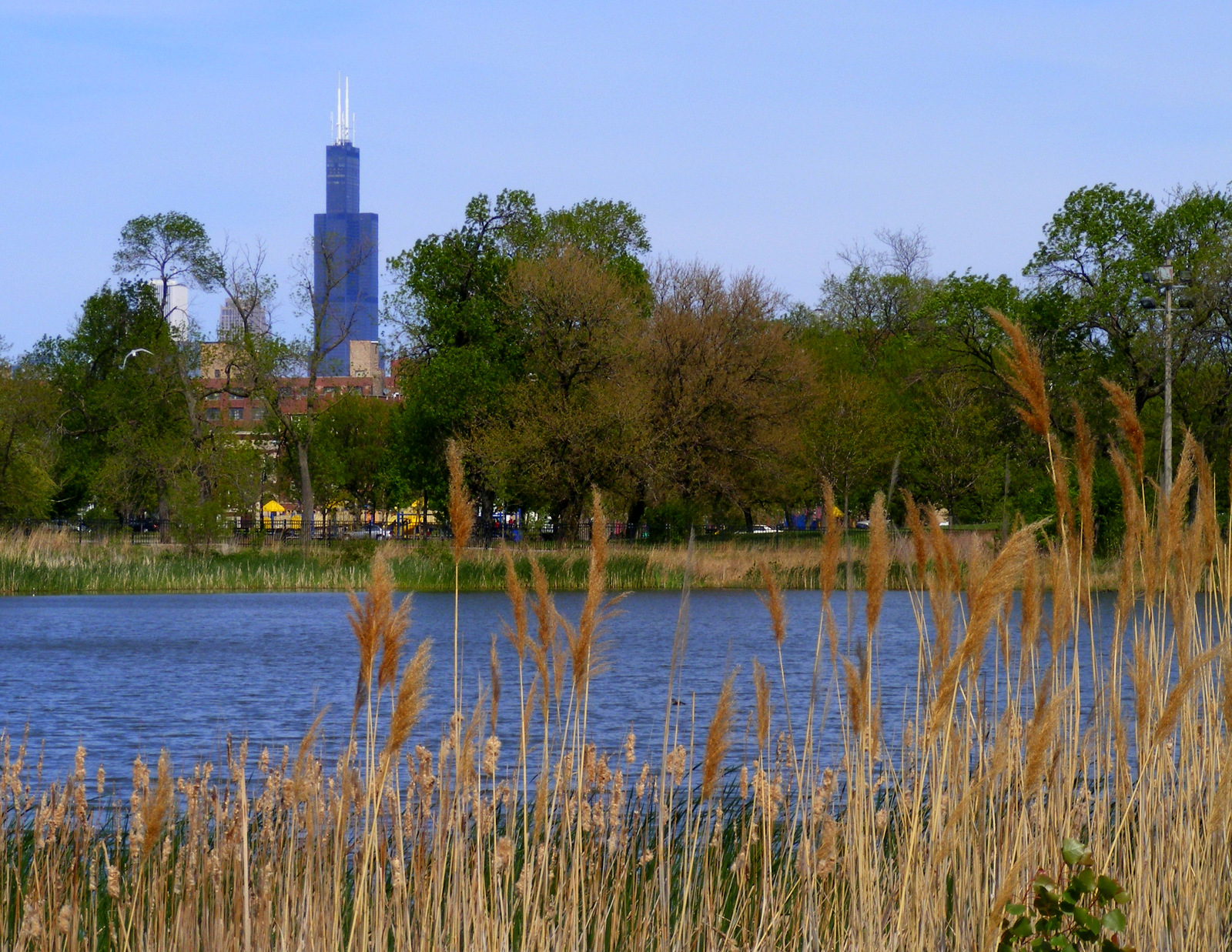
The birders were there when I arrived, but they weren’t looking anywhere in particular. I’ve been in on enough rare-bird sightings that I can read birders’ body language. There was no elaenia in sight. About 10 people were standing on the shore of a pond looking across 20 feet of muddy water at a densly-wooded island, but by the time I parked and got my stuff and wandered over, they were beginning to disperse.

One guy told me he’d seen it around 11, but that nobody had seen it since then. I began to stroll around the area. I checked out the birds I saw, but they were all the usual suspects. I didn’t really know what I was looking for. I don’t have a bird book at home that includes elaenias and I hadn’t had much time to research on the Internet. I took a quick look at a couple photos before I left, so I knew it was a grayish-brown, flycatcher-looking thing that supposedly had a white stripe on the crown of its head and three white wing bars. But I had no idea how large it was or how it behaved.

The guy I talked with had driven up from Cincinnati on Saturday and had a five-and-a-half hour drive ahead of him. He left, as did several other people. This wasn’t a neighborhood in which I felt entirely comfortable walking around by myself with expensive binoculars and a camera around my neck.

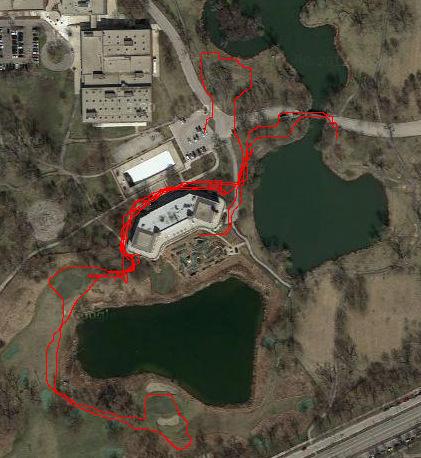
It quickly began to feel like one of those rare-bird searches when I arrived just a little too late. I looked at my phone and saw that it was 2:30. I determined to stay for an hour. Here’s the approximate route I took looking for the bird.

There was an elderly gentleman sitting in a van near the bridge. As I walked by, he rolled down his window and said “Can I ask you a question? It’ll only take a minute of your time.” He spoke with a strong southern accent. The two or three remaining teeth in his lower jaw fit perfectly into an equal number of gaps in his upper jaw. When he smiled, which he did often, it was as though he had a complete set of teeth — but just one row.

I stopped, and we had the following conversation:

“What’s so special about this bird y’all looking for?”

“It’s very rare. It’s from South America and has never been seen around here before.”

“That’s interesting. Let me tell you. Last fall, I was walkin’ by an empty lot near my house when I spotted two yellow birds. They were about the size of sparrows. I’m from Arkansas and we have sparrows down there, so I knows what sparrows look like.”

“Did they have black wings?”

“The yellow birds? Yup, they had black wings.”

“They were goldfinches.”

“Is that what y’all lookin’ for?”

“No, we’re looking for a little gray bird.”

“I can get where you’re coming from, let me tell you. Just the other day I was over there talkin’ to a fisherman when I felt something on my ear. I put my hand up, like this, and felt around, and it was a tiny gray feather. I thought to myself that it was too early for baby birds. I wrapped it up in a tissue and put it in my freezer.”

“Well, (smiling semi-sardonically) maybe you’ve got the feather of a very rare bird.”

We said our good-byes and I walked on.

It was getting close to 3:30, my intended departure time, when I ran into Charles Wescott. Back in the early 198’0s, I used to bird at Crabtree Nature Center several times a month. At that time, Mr. Wescott was on staff and often worked behind the desk in the visitor center. He kept a list in the spring and fall to record when various migrant birds arrived. I frequently reported my sightings and got them on the list along with my name. I was new to birding back then and had as many questions as I did sightings. Mr. Wescott was always very patient with me. He gave me a lot of great information on birding and local spots. He left Crabtree many years ago, and I hadn’t seen him since, but I recognized him right away.

When I introduced myself to him, he told me he’d requested copies of all his old migrant lists and had just been looking them over recently. He said he recognized my name. It’s probably true, although, like I said, he was always a very kind and gracious man.

All this time, birders were arriving and birders were leaving. As I was talking with Mr. Wescott, another birder walked up to find out if we had any news on the elaenia. He said that there had been a period of time on past afternoons (it was discovered on Thursday) when it disappeared, but it always showed up again around 4:00 and in basically the same area.

I asked if the bird was on Central Time or South American Time, but by then the guy was walking away. It was 3:53. I’d already invested more than three hours, but I didn’t want to get home and learn that somebody found it at 4;00. I decided to stay until 4:30.

Another local guy walked by and said, “You lookin’ for that bird from Africa?”

I said, “From South America, yes.”

He said, “Well tell me. What’s it doing all the way up here?”

I told him, “It got lost. Very lost.”

He laughed.

In all, I probably saw 40 birders in the time I was there. They were easy to spot. Besides the obvious binoculars and cameras (some with lenses the size of my leg), they were the only people around who were white.

There was a large-hatted birder who walked all around the area like he was competing in one of those speed-walking races that used to be in the Olympics.

There was a guy with a young son in tow. He said he didn’t really know much about birds, but he lived not far away and heard the report on the news and was intrigued. He didn’t stay long.

There was another guy who ran from spot to spot with two other birders in tow, always enthusiastic and always sure he was about to find the bird. He introduced himself to me, then took off running, tossing a “It’s here somewhere” back over his shoulder.

It was now 4:30. Part of me was still hoping, but most of me had given up. And then a guy who had been there as long as I had came running. “We’ve got it.” The six or so of us within earshot followed him rapidly to a patch of brush and small trees on the southwest side of the field house. I’d spent quite a bit of time looking for it in this very area because it was out of the wind and felt “birdy.”

It was big-hatted speed-walker guy who had found it. He was there with the running guy and several others. They were crouching down, looking up into a tree. People kept yelling “I’ve got movement over here,” “I’ve got movement on the left.” But it kept turning out to be Ruby-crowned Kinglets or Robins. I began to doubt.

And then from the other side of the tree I heard several people yell, “It’s here.”

About 15 of us gathered on a tiny knoll and looked into the tree. Others were seeing it and pointing out where it was, but I wasn’t spotting it. A guy standing right next to me leaned over and pointed.

The bird was hopping around near the end of the branches, just above eye-level and in the perfect spot to give us the best light for viewing it. It perched and looked around, then flitted to another branch and repeated it — over and over for the 10 minutes I saw it. It never stayed in one spot for more than two seconds. A few times it disappeared into the interior of the tree, but it would soon flit out again.

I leaned toward the guy who had shown it to me and said thank you. He replied, “Can I see it now?” I turned to look at him and saw that he had a camera with a big lens, but no binoculars. I took mine off my neck and handed them to him. He kept them for about two minutes while I took photos. The guy on the other side had one of “those” cameras.

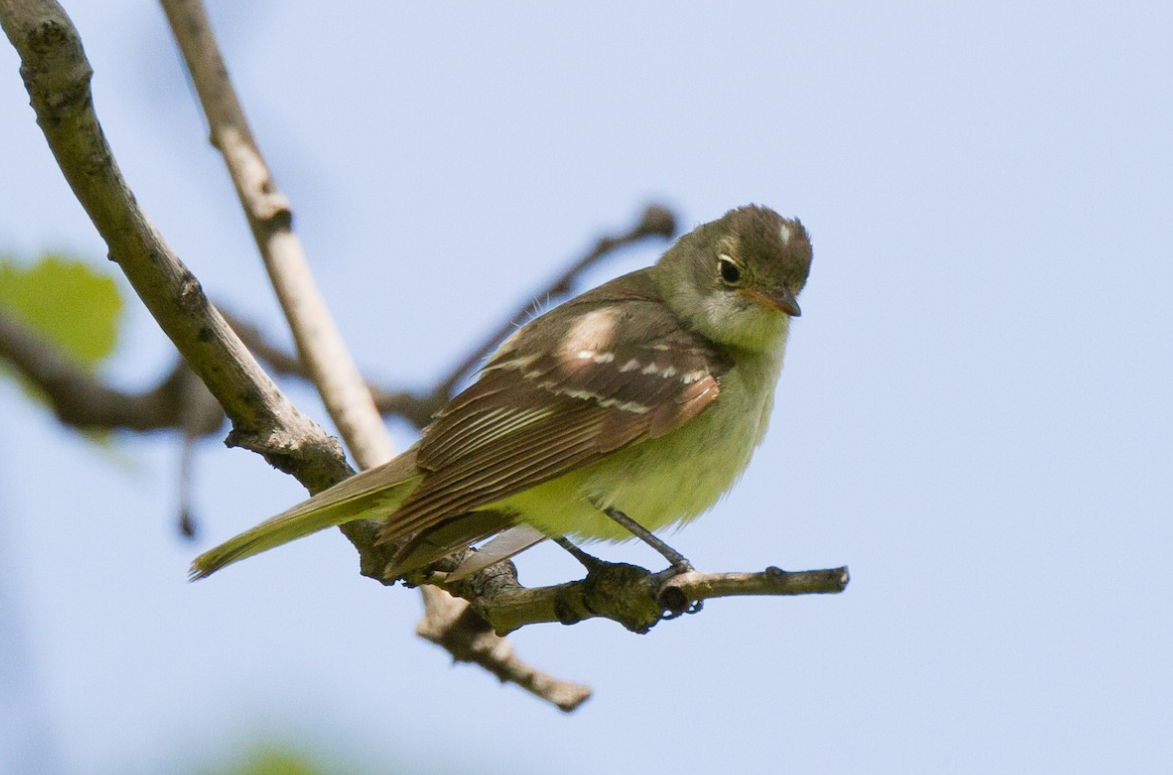
It had a thin but distinct white line down the center of its crown that doesn’t show up in any of my photos. (It shows up nicely in photos taken by people with real cameras.) I couldn’t decide if I was seeing two or three white wing bars, but in two of my photos, you can see traces of three. The underside of its bill was pale orange. It was grayish-brown on top and a light, buffy white underneath.

One woman (who had come up from Florida to see it) had a South American field guide. I looked over her shoulder at the illustrations of the White-crested and Small-billed Elaenias, but they looked identical to me in the book.

And then the bird was gone. I heard someone say they spotted it in a tree about 30 yards away, but when I got there, they were shrugging their shoulders.

The red circle indicates the spot where it was seen this morning and where it was supposed to show up at 4:00 this afternoon. The green circle is where I saw it at 4:40.

So what was it? When I got home (around 6:00), I looked at photos of both species on the Internet and my completely uneducated vote is for Small-billed. The bird I saw just looks more like that one. I saw no hint of a crest. The white on the crown was very narrow. There was a trace of a third wing bar. And the contrast between the color on the upper-side and the underside was much greater than that shown on any photos of the White-crested I saw. Here’s a better photo of the bird I saw that I stole off the internet.

There’s talk now about netting it and finding out for sure. I should let them know they don’t need to. I know a guy who has one of its feathers in his freezer.

In case you’re wondering, I am allowed to list an unidentified bird if I’ve narrowed it down to genus and haven’t already listed any of the species it could be. But in this case, until I hear evidence to the contrary, I’m thinking I saw a Small-billed Elaenia — the first one ever discovered in the United States.

UPDATE: In 2020, the Illinois Ornithological Records Committee decided this bird was, in fact, a Small-billed Elaenia and added it to the state list. That means that eBird accepts it, and I can officially count it. Which I already had. The American Birding Association voted not to add it because a few members wanted DNA or vocal records to support the identification. Personally, I was very sure before and am definitely satisfied now.

For the record, other birds hanging out in Chicago today included:

  • Blue-gray Gnatcatcher
  • Yellow-rumped Warbler
  • Red-winged Blackbird
  • Common Grackle
  • Palm Warbler
  • American Robin
  • American Coot
  • American Goldfinch
  • Ruby-crowned Kinglet
  • White-throated Sparrow
  • Hermit Thrush
  • American Crow
  • Red-tailed Hawk
  • Pied-billed Grebe
Posted in Wildlife | Comments Off on Bird #450 — Small-billed Elaenia

Bird #449 — Pacific Wren

troglodytes (creeper into holes) pacificus (calm, tranquil)

Tuesday, May 6, 2008 — 3:21 pm

Mount Hood National Forest, Oregon — Eagle Creek — Wauna Viewpoint Trail

You have to love this hobby. Sometime in the past three years (November, 2010 to be exact) when I wasn’t paying attention, the powers that be decided that the eastern and western populations of the Winter Wren are distinct species. This isn’t just an arbitrary thing. In this age of advancing science, they are classifying birds genetically instead of just by external appearance. The eastern population is still called Winter Wren. The western population is called Pacific Wren.

That means, that if I’ve seen birds from both populations (and I have), identified them (and I did), I can count them, even if they weren’t distinct species when I saw them. (This happened to me once before, in 1996, when the Gilded Flicker was separated from the Northern Flicker.)

So here I sit on April 15, 2012, in my study at home, contemplating the effort it will take to see 51 more lifers, when suddenly I discovered that I only have to see 50 more! Maybe if I sit around some more …

Anyway … Back in May, 2008, I was in Portland, Oregon for a convention. My sister and I flew out two days early to do some sightseeing. On the first afternoon, we drove east along the Columbia River and stopped here and there to see the sights and do a bit of birding.

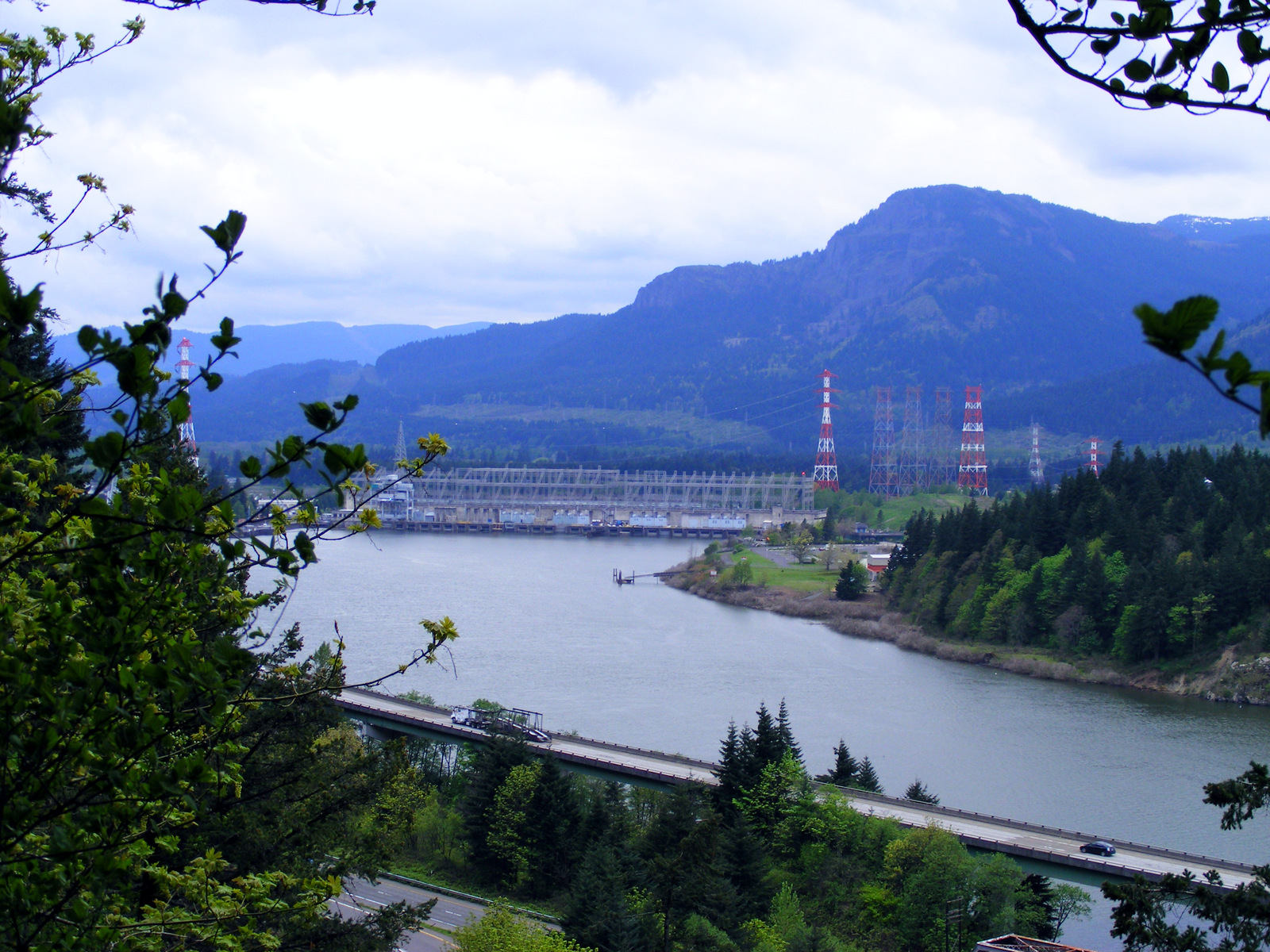
One of our stops was Eagle Creek, where we hiked through damp woods along the edge of a hillside until we got to a spot where we could look out over the river.

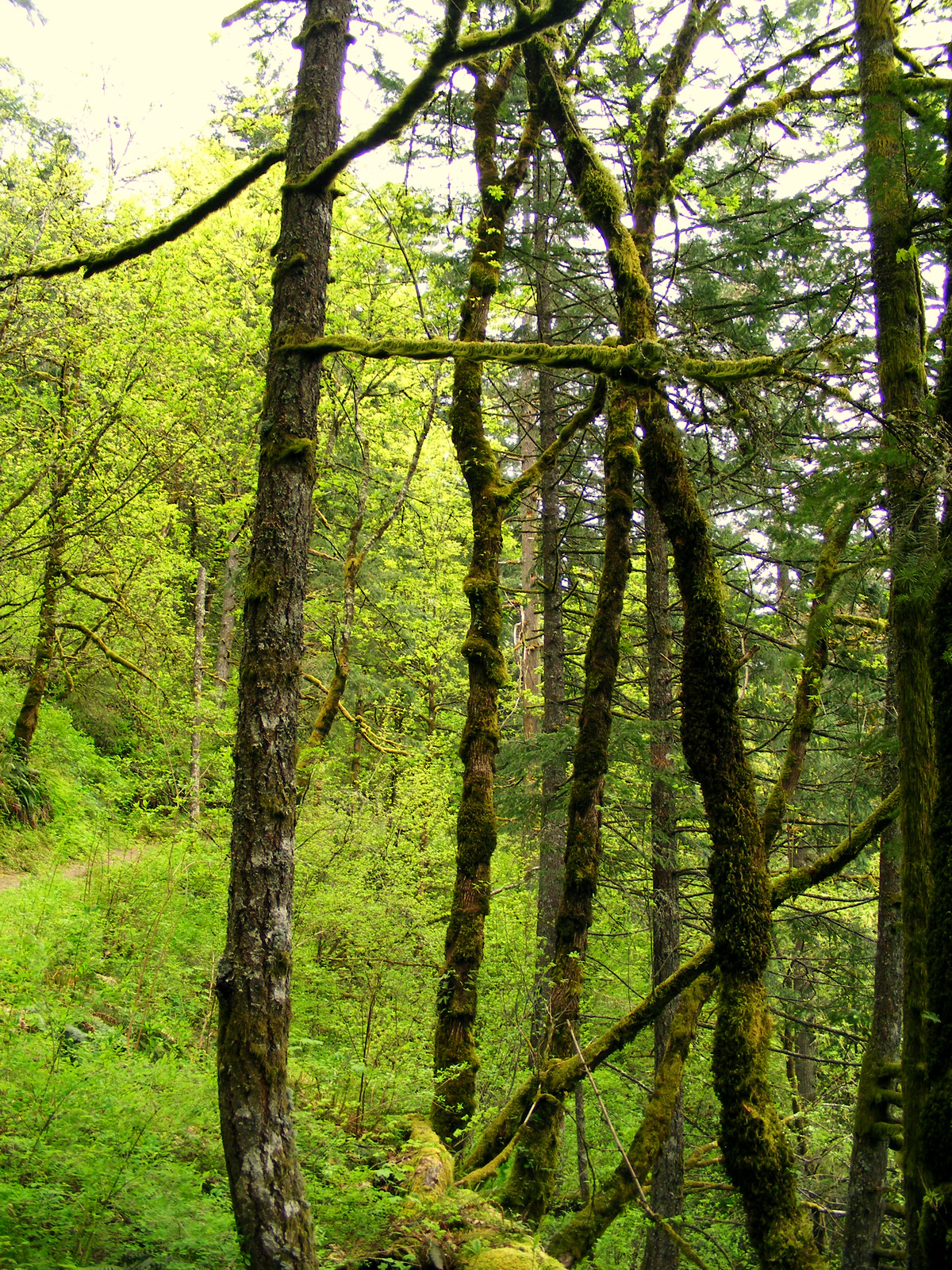
We hadn’t seen many birds on the half-mile walk from the parking lot to the end of the trail, but on the return trip, things started picking up and I saw six lifers. Well, actually, seven. Two Pacific Wrens were hopping about in a tangle of branches in the underbrush along the trail not far from where I took this photo.

Ain’t life grand?

Posted in Wildlife | Comments Off on Bird #449 — Pacific Wren

The Curse of the Year List

My major objective, as with every birder, is to add as many birds as possible to my life list — the list of all the species I’ve ever seen.

But the list that always received most of my attention, the list I had the most fun compiling, was my year list. I had a tradition — every New Year’s Day, I’d get up long before my family was awake and go downstairs. I’d eat breakfast while looking out the window at our bird feeders. As the common backyard birds showed up, I’d dutifully write down their names and the exact times when I saw them.

In December, when it was time to put up our Christmas tree, I generally begged off as much as possible. Once I dragged the boxes out of the crawl space and set up the bare tree, I disappeared. I could get away with this because every New Year’s Day, I’d take the tree down all by myself. Every few minutes I’d wander over to the window to check for new birds. By the time noon came around and my family was starting to stir, the tree would be put away and I’d have eight or ten birds on my year list.

For the first six months of the year, I’d go birding regularly. I knew what birds to expect when, and where to find them. If it was a warm day with southerly winds in early May, it drove me crazy to be indoors. What if I missed a Blackpoll Warbler this year? Was it too late to see a migrating Winter Wren?

It was exciting, and I always got a kick out of compiling a list of more than 200 birds (which is pretty pathetic when compared to the North American record, which I think is 745 birds). Some years I did more traveling, and that meant more birds.

I thought it was great because at least once a year, it was exciting to see even House Sparrows and Eurpean Starlings Northern Cardinals and Black-capped Chickadees. I always hoped for a good bird for my first bird of the year, as though that would establish a trend.

Here are my totals for each year, along with the first bird I saw and the number of lifers I added:

  • 1979 — 101 (House Sparrow) — 101
  • 1980 — 185 (Ruffed Grouse) — 89
  • 1981 — 195 (Black-capped Chickadee) — 24
  • 1982 — 204 (American Crow) — 19
  • 1983 — 193 (European Starling) — 13
  • 1984 — 249 (House Sparrow) — 67
  • 1985 — 131 (American Crow) — 0
  • 1986 — 178 (Black-capped Chickadee) — 0
  • 1987 — 89 (Mourning Dove) — 0
  • 1988 — 147 (American Crow) — 5
  • 1989 — 139 (Dark-eyed Junco) — 0
  • 1990 — 210 (Northern Cardinal) — 19
  • 1991 — 210 (House Finch) — 8
  • 1992 — 122 (Dark-eyed Junco) — 2
  • 1993 — 123 (European Starling) — 0
  • 1994 —119 (European Starling) — 0
  • 1995 — 146 (House Finch) — 1
  • 1996 — 165 (House Sparrow) — 2
  • 1997 — 216 (Northern Cardinal) — 7
  • 1998 — 208 (House Finch) — 7
  • 1999 — 262 (American Crow) — 13
  • 2000 — 227 (European Starling) — 3
  • 2001 — 251 (Dark-eyed Junco) — 21
  • 2002 — 233 (House Finch) — 13
  • 2003 — 205 (American Goldfinch) — 2
  • 2004 — 174 (American Goldfinch) — 0
  • 2005 — 190 (Northern Cardinal) — 3
  • 2006 — 149 (House Sparrow) — 0
  • 2007 — 173 (House Sparrow) — 2
  • 2008 — 249 (House Sparrow) — 24
  • 2011 — 1 lifer

You can clearly see that there is no correlation between desirability of the first bird of the year and the total number of birds seen that year.

My totals came down to three factors:

  1. Did I go birding at least 30 times.
  2. Did I do much traveling.
  3. Was I birding on a few days when the weather/migration patterns were right.

In 2009, I began the year in my usual fashion. I had about 15 birds on my list after the first week or so. I was driving to work and spotted a flock of Canada Geese flying over the road and reached for a pen and paper to note the time and date. I suddenly realized that it was a chore. I didn’t really care. I was doing it because I somehow felt like I was supposed to. I quit.

I fully expected just to take one year off, but after fighting off a little bit of self-nagging in 2010, the habit was broken. In 2011 and 2012, I didn’t even think of keeping a list. In fact, during the winter of 2011-2012, due to some financial priority setting, we didn’t even put out bird feeders.

As I contemplate picking up my hobby again, I’ve decided not to keep year lists.

Yes, they made seeing common birds interesting at least once a year, but they also made seeing common birds interesting only once a year. Once I’d spotted an American Tree Sparrow, I didn’t pay attention to any others. I wanted new birds for my list.

Yes, they gave me a goal whenever I went out birding, but once I’d seen the birds I could expect to see, I wasn’t interested in going out much. It was the law of diminishing returns.

For now, I’m just going to look for birds — and that only when I’m in the mood. If I see extraordinary birds, great. If I only see ordinary birds, that’s fine too. I’ll look to see if they’re doing anything extraordinary. I’ll keep daily lists, but without setting any sort of goal. I’ll bird when I want to and stay out until I don’t want to stay out any more.

This might all sound rather strange to you, but if you’re a lister (of anything), you can understand what a radical shift in thinking this represents.

(The exception is my life list. I’ve decided to go for 500 birds. But that’s a topic for another post.)

UPDATE: In early 2017, shortly after we moved to Colorado, I decided to give eBird a try. All you have to do on that data base is add your day lists — or, even easier, keep your day list on the app — and eBird does all the rest for you — it keeps years lists, month lists, state lists, county lists …. It takes away almost all the drudgery.

Posted in Stories | 1 Comment