Small Annoyance — Canadian Geese

They’re only Canadian Geese if they happen to be from north of the border. The species name is Canada Geese. I don’t know why. I didn’t name them. But that’s the way it is.

It’s a natural mistake, and I don’t get terribly annoyed when people make it. But when they argue with me about it … I once had an editor insist I was wrong. He changed the name in an article I wrote, which made me look stupid. I have no idea what he’s doing now, but I’m doing his job.

CANADA Geese - Rock Cut State Park - May, 2009

Posted in Humor | Comments Off on Small Annoyance — Canadian Geese

Great Painting #5 — Hare

I’m up to page 134 in 1001 Paintings You Must See Before You Die, and I’ve finally found one I wouldn’t mind hanging in my house. It was painted by Albrecht Durer in 1502 using watercolors on paper. Durer was born in Nuremburg, Austria. He is widely considered the best printmaker in history. His AD monogram can be seen at the bottom of the painting.

There isn’t much to say about the painting itself. It’s an amazingly realistic and detailed drawing of a rabbit. Durer drew it so that you can see the touch of light on individual hairs (and hares).

Posted in Miscellaneous | 2 Comments

Great Painting #4 — Herod’s Feast

I wasn’t able to find much information about this painting on the Internet, but I did find several places where you can buy it as a poster. It is a fresco, painted around 1457 on the wall of the Santo Stefano Cathedral in Prato, Italy. The artist was Fra Filippo Lippi.

Lippi was abandoned by his parents as an infant, raised in a friary and ordained as a friar. His art gained him the attention of the Medici family and the pope, but he fell out of favor when he had an affair with Lucretia Buti, a nun. She became pregnant, and they may have married. Rumor has it that Lippi may have died from poisoning at the hand of relatives of another woman he had a fling with.

Anyway, this painting is from a series known as “Scenes from the Life of St. John the Baptist,” although I’m not sure life is the appropriate word in this case.

You know the history — Herod was living with his brother’s wife, Herodias. John told Herod he was living in sin. Herodias didn’t care for this and forced her husband to throw John in prison. She wanted him killed, but Herod was afraid to do anything because John was a prophet and beside, he kinda liked the guy. Then Herod threw a birthday party for himself and the local bigshots. His daughter-in-law, Salome, danced as part of the entertainment, and Herod, in a moment of rashness, promised the girl she could have anything she wanted, up to half his kingdom. Prompted by her mother, the girl asked for John’s head on a platter. And so it was done.
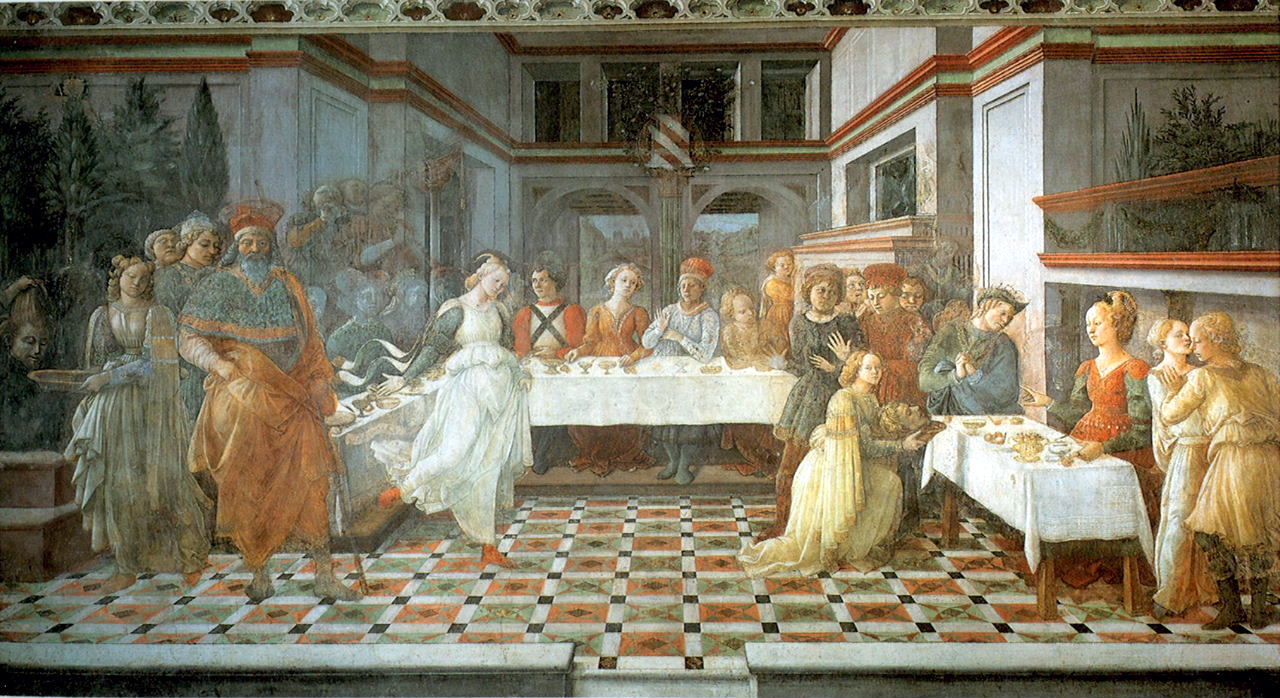
I suspect that’s Herodias on the right, looking at the head with unfeigned malice. Herod is on the left, looking stern. Salome is still dancing in the center of the room. She’s usually pictured as a seductress, but Lippi shows her as downcast and, perhaps, in mourning for what she has done. Salome is a portrait of Lucretia Buti, Lippi’s girlfriend/wife, which says something or other about something or other. Apparently, John had two heads (there’s a second one on the extreme left). Either that, or Herod was throwing a beheading party.

Posted in Miscellaneous | 1 Comment

Young Woman in Black

Young Woman in Black was painted in 1902 by Robert Henri (pronounced “hen-rye”). He was born Robert Henry Cozad in Cincinnati in 1865 but later changed his name after his father killed a man in a dispute over cattle. Henri began as an Impressionist but later in his career gave that up and focused on art as journalism and tried to make his paintings “as real as mud.” He became one of the founders of the Ashcan School, a group of loosely-connected artists who attempted to portray the real, gritty side of New York City.

Young Woman in Black is a portrait of Jesseca Penn, a dancer and artists’ model from Des Moines, Iowa. I think she looks like she’s waiting for someone. My wife thinks she looks hard and cold in the painting and prefers the portrait of her by Louis Loeb (below right).

Henri said Penn was his favorite model because “she was tall, had a small waist and, like both my wives, she was a redhead.” Henri also used her as his model for the painting below left, which is titled Jesseca Penn in Black with White Plumes.

Penn modeled for many artists at the turn of the last century. Daniel Chester French used her likeness on the doors he created for the Boston library. Edwin H. Blashfield included her in his murals for the state capitols of Minnesota, Wisconsin and Iowa (bottom — she’s the woman on the wagon seat). One of Penn’s four husbands was artist Louis Loeb who painted her portrait several times, including Jesseca in 1905. Penn studied acting and even appeared on Broadway in two plays. She later moved to Wisconsin where she died, in 1957, probably of a stroke.

Posted in Miscellaneous | Comments Off on Young Woman in Black

Great Painting #3 — The Triumph of Death

This work of art is a fresco (a mural done with water colors on wet plaster) that covers an entire wall in Palermo, Sicily, Italy. The artist may have been Antonio Pisano, know as Pisanello, but nobody knows for sure. Whoever he was, he drew himself into the painting — he’s the gentleman on the left holding a paintbrush and staring out at the viewer. The best guess of when it was completed is “around 1450.”

The central figure is Death riding a skeletal horse. He’s passing by the poor and sickly people and stomping to death the wealthy and the members of the clergy. (Those already dead are pretty much the same color as the horse.) On the right are men and women living in luxury. They’re aware of death’s approach but can do nothing about it and don’t even seem to be trying very hard. Lengthy studies have been done on the fashions worn by the rich in this painting, but I’ll spare you the details.

The title might refer to the 13th card in a tarot deck. In the Middle Ages, tarot cards were very popular and were known as “triumphs.”

I’m not sure about the philosophy of this painting — I’m pretty sure the poor and sick die too. But it does make a good point about the inevitability of death. I don’t see any indication of the life offered by God, but that may have been the theme of the painting on the next wall, I don’t know. But here’s the thing that most interested me about this piece and is the reason I chose to include it on my list — it was originally painted on a wall in a hospital. Cheery, no?

Posted in Miscellaneous | Comments Off on Great Painting #3 — The Triumph of Death