Bird #378 — Smith’s Longspur

calcarius (spur) pictus (painted)

Monday, December 27, 1999 — 9:45 am

Stuttgart, Arkansas — Stuttgart Municipal Airport

I first learned that Smith’s Longspurs could be seen at the Stuttgart Airport from A Birder’s Guide to Arkansas. I spent a day walking along the runways two winters ago, but didn’t see a hint of them. As this year’s trip approached, I checked the Arkansas birder chat line. At least 50 Smith’s Longspurs have been seen recently, along with a bonus bird, a Sprague’s Pipit.

I checked in at the terminal to make sure it was OK to go out on the runways. The guy was very friendly between phone calls. He showed me some notes other birders wrote on the back of business cards. The most recent was from the 10th and reported the longspurs and three or four pipits. The guy showed me an aerial photograph of the airport and pointed to the exact spot where the longspurs had been seen. When I had been there in 1997, I wasn’t allowed on the runways and had to walk all the way around the airport, probably five miles. This time I was allowed to park near a hanger and walk anywhere I wanted. I was only told that when an airplane came in or took off, I should walk off to the side and turn my back on the plane so the pilot would know I wasn’t about to walk out in front of him. The runways are surrounded by miles of fields and between and around them, the grass is quite short. The two main runways come together at a 90 degree angle. The longspurs had been hanging around in 150′ x 150′ squares of mowed grass that extend beyond the ends of the runways, and indeed, this is the place mentioned in the book.

I walked out to the angle and began wading through the grass. I flushed a whole bunch of Savannah Sparrows and saw several Horned Larks. I hadn’t gone far when several longspur-sized birds flushed from right in front of me. They gave a unique rattling call. It wasn’t musical, but it wasn’t harsh either. The birds flew up, circled (calling repeatedly) and landed in the grass at the end of the other runway. I watched them until they landed, then walked forward again. Almost immediately, more sprang up and followed the first group.

To make a long story short, I spent the next hour trying to get a good look at them on the ground. Two times I got very brief looks at the heads of birds as they ducked into cover immediately after landing. But that was it. I stood and stared at the grass looking for any kind of movement, but they were geniuses at keeping out of view. When they flew up, they weren’t shy. They called loudly and circled over the area, often coming within 15 feet of where I stood.

I left the longspurs and went searching for the Sprague’s Pipit.  That search took me back to the area where I saw the longspurs, and I decided to give them another look. Again they exploded out of the grass as close as 10 feet away, and often they would land within 50 feet, but then they would disappear. And then I saw a dark spot in the grass about 25 feet away. I focused on it and … it was a Smith’s Longspur. It stood motionless, facing me. Only the head and upper back were visible. After two minutes or so, the bird took off and joined its less brave companions.

During the three hours I spent at the airport, I flushed longspurs probably 25 times, usually from the square areas at the ends of the runways, but also from the edges of the runways as far as 500 yards from the original spot. I flushed as few as one and as many as … it’s hard to say, everyone else says 50, so I’ll say … 50.

Things I read advised me that they usually disappeared to parts unknown when flushed, but that wasn’t the case this day. Often they flew no more than 50 feet, sometimes as much as 200. At the end of my first chase, they had all gone off out of sight, but when I went back an hour later, they were all back and this time, they seemed to wait longer before flushing and to fly shorter distances before landing. I would have liked to get a full-blown view of one on the ground, but I saw almost everything the field guides mention at one time or another.

Posted in Wildlife | Comments Off on Bird #378 — Smith’s Longspur

Bird #377 — Pacific Loon

gavia (sea smew) pacifica (of the Pacific)

Monday, September 20, 1999 — 6:45 pm

Crystal Lake, Illinois — Vulcan Lake — Dartmoor Road

This one was easy. I got an E-mail from IBET at work this afternoon reporting a Pacific Loon in Crystal Lake. It was in Vulcan Lake, a flooded quarry southeast of town. I knew right where this was. Twice this year I’ve spotted loons there as I drove by. But Monday is basketball night, and I didn’t want to miss that. When I finished playing, I drove over. The directions sent me to Dartmoor Road, on the west side of the lake. The road ended in a cul-de-sac. There was a ridge between the road and the lake lined with no trespassing signs. I climbed the ridge and walked about 15 feet down the other side. Beyond that there was a 50-foot drop- off to the water.

There were only two birds in sight, about 100 feet out from the shore. I set up my scope. Both were loons, a Common and a Pacific. They were very similar looking, but I could see some vital differences.

The two birds stayed close together, never more than 10 feet apart. They drifted, looking about alertly, sometimes facing directly at me, but usually showing me their right sides. I ran up over the ridge to the car and checked my field guide to make sure I was seeing what I needed to see then went back and looked again. The loons were closer, perhaps within 75 yards.

I was still in my shorts and T-shirt from basketball, although the sweat had dried. A fairly brisk wind was blowing right in my face, from the northeast, and there were six-inch waves. The sun was setting fast and was by this time below the skyline. If I had arrived 10 minutes later, it would have been difficult to make out colors on the birds. I was going to stay as long as they kept drifting closer, but this wasn’t long. About 10 minutes after I first arrived, they turned and headed back the way they had come. The swiftly-arriving dusk, the chill (probably about 55), my attire, and my hunger decided me, and I went home. I found out the next day that the property owners of Vulcan Lake were having birders arrested and prosecuted for trespassing where I had been.

Posted in Wildlife | Comments Off on Bird #377 — Pacific Loon

Butterfly #17 — Viceroy

limenitis archippus

Friday, August 6, 1999 — 9:45 am

Moraine Hills State Park, Illinois

I was walking the Leatherleaf Bog trail through an area of bushes and brush not far beyond the two marshes near the trailhead. The Viceroy flashed past me about head high and darted into a bush. It perched with its wings open toward me for a few seconds, then closed them for a few minutes. After two or three minutes, it opened its wings again, slowly, then took off along the path.

It looked like a Monarch, but with black subterminal lines on the upper and under sides of its hindwings. It was also a bit smaller than a Monarch. The black terminal margin had a single row of white crescent marks.

I took the photograph below at Hickory Grove Conservation Area in McHenry County, Illinois on July 1, 2007.

Viceroy at Hickory Grove — 7/1/07

Viceroy - Crabtree - June, 2008Viceroy - Crabtree - June, 2008

Posted in Wildlife | Comments Off on Butterfly #17 — Viceroy

Butterfly #16 — Clouded Sulpher

colias philodice

Friday, August 6, 1999 — 9:30 am

Moraine Hills State Park, Illinois

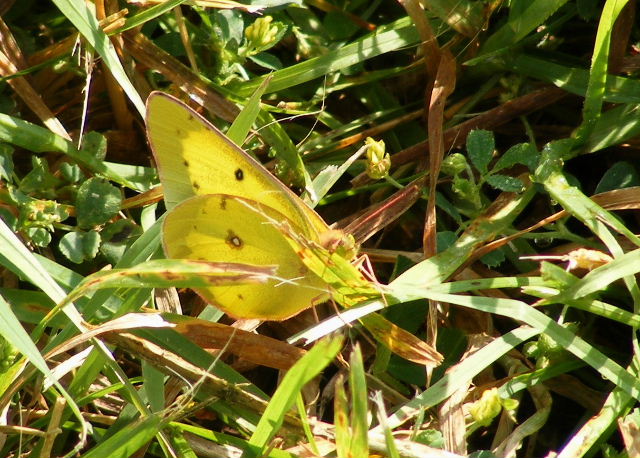
This butterfly was flitting low over the path and the mowed grass along the edge of a large, weedy field on the Letherleaf Bog trail. It rarely ventured over the taller grass beyond the fringe of the trail. It landed frequently for short periods, but always with its wings tightly folded. Sometimes it perched on the ground, sometimes on weeds, and once on a purple clover flower.

The upperwings were pale yellow with a black border. There were a few yellow spots in the black area. The underwings were even paler, with a row of tiny, faint black spots submarginally, a pinking-rimmed white spot on the hindwing, and a black spot on the forewing. The black border on the upperwing could be seen through the wing.

After watching the Clouded Sulphur for a few minutes, an Orange Sulphur showed up. The two flitted around in tight circles and, a little later, perched side by side on a weed. When they were in flight near each other, the difference in color, pale yellow versus orange-yellow, was obvious.

Clouded Sulpher - Cuba Marsh - June, 2008Clouded Sulpher - Silver Creek - July 4, 2008

Posted in Wildlife | Comments Off on Butterfly #16 — Clouded Sulpher

Butterfly #15 — Orange Sulpher

colias eurytheme

Friday, August 6, 1999 — 9:10 am

Moraine Hills State Park, Illinois

I was walking through an open weedy glade about halfway around the Leatherleaf Bog trail. The sulphur was flitting over the path and the grass along its edges. It landed frequently. When perched, its wings were tightly closed. Underneath, it was very similar to a Clouded Sulphur, but there was a trace of orange visible along the upper edge of the hindwing.

It flew around my legs, and I could easily see the orange patch and solid black border on the upperside of the forewing. It was about the size of a Cabbage White and Clouded Sulphur.

2009_0430various0126

Posted in Wildlife | Comments Off on Butterfly #15 — Orange Sulpher