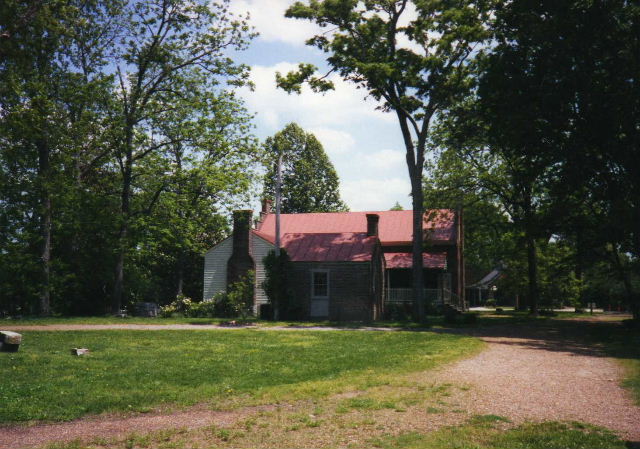
The Carter House — Franklin, Tennessee

I was in Nashville with three other people from work for a convention. We arrived the day before things got started and looked for some way to pass the time. I suggested this place and, to my surprise, was taken up on it.

The Carter House was the center of the battle of Franklin. We took a guided tour, and it was excellent. The guy who led the tour was passionate about his subject and made things interesting even for my fellow-workers who weren’t terribly interested in the Civil War. The yard of the house is all that remains of the battlefield. The rest is covered by residential areas and businesses. Our guide used this to his advantage (while making sure we knew he resented it). He said things like, “The Confederates were driven back to the breastworks that ran from the Pizza Hut to Dominoes. They attacked again and were repelled. They fell back to the telephone.”

The house and outbuildings show hundreds of bullet holes. We were told that the red frame shed is the most battle-damaged building from the war still in existence.

Posted in Tennessee | Comments Off on The Carter House — Franklin, Tennessee

Blondie

The Comic Strip Blondie was created in 1930 by Chic Young. When Chic died in 1973, his son Dean took over the writing while several different artists handled the drawing. In fact, both father and son have often only handled creative control while gag writers and artists actually worked on the strip.

Originally the story was about a flapper named Blondie Boopadoop who dated Dagwood Bumstead, the son of a millionaire.

Dagwood’s parents didn’t think Blondie was good enough for their son, so they did everything they could to prevent the two from getting married.

After three years of this story-line, Young had Dagwood go on a hunger strike until his parents consented to the marriage. They finally did, but only after writing Dagwood out of their will. Blondie and Dagwood were married and set forth on a middle-class life — the theme that has continued until today. In the early strips, Blondie was a ditz and Dagwood was her straight man. After the marriage, Blondie’s character became more sensible and Dagwood became the bumbling fool. Along the way, the couple had two children, Alexander (originally called “Baby Dumpling”) and Cookie, both of whom grew up in the strip until they reached their teenage years where they apparently stalled out. At a time when comics and movies insisted on showing married couples in separate beds, Young insisted on showing Blondie and Dagwood sleeping together in the same bed.

The strip was so popular that it spawned a series of 28 movies, beginning with Blondie in 1938. There was also a TV show and a radio program.

When we had the Chicago Tribune delivered, I would scan through the comics page and read the scrips I enjoyed. Blondie wasn’t my favorite, but I enjoyed it enough to read it every day.

For the purposes of this look, I read:

  • Blondie: The Bumstead Family History, by Dean Young. It was an overview of the strip, with commentary on each of the main characters. Most of the sample strips were from the Dean Young years, but there was a section on the pre-marriage strips.
  • Blondie: Book Number 1, a collection of strips from 1984 and 1985.
  • Blondie: The Courtship and Wedding — Complete Daily Comics 1930-1933, all the strips from the beginning through the wedding. I enjoyed this more than I expected to — probably because it was fun seeing 1930’s humor. I decided to order the next volume.

I also watched two of the movies.

  • Blondie (1938) — It’s Blondie (Penny Singleton) and Dagwood’s ( Arthur Lake) fifth wedding anniversary, but Dagwood’s in trouble. He owes $500 to a credit agency because he co-signed a loan for a woman named Elsie, and she skipped. The agency is coming to his house to repossess all his furniture. Meanwhile. Blondie decides to trade in all the Bumstead furniture for new stuff. Dagwood’s one chance to escape his problems is to negotiate a deal with C.P. Hazlip for his boss, Mr. Dithers. He’s waiting for Hazlip in his hotel lobby when he begins to help a man try to fix a vacuum cleaner. He doesn’t realize the man is Hazlip (who has a daughter also named Elsie). Before long, Blondie thinks Dagwood is having a fling with Elsie Hazlip. Dagwood borrows his mother’s car and hits a police car. Hazlip is arrested for stealing the hotel vacuum cleaner. Everyone ends up in court and things don’t look good. But then Blondie steps forward and saves the day by explaining things to the judge as only she can. Hazlip signs the deal with Dagwood, but Blondie won’t let Dithers in on it until he gives Dagwood a huge raise. The movie managed to be stupid, sweet, and funny at the same time. I gave it a 7.
  • Blondie on a Budget (1940) — Blondie (Penny Singleton) wants a fur coat. Dagwood (Arthur Lake) want to join a fishing club. They can’t afford both and can’t easily afford either. Dagwood’s ex-girlfriend Joan (Rita Hayworth) shows up to give Dagwood a contract (she works for a company Dagwood’s company does business with). Joan volunteers to give Dagwood a ride, and the two end up stranded in the country. Their car is towed into town, and they go see a movie while waiting for it to be repaired. Dagwood enters a lottery at the theater. When Blondie finds out Dagwood spent the day with his ex, she is jealous. Dagwood tells her the truth about his day and promises not to see Joan again. But then he wins the theater lottery and has to pick up his money. He has to take Joan along because it’s her signature on the card. Dagwood decides to use the money he won to buy Blondie her fur. He takes Joan along to make sure it fits. Blondie sees Dagwood and Joan together at the store buying a fur coat and decides to get a divorce, but a wise lawyer talks her into going home. After a bunch more muddle, they finally get their stories straight and all is well. It was interesting seeing the pre-stardom Rita Hayworth. Her character seemed to be along just to give Blondie and Dagwood something to misunderstand each other about. There wasn’t much of a story to the first movie, but by this one (number 5 in the series), it’s obvious that the producers had already settled into a formula that didn’t require logic or creativity. I gave it a 5.  I can’t imagine how people managed to watch another 23 of these.

I listened to one episode of the radio program, entitled, “Dagwood’s New Suit” which aired on October 30, 1939. Dagwood has been chosen to be a model in a fashion show put on by Mrs. Dither’s. He goes to a clothing store and gets talked into buying a horrid suit. He’s about to embarrass Mrs. Dithers, which will put his job with Mr. Dithers in jeopardy. But then Blondie has words with the clerk at the store and gets everything worked out. It was just silly.

Posted in Pop Culture | Comments Off on Blondie

Animal #39 — Bobcat

lynx rufus

Tuesday, December 28, 1999 — 8:54 am

Holla Bend National Wildlife Refuge, Arkansas

I arrived at the refuge at 8:05, just after it opened. I drove along the river and stopped a few times when I saw something interesting. I usually continue along the river to the boat landing on the old channel, but this day I didn’t. Two Golden Eagles were seen at Holla Bend on the CBC, and I figured I’d most likely find them in the large fields back in from the river.

I drove over the levy and headed out into the fields. I hadn’t gone far when I saw an animal trotting complacently along the road toward me. It was probably 150 yards away when I first saw it. It was the size and color of a Coyote, and that’s what I thought it was at first. But something about the way it ran made me look closer. I even said out loud to myself, “What is that?”

I stopped the car and grabbed my binoculars. Just as I thought “Bobcat,” it saw my car and cut off into the field along the road and disappeared from view. I drove ahead, but soon saw it again. It was now running, but not in a full sprint. It was coming toward me parallel to the road. I stopped and watched from the car as it passed me in clear view about 40 yards away. When it reached the brushy area on the levy, it stopped and looked back over its shoulder, giving me a good look for about 20 seconds. It then ducked into the cover.

It was a large cat, larger than I expected. It was every bit as big as Coyotes I’ve seen. I’d guess it was about 35 inches long and 30 inches tall. Its long legs gave it a gangly look, especially when it trotted. Its fur was gray. It had black spots on its belly and upper legs. The tail was short, maybe seven inches long and usually held down against the body with the tip curled out and up in a hook. The tip was black with a flash of white, which probably came from the underside.

Although it obviously ran off the road and through the field because of my presence, it didn’t seem to be panicking. It simply ran toward the nearest cover and then stopped to view the situation before heading to cover. I never saw the Golden Eagles, but I was able to console myself with the Bobcat, an animal I never thought I’d see.

Posted in Wildlife | Comments Off on Animal #39 — Bobcat

Animal #38 — Spotted Skunk

spilogale putorius

Monday, December 27, 1999 — 11:20 am

Stuttgart, Arkansas — Stuttgart Municipal Airport

I drove to the Suttgart Airport on Monday to look (successfully) for Smith’s Longspur and Sprague’s Pipit, both of which had been reported from there all winter long.

I was told to watch for airplanes. If one came in or took off, I was to walk off the runway and turn my back so the pilot would know I wasn’t about to walk in front of him. As I was looking for the pipit, a small jet taxied out from the terminal and lined up on the runway right next to me. I walked off into the grass and stopped just at the edge of a strip of tall weeds that divided the airport from a large field of mud.

As I stood there, looking away from the runway, I heard a scurrying noise in the weeds. I soon saw a small black animal nosing through the grass. I knew it was a skunk, but I wasn’t sure what kind. It was about two feet long from tip of nose to end of tail, with the tail taking up half the length. The tail was very bushy. Its legs were short. The fur was mostly black. There were two startling white eyebrows about two inches long and a half inch wide. In other areas on the body — around the base of the tail and scattered around in places on the body — there were traces of white fur. But in no place other than the eyebrows was there bold white.

It nosed around in the weeds, probing in the dirt. At times, it disappeared under clumps of grass. As I watched, the jet took off behind me. The skunk paid no attention. At one point, it came within ten feet of where I stood. Except for occasionally looking up and sniffing at the air, it showed no indication that it was aware of me or the plane. After watching for a while, I walked on to look for the pipit. Fifteen minutes later, I walked back along the runway and saw the skunk, still nosing through the strip of weeds maybe 30 yards from where I first saw it.

Posted in Wildlife | Comments Off on Animal #38 — Spotted Skunk

Bird #379 — Sprague’s Pipit

anthus (In Greek legend, Anthus, a youth killed by his father’s horses, was changed into a bird) spragueii (given by John James Audubon in honor of Isaac Sprague, artist and botanical illustrator, who accompanied Audubon on his Missouri River expedition in 1843)

Monday, December 27, 1999 — 11:00 am

Stuttgart, Arkansas — Stuttgart Municipal Airport

I went to the airport to see the Smith’s Longspurs that have been seen there in past years and regularly this winter. But three or four Sprague’s Pipits were also being seen, so I couldn’t pass up a possible two-for-one.

The guy in the terminal showed me on an aerial photograph exactly where other birders were seeing the longspurs. I spent an hour flushing them and watching them circle around me. I decided I wasn’t going to get a better view, so I determined to look for the pipit. But when I looked around at the huge expanse of territory to cover, I decided to ask for help. Besides, I had to use the bathroom. I went back to the terminal. There were three men there now, all very friendly. I told them I had success with the longspurs and ask for more specific directions to the pipit’s location. Again, I was shown the photograph and told exactly where to look. I don’t think the guys in the terminal were birders, but they were as friendly and helpful as tour guides.

I walked out to the spot where an old abandoned runway cut across the field with grass growing through cracks. It intersected the main runway about 350 yards from where I saw the longspurs. Before I got to the area, I looked in my field guide to review the Sprague’s Pipit’s marks. I also noticed its call, a repeated “squeet.”

I cut across a small (80′ x 50′) grassy plot and very shortly flushed a Horned-Lark size bird. It was thinner than the longspurs with a long tail. It gave a loud “squeet” as it took off and repeated the call three or four more times before landing in the grass on the other side of the main runway. I walked right to the spot, a strip of short grass between the runway and a weed bordered field of mud. I could see nothing, and so continued walking.

I noticed a dark spot and looked with my binoculars. I saw the head and shoulder of a bird. It was facing away but looking back over its left shoulder at me. I only had a few seconds before it took off. It flew right past me, maybe five feet away, again making the “squeet” noise. It circled and flew back across the runway and landed, or appeared to land, on the pavement of the abandoned runway, maybe 75 yards away.

I walked toward it. As I passed the patch of grass where I first flushed it, a bird flushed and gave the call. It flew back across the main runway to the strip where the first one flushed. I thought this was a second bird and continued to where I saw the first one land, but couldn’t find it. I went back to where the second one landed. It flushed 30 feet from where it landed and flew down the strip away from me, this time without making noise. I followed but didn’t see it again.

I walked down the strip the other way and flushed one. It flew about 50 yards further away, calling. I saw exactly where it landed. I approached from the direction of the runway and stood looking for several minutes, waiting for it to move. I saw nothing, so waded in. It took off from about 40 feet from where it landed and headed back to near where it had just come from. I never saw a hint of one again.

To sum up, I flushed one or two birds a total of six times. Four of those times it called. I also had one brief look at the head of a standing bird. In flight, I only saw it flying away from me. The tail was long, thin and black with white outer feathers. Its flight seemed choppy somehow. Otherwise, it just looked like a brownish-tan bird with a white belly. I never saw it fly more than 100 yards. It always flushed between 30 and 50 feet from where it landed (or not at all). When it gave the loud “squeet,” the call was repeated about once a second until it landed. The shape, size, call, and markings convinced me it was a Sprague’s Pipit. In addition, the habitat was right, other birders had seen it there recently, and it was right where I was told to look.

I had additional confirmation later in the day. On the way back to Conway, I stopped at the Joe Logan Fish Hatchery in Lonoke. On the mud in the wet bottom of a drained pond, I saw an American Pipit. It was the same size and shape as the Sprague’s, but much darker on the back. The face pattern was different, with an eye stripe and no noticeable eye ring. It flew past me giving a totally different two-syllable call repeatedly. It sounded like “peet-peet” and not at all like “squeet.’ Also, the white on its tail, while visible, was narrower and harder to see, both in flight and when on the ground.

Posted in Wildlife | Comments Off on Bird #379 — Sprague’s Pipit