World’s Largest Catsup Bottle — Collinsville, Illinois

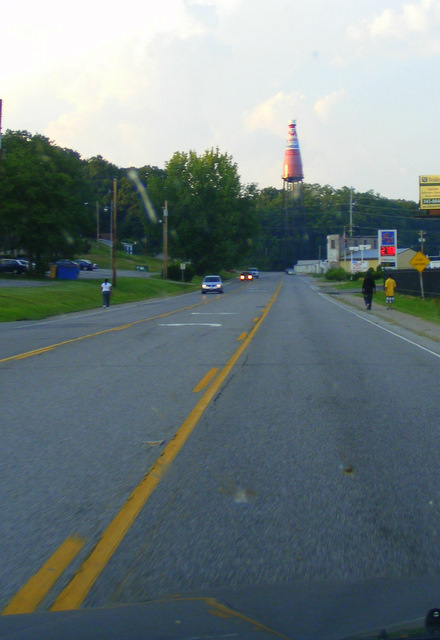
After supper at St. Louis Bread Company and a blizzard at Dairy Queen, I dropped my wife off at our hotel and went forth in search of Collinsville’s chief claim to fame.

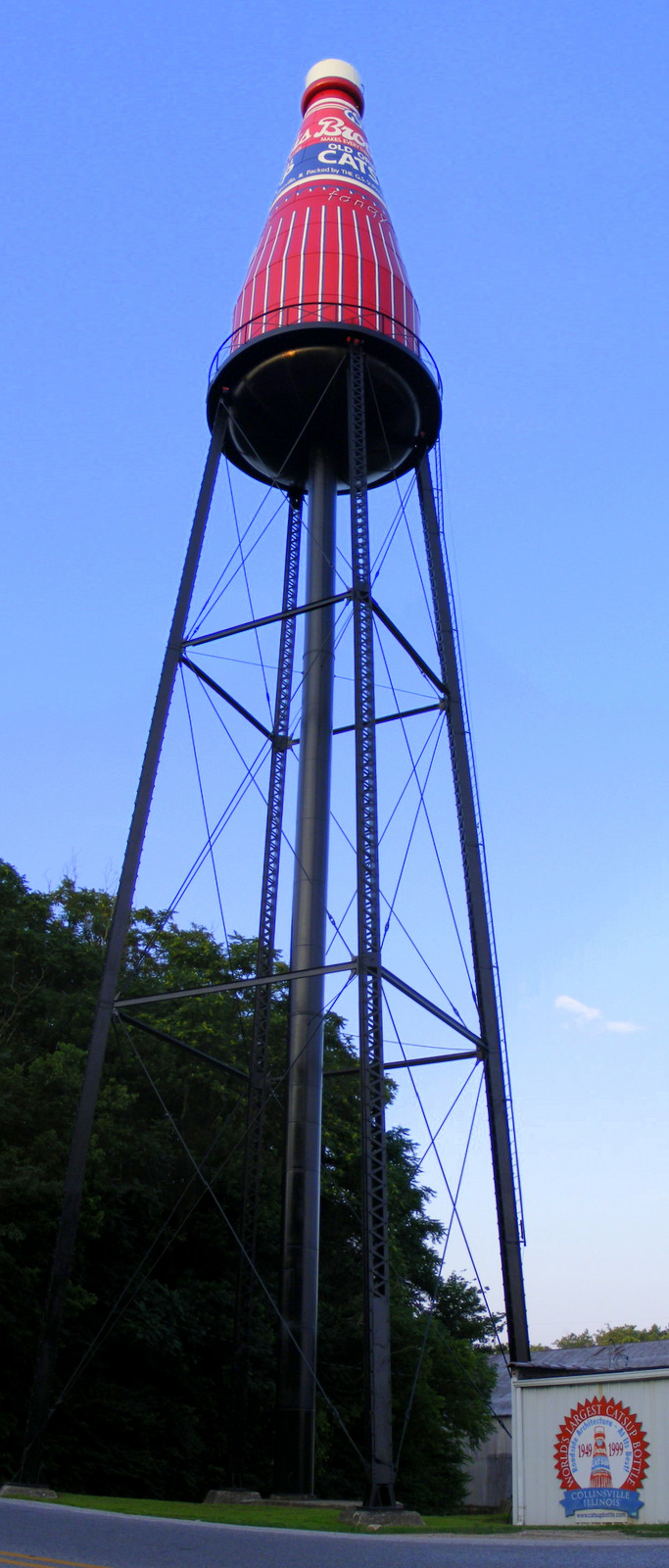
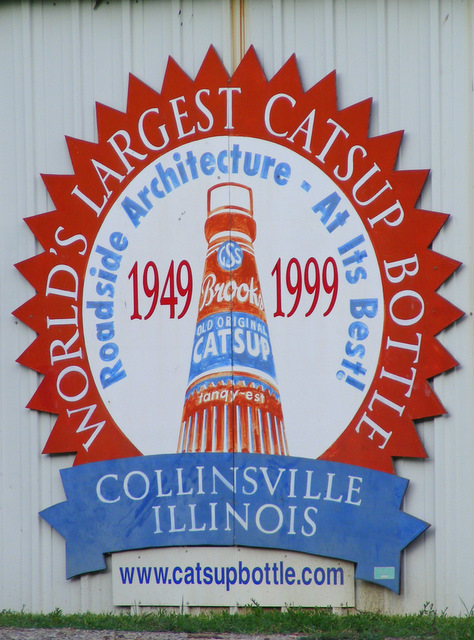
In a weird way, this water tower is really quite impressive. It was built in 1949 for the G.S. Suppiger Bottling Plant where Brooks Catsup was made. The tower is 170 feet tall and has it’s own web site.

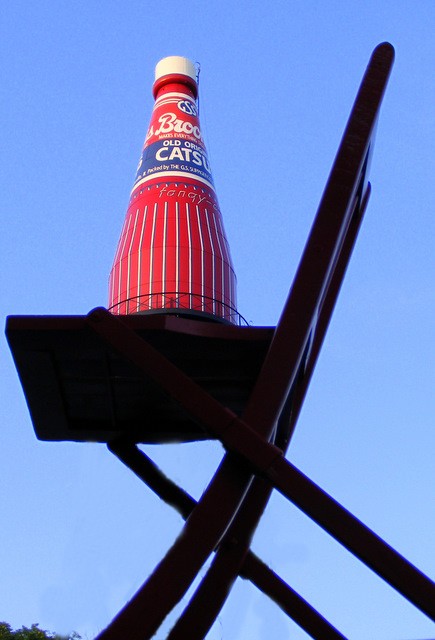
I pondered how best to incorporate a small chair into a photograph of a 170-foot catsup bottle and could come up with nothing better than this.

I messed about a bit with my editing software and removed the tower structure from beneath the chair. You can click on the above photo to see the results.

Posted in Illinois | Comments Off on World’s Largest Catsup Bottle — Collinsville, Illinois

Lincoln-Douglas Debate Square — Alton, Illinois

When I decided earlier this year that I’d like to visit the sites of all seven of Lincoln’s debates with Stephen A. Douglas, I never thought I’d have opportunities to visit four of them within the next three months.

The seventh, and final, debate was held in Alton on October 16, 1858 before approximately 6,000 people in front of city hall.

For some bizarre reason, the city of Alton saw fit to engrave the words “KEEP OFF” into the steps of the monument. There was nobody around, and I’m sure I could have posed with the statues without hindrance, but when given the chance, I normally obey the law. So I KEPT OFF. It said nothing about chairs, however …

The monument is just about a hundred yards from the Mississippi. A garishly-painted riverboat casino presents an obnoxious backdrop.

Even the statues were sweating in the oppressive heat and humidity, so I didn’t stay long.

Posted in Illinois | Comments Off on Lincoln-Douglas Debate Square — Alton, Illinois

Robert Wadlow

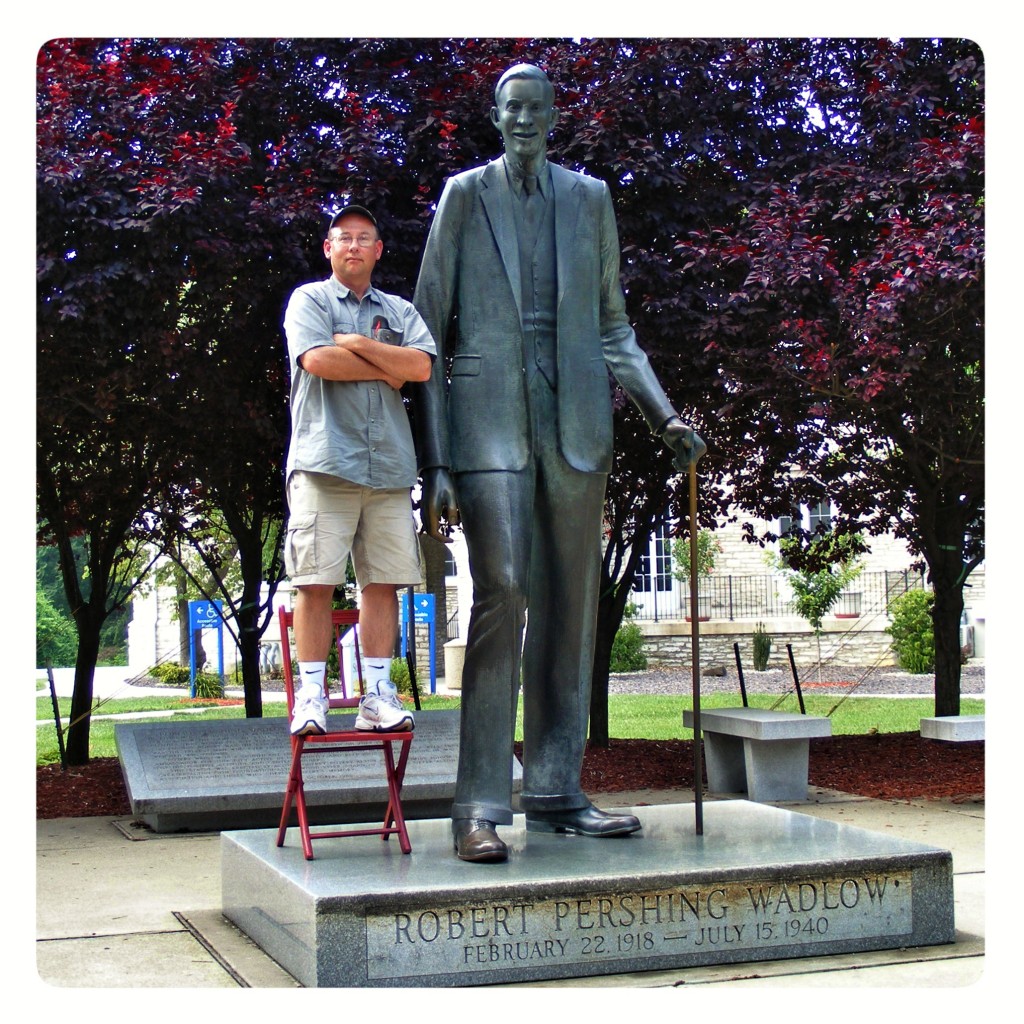
Robert Wadlow was born in Alton, Illinois in 1918. By the time he was five, he was five-and-a-half feet tall. At 13, he became the world’s tallest Boy Scout — 7’4″. His shoes, which were size 37, were provided free by the International Shoe Company. Robert and his father toured the country in a modified car, making appearances for the company. He had very little feeling in his feet and died at the age of 22 from an infection from a blister. He was 8’11.1″ at the time and weighed 490 pounds.

In 1985, Alton erected a life-size statue of Robert Wadlow.

photo-76-1024x1024

Near the statue is a life-size reproduction of the chair specially made for Robert by the Galax Furniture Company.

Posted in Illinois | Comments Off on Robert Wadlow

Lewis and Clark State Historic Site — Hartford, Illinois

Lewis and Clark and their Corps of Discovery spent the winter of 1803-1804 near where the Missouri River flows into the Mississippi. They built a fort near the River Dubois (Wood River) where they trained and gathered supplies.

No evidence of that camp has been found. A few miles to the south, the state of Illinois has built a reproduction based on Clark’s rough sketches and the design of other forts they built later in the journey. There’s also a visitor center with displays on their time in the area. As we walked in, a guy told me I could take as many photos as I wanted because, “The only things that are real in this building are you and me.” I found this surprising, because my wife was standing right next to me, but perhaps he knows something I don’t.

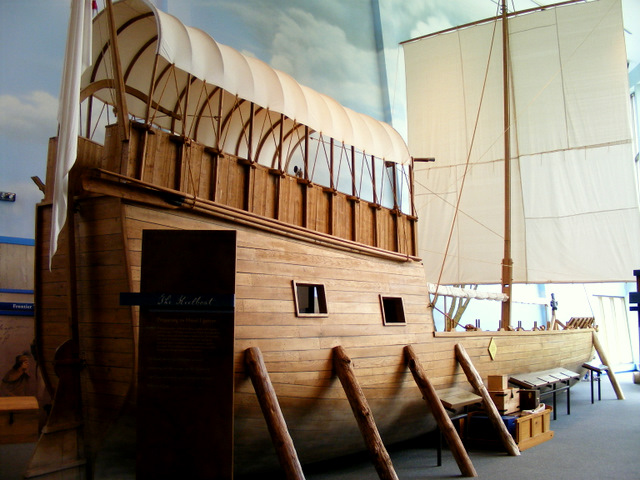
The museum was mildly interesting. It’s chief feature was a reconstruction of the keelboat the Corps used during the first summer of the journey from Camp River Dubois to the Mandan villages in what is now North Dakota. I had no idea the craft was this large. The back side is cut away so we could see inside the cabin and storage areas. Forty-some men crowded in this boat to sail and paddle upriver against the current. Most of them slept on shore each night. To get upstream against the flow of the Missouri, the Corps had to edge along the bank and deal with sandbars and snags and heat. It sounds like a lot of work.

It was about 900° out, with 400% humidity, but we braved the conditions and walked out to the reproduction of the camp. Of course, this being Illinois, it was padlocked.

There is also a granite monument to Lewis and Clark on the site, but, this being Illinois, it was closed. (OK, to be fair, the river was very high and the monument might have been under water, but still … ) We drove along the levy for a bit, and I took another shot of the camp.

Posted in Illinois | Comments Off on Lewis and Clark State Historic Site — Hartford, Illinois

David Davis Mansion State Historic Site — Bloomington, Illinois

It was time to pick up our daughter from her two-week stay with relatives. We were meeting halfway — near St. Louis — at noon on Sunday. My wife and I decided to make a mini-vacation of the trip and left home early Saturday morning, June 26. Our first stop was this house in Bloomington.

David Davis was born in Massachusetts. He studied law in Ohio and, when he was 20, proposed to Sarah Walker. Sarah was an educated woman from a well-to-do family. (The Walkers are connected somehow to the two President Bushes.). Her father refused to let her accept David’s proposal until he’d established himself. David moved to Illinois and soon had a thriving law firm established in the village of Bloomington (population 450). David and Sarah married in 1838. They had seven children, only two of which survived to adulthood.

David became a judge on the Eighth Judicial Circuit where he became friends with fellow lawyer Abraham Lincoln. Davis was a major player in politics and was responsible for getting Lincoln nominated at the Chicago Republican convention in 1860. Lincoln responded by appointing Davis to the Supreme Court where he served for 16 years until he became a Senator in 1876.

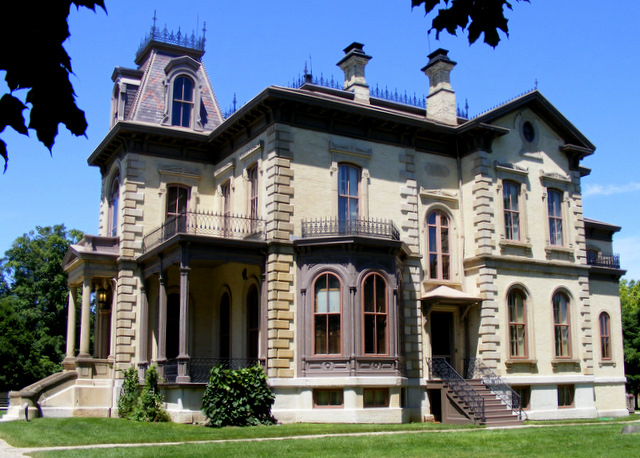
In 1870, David and Sarah built this house in Bloomington. They were at the peak of the social pyramid and intended their home to be a showcase. Sarah died in 1879. David married Addie Burr, Sarah’s nurse, who must have been an interesting woman. After David died in 1886, Addie became nurse for another woman. When she died, Addie married her husband.

Our tour included the guide and four women, one of whom was previously a guide. I asked a lot of questions, and before long, the two women were doing tag-team guiding. They were both knowledgeable and interesting, but prone to tangents. We heard about more than just the Davises and the home — such as the story of the tourist who wandered away from the group and was stopped moments before using one of the house bathrooms in which the fixtures are not hooked up.

David descendants lived in the house until 1959 at which point the family turned it over to the state. Many of the furnishings are original. Indoor photography was forbidden, so I can’t show you the painted ceilings, massive ornate crown molding or “modern” conveniences. The mansion was amazing for 1870. It had central heating, hot and cold running water, flushing toilets — in fact, it had one of the very first master bathrooms in the state.

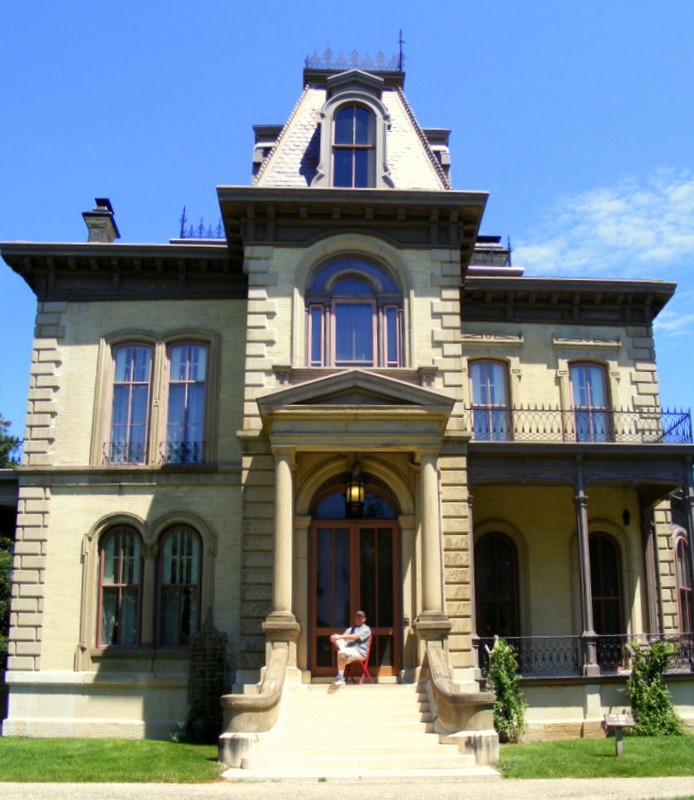
I thought the outside of the house was rather ugly. The front was asymmetrical, and overall it reminded me of some huge toad crouching on the grass.
The wood house in the yard was designed to complement the main house. It contained two outhouses and space to dry and store wood.

The barn and carriage house predate the mansion and were almost certainly on the site when Abraham Lincoln visited the Davises at their earlier house.

Sarah oversaw the design of a formal gardens in the yard. The garden has been maintained ever since and has the same design and the same types of plants, seven of which have been identified as actually the very same original plants. My wife wandered off to see the garden, but not surprisingly, this being Illinois, it was locked.
Posted in Illinois | Comments Off on David Davis Mansion State Historic Site — Bloomington, Illinois