Bird #349 — Short-eared Owl

asio (long-eared owl) flammeus (flaming)

Tuesday, February 7, 1995 — 5:45 pm

Du Page County, Illinois — Munger Road — Pratts Wayne Woods Forest Preserve

I hadn’t been birding around home much in recent months, and I hadn’t been thinking about it much. But a week or so ago I read The Feather Quest by Pete Dunne and it gave me inspiration. On Monday afternoon, I called the bird hotline for the first time in several years. I wasn’t planning on doing any birding, but I wondered if the line was still in existence. Short-eared Owls, as many as six of them, were reported from Pratts Wayne Woods. This was too close to pass up. I didn’t have binoculars or warm clothes with me, but I determined to come prepared on Tuesday.

Munger Road cuts through the forest preserve, and for most of the way, it was bordered by weedy fields or cornfields that had been cut. There was about three inches of snow on the ground. As soon as I turned on Munger Road, I spotted an American Kestrel and a dark-phase Red-tailed Hawk. Moments later five cock Ring-necked Pheasants walked across the road in front of my car. I saw a few other birders, but it was still pretty light and the owls weren’t supposed to show themselves until sunset.

But on the other hand, the field guides say that Short-eared Owls sometimes hunt during the daytime. When I spotted two birds coursing low over a weedy field, I got excited. I jumped out of the car, but they were immature Northern Harriers. I drove back and forth for a while, getting out occasionally to scope the fields, but all I saw were two more Red-tailed Hawks and three deer. The wind was whipping across the open fields, and I couldn’t stay outside long.

As it got closer to dark, I found what I thought the most likely spot and parked. A few minutes later an old guy pulled up and asked if I was looking for owls. He told me he was going to look further up the road. I watched for owls and watched him to see if he was seeing any. It was getting pretty dark, and the sun was going behind a bank of clouds on the horizon. There was a beautiful red sunset, but that wasn’t what I was looking for. A few other birders were driving around, but I didn’t see anyone who looked like he was seeing owls. Disappointment was setting in when the old guy came by again. He said he had seen two about a quarter mile from where I sat, where Forest Preserve Drive intersects Munger Road. I thanked him and headed up that way, but I was skeptical. I figured he had just seen the harriers. I turned up Forest Preserve Drive and followed it until it entered a housing development. I was alone in the area now. It was all but dark and very cold. I figured I’d missed the owls. I felt lonely and discouraged, knowing that I was 20 miles from home and had wasted most of an evening. I turned around and headed back toward Munger Road, going slowly, but planning on heading for home.

And then I saw a large bird out over the field, silhouetted against what little light was left. I pulled over quickly and got out. I knew immediately it was an owl. Its profile was weird. It had a normal bird’s body with long wings and a flared tail, but instead of a normal bird head, somebody had pasted a 12″ softball on the shoulders. At least that’s what it looked like; blunt, rounded and … owlish. The books say that Short-eared Owls are a bit smaller than crows, but this one looked pretty big to me. Maybe the head shape and the fact that it was silhouetted in the dark made things deceptive. It was about 50 yards away over the cornfield where I had seen the harriers. It never went more than 20 feet above the ground. Its flight was erratic. Short glides would lead to quick flaps with the wings held in a “V.” It changed direction frequently and a few times poised in place on the wind for a few seconds. It looked like a giant butterfly in slow motion. Twice it dropped down to the ground. The first time it rose up again so quickly that it looked like it bounced. The second time it stood on the ground for maybe a second. If it had been any darker out, or if my binoculars had been of any lesser quality, I wouldn’t have been able to see any field marks, and I would have been in a quandary about whether to count it. As it was, I could get no sense of face. The head was just a dark ball. The wing marks I did see. I was able to make out the pale buffy areas on the top surface against the darker feathers. The black wrist marks on the underside of the wings stood out markedly against the under-wings that looked white with black tips. After fluttering around for a few minutes, it headed up a little ridge to my left over a weedy field, then disappeared into the gloom. While I was watching it, I heard a single call off to my right that sounded a little cat-like. I’m pretty sure it was another owl, but I didn’t see it.

I drove around for a few more minutes. It was now full night, but I hoped to see one in my headlights. I soon left. On the way out, I saw another birder, a guy I had talked to briefly earlier. He was standing in a small wooded area. He was wearing a trench coat and a furry hat and had no binoculars. His hands were in his pockets and he was staring up into the trees. It was obvious that he was new at this game and didn’t know a thing about Short-eared Owls. (Earlier he had told me he was a bird watcher, not a birder, sure evidence of a rookie.) I contemplated stopping and telling him where I saw the owl, but I didn’t. I figured in the pitch dark, without binoculars, he had as good a chance in the woods as anywhere.

The human mind is a funny thing. One minute I had been cold, lonely and discouraged. Three minutes later I was happy and content. It had all been worthwhile after all.

Posted in Wildlife | Comments Off on Bird #349 — Short-eared Owl

Indians vs. White Sox — Jacobs’ Field

We saw the 48th game ever played in the Indian’s new park. It rained for most of our trip, but stopped about three miles from the park.

We parked on the top level of a garage next to the stadium then walked around outside the park.

When we got to our seats in the right-field bleacher section (beneath the flagpole in the postcard view), the game was about to start. I wandered around with my camera, which meant that I missed Cleveland’s four runs (on three home runs in the first inning. I didn’t entirely miss them — the stadium is covered with monitors and speakers, so I was able to keep track of what was happening.) I bought supper and souvenirs and got back to my seat in time to see the White Sox come back with five of their own in the top of the second — and then the Indians score three more in the bottom of the inning. Cleveland ended up winning 9-8.

It rained for about 20 minutes in the third inning or so, but the game didn’t stop. We got pretty wet.

The strike that eventually ended the season was looming. The two teams were fighting for first place, but we all knew the game was meaningless. As a result, I wasn’t really in the mood to be watching baseball, and I didn’t like the stadium. It was a massive frame-work of white beams that was supposed to represent the industrial base of Cleveland, but I thought it just looked unfinished and sterile. Our seats were pretty good, considering that they were in the outfield. The place was loaded with scoreboards, and it was easy to follow the action.

After the game, we took our time getting to the car, and when we did, the parking garage was full of cars lined up waiting to leave. We finally got out after a half-hour wait and promptly got lost looking for the friends’ home where we were staying.

One last bit: As we were waiting in line to get out of the parking garage, a couple of local kids walked by and laughed at our Illinois license plates (because the White Sox lost). I yelled out the car window, “The jokes on you. We’re Cubs fans.”

I had tickets to a couple of other games this season. I made a pledge to myself that I would skip a season for every one of those games I missed. I ended up missing both of them, and it was several years before I went to another game.

Posted in Baseball | Comments Off on Indians vs. White Sox — Jacobs’ Field

Spiegel Grove — Fremont, Ohio

We took a weekend vacation with friends to see the Cleveland Indian’s new stadium. On the way, we visited Rutherford B. Hayes home and Presidential Center.

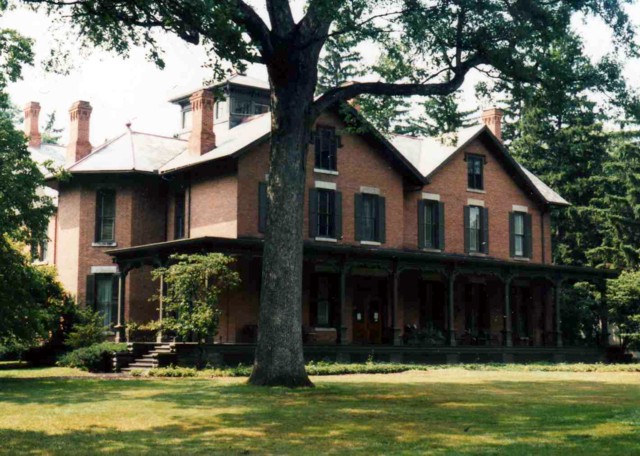
Spiegel Grove, Rutherford B. Hayes house

The house is beautiful, with a lot of windows and a huge front porch. It’s located in a 25-acre wooded lot. Right next to it is an incredibly ugly white marble monstrosity that houses the museum. This building is so ugly it almost ruins the look of the entire place. We bought our tickets and toured the house.

The lady who guided us through the downstairs was a jerk. Her attitude showed that she thought she knew a lot more than we did and, furthermore, she wasn’t about to share any of it with us. We were having a good time and laughing, and I think that bothered her, although we were also interested and paying close attention.

The upstairs guide was much better. She was a little old lady who knew a lot about Hayes and enjoyed her job. She also figured out right off the bat that we were genuinely interested. She showed us everything there was to see upstairs, and when she found out there was a lot downstairs that we were supposed to have been shown but weren’t, she took us back down there and showed it to us.

I wasn’t allowed to take pictures inside the house, but here are some postcard views. On the left is the Red Parlor. The library (right) had cool bookcases, but the room was too narrow for its length. I thought it looked like it had been crammed in as an afterthought.

Here’s the dining room (left). The sideboard on the far right was in the White House. It was rescued after the British burned the building during the War of 1812. Its twin is on the other side of the window, hidden behind the table centerpiece. This is one of the things the downstairs guide didn’t show us. On the right is Hayes’ bedroom. Both Rutherford and his wife Lucy died in the four-poster bed. Several generations of Hayes’ family lived in the house after the President died, and many of the rooms are filled with their furniture and decorations.

When Hayes lived in the house, he had a lot of famous visitors. Hayes had them touch trees on his property, then hung up plaques with the person’s name. We walked around the grounds touching trees that were touched by famous politicians and Civil War generals. Rutherford and Lucy are buried in this grave on the property. Several other family members and a few dogs and horses are also buried in this enclosure.

After walking the grounds, we went inside the ugly building and toured the museum. It wasn’t very well put together and had a lot of random stuff that had nothing to do with Hayes, like the capstan from the Battleship Maine and a ring with a lock of George Washington’s hair. There was some Hayes’ stuff — Lucy’s gowns, Rutherford’s Civil War gear, and their daughter Fanny’s doll house. We also saw the carriage Hayes used when in the White House.

Posted in Ohio | Comments Off on Spiegel Grove — Fremont, Ohio

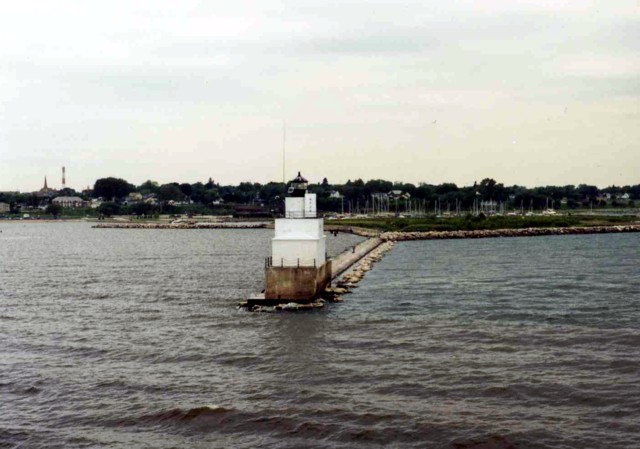
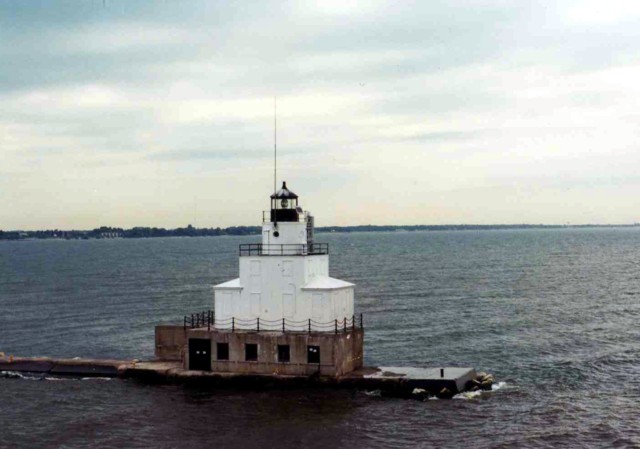
Manitowoc Breakwater Light — Manitowoc, Wisconsin

We passed this light as we entered the harbor on the S.S. Badger car ferry on our trip from Ludington, Michigan. The lighthouse was built in 1918.

Manitowoc Breakwater Light
Posted in Wisconsin | Comments Off on Manitowoc Breakwater Light — Manitowoc, Wisconsin

S.S. Badger — Ludington, Michigan

This was one of those things that it was really fun to do once. Instead of driving around the south end of Lake Michigan and fighting our way through Chicago traffic, we stayed overnight in Ludington, Michigan, then took the car ferry across the lake in the morning.

The S.S. Badger was built in 1952 as a railroad ferry, but now it is used exclusively as a car/passenger ferry between Ludington and Manitowoc, Wisconsin.


S.S. Badger loading in Ludington

We arrived at the ferry dock at 6:30 am. The hold of the ship was divided down the middle by a bulkhead. The cars were driven up the port side to the bow, then back down on the starboard side until parked, so all the cars on the port side were facing the bow and the cars on the starboard side were facing the stern. The large scaffolding in the panorama shot above can be used to park cars on the upper deck.

In the photo above, you can see the railroad tracks on the deck, left over from when the ship was a railroad ferry. The black gate that is raised here is lowered when the ship is on the lake. In the early days, the ships were built without these gates, but one ship was hit by a large stern wave and sank immediately with the loss of all on board. Since then, all ferries have had this gate. We climbed up those stairs on the right to the passenger deck.

Two other railroad ferries, the Spartan and the City of Midland 41, are docked in Ludington awaiting their fate.

We found a table in an enclosed portion of the top deck near the stern. We finally sailed at 8:00, a half hour late.

My older daughter and I spent the first half of the voyage exploring the ship — the gift shop, the maritime museum room, and every other part we were allowed in. The only time I sat down during the entire voyage was the 15 minutes I stayed with the girls while my wife toured the ship and the 20 minutes I stayed with my younger daughter while my wife and older daughter visited the gift shop to buy a T-shirt.

The voyage took four hours. There were perhaps 30 minutes in the middle of the lake when we couldn’t see either shore. The lake was smooth and the trip was relaxing. The strangest thing about it was that it seemed to be a tourist attraction, not a method of transportation. I woke up 400 miles from home, visited a tourist spot for four hours, and the next thing I knew I was just north of Milwaukee and headed for home.

Posted in Michigan, Wisconsin | Comments Off on S.S. Badger — Ludington, Michigan