Lincoln-Herndon Law Offices State Historic Site — Springfield, Illinois

We stopped in Springfield for a few hours to see the sights. After driving by Lincoln’s home and the current state capitol, we parked and toured the Lincoln-Herndon Law Offices.

The interior of the three-story building has been restored to the way it looked when Lincoln had his law offices here from 1843-1852. His office was on the third floor, looking out at what was then the capitol building.

Next to his office was the jury room, then a smaller office where Herndon ran the business when Lincoln was in Washington. On the second floor was the federal courtroom. There was a trap door from Lincoln’s office to the courtroom. Lincoln used to prop the door open so he could listen in on court proceedings. On the bottom floor, Seth Tinsley, the building’s owner, kept a store and rented space for the Springfield post office.

Posted in Illinois | Comments Off on Lincoln-Herndon Law Offices State Historic Site — Springfield, Illinois

U.S.S. Cobia — Manitowoc, Wisconsin

We stopped at the Wisconsin Maritime Museum on Lake Michigan in Manitowoc, Wisconsin. The museum was well done, but not very large. The most interesting feature was the U.S.S. Cobia, a WWII submarine docked in the river next to the museum.

It’s the same type of submarine as those built in Manitowoc during the war.

Posted in Wisconsin | Comments Off on U.S.S. Cobia — Manitowoc, Wisconsin

Animal #32 — Fisher

martes pennanti

July 18, 1995 — 2:00 pm

Oneida County, Wisconsin — County Road D

I’d been birding at Rainbow Flowage and decided to head east on “Dâ” to see if the local cranberry farm gave tours (it didn’t). I was driving through a wooded area beyond the farm, near a boggy marsh, when I spotted the Fisher.

It loped across the road about 50 yards in front of my car and disappeared into the woods. I drove slowly past the spot but didn’t see it again. It was about the size and shape of an Otter, but with longer-looking legs and bushier black fur. It loped lazily with either its two front feet or its two hind feet off the ground together. Its back was arched into a hump. I didn’t see it long, but I saw it well. There’s nothing else it could have been.

Posted in Wildlife | Comments Off on Animal #32 — Fisher

William A. Irvin — Duluth, Minnesota

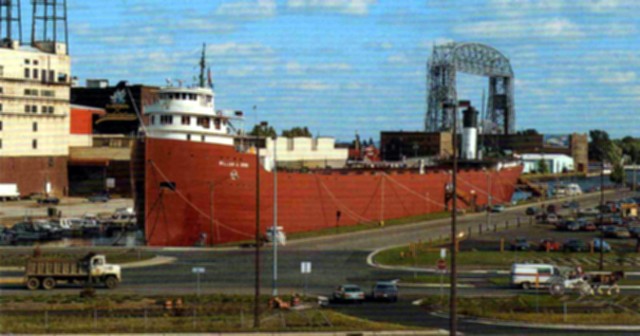
William A. Irvin (postcard view)

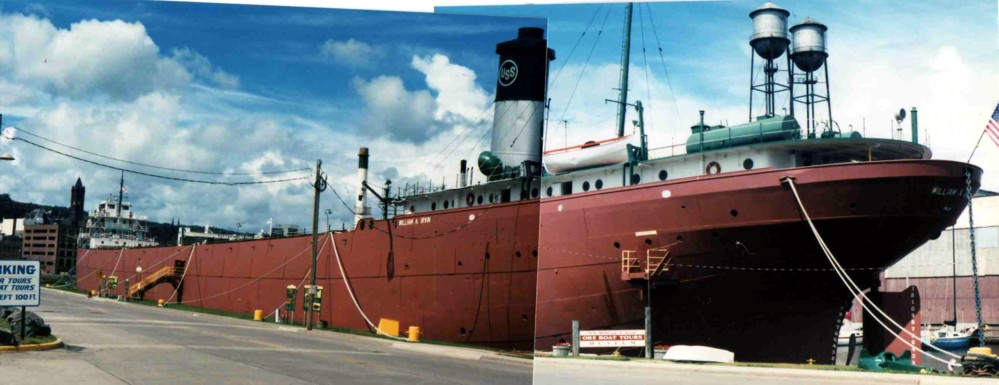
We took a day trip to Duluth. We spent the morning in a railroad museum, then split up. The rest of the family went out to lunch while my daughter and I toured the William A. Irvin, a Great Lakes tanker that was built in 1936 and decommissioned in the early 1970;s because the Sault Ste. Marie locks were rebuilt to handle larger ships — even though the Irvin is the length of two football fields.

Our tour was led by Captain Bob, a nice old guy who used to sail on tankers. There were about 25 people in the tour, including one boy about 10-years old who was desperately in need of a spanking. Captain Bob tried to befriend him in an attempt to control him, but the kid’s response was to poke Captain Bob in the neck. His father pulled him away and spoke to him in a whisper. The kid jerked away from his father, walked over to his mother and said in a loud voice, “Mom, keep Dad away from me.” The mother shrugged.

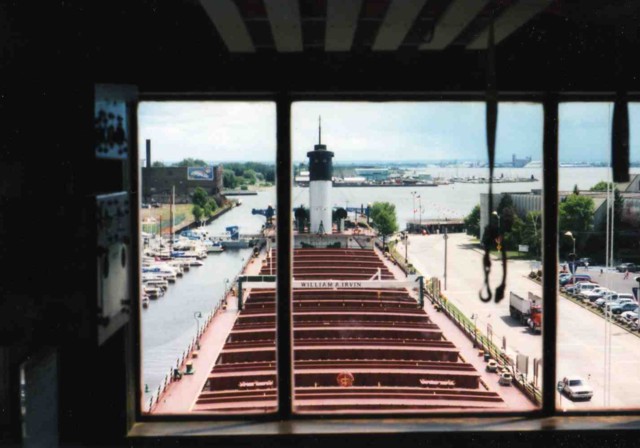
This view  is looking down the length of the ship from the wheelhouse.

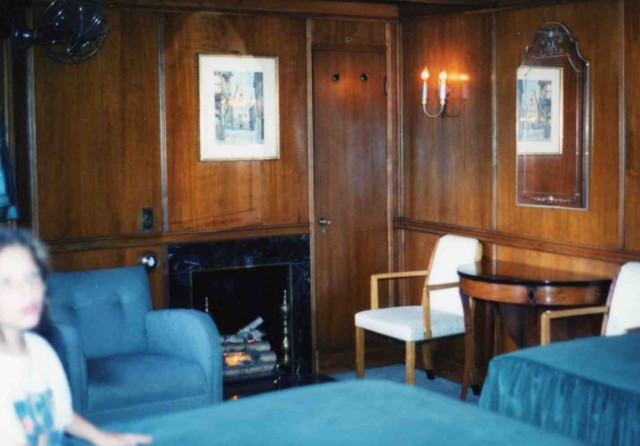
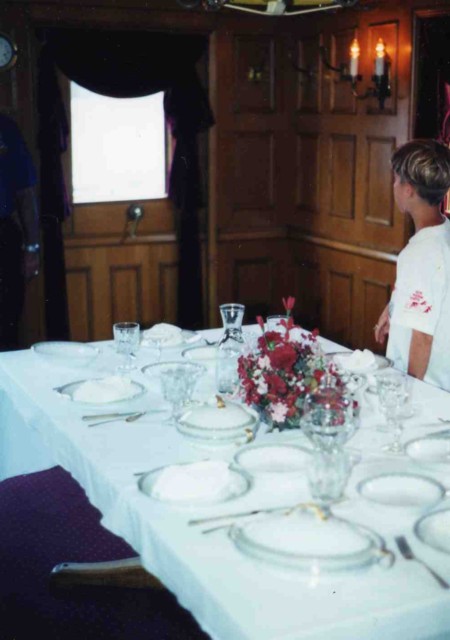
The Irvin was the flagship of the fleet, which meant that company big shots would occasionally travel on board. For this reason, there were four fancy staterooms and a passenger dining room. The mirror in the stateroom was tinted pink to offset the yellow pallor of seasick passengers. This made them look, if not feel, healthier.

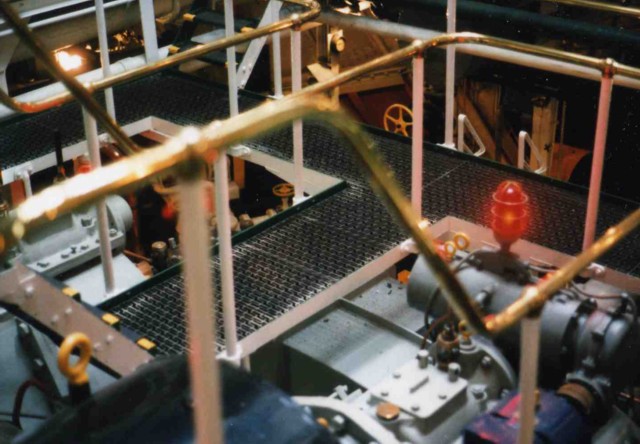
The staterooms weren’t the only fancy part of the ship — the engine room had brass railings to impress the company celebrities. In the other ships in the fleet, the railings were painted. It looked impressive, but must have been a pain to keep polished. The engine room was a four-story maze of walkways, engines, dials, pipes, lights, bells, etc. I found it fascinating.

Here’s Captain Bob explaining things in the engine room (above right). The ship is kept in operating condition, and all the bells and whistles work. Captain Bob operated all of them and explained what they meant.

The word “left” is painted on the wood above the windows in the pilot house. In the late 1960’s, the U.S. Congress decided that sailors were stupid and passed a law that “port” and “starboard” could no longer be used on the Great Lakes. Every ship had to have “right” and “left” painted on the corresponding sides in the wheelhouse. Of course, all the sailors ignored the law and used the nautical terms. The knob dangling from the ceiling is attached the the ship’s bell and was pulled a various number of times to give signals to the crew. The large brass contraption contained the compass in case the electrical navigation failed.

Posted in Minnesota | Comments Off on William A. Irvin — Duluth, Minnesota

Wilson’s Creek National Battlefield, Missouri

I went on a business trip to Nixa, Missouri, with a coworker and a business associate. It was a lot cheaper for us to fly to St. Louis and rent a car to drive to Nixa than it would have been to fly straight to Springfield, so that’s what we did. This meant that we had to stay overnight, and also that we had some time on our hands. I saw that we would be close to Wilson’s Creek, and the other guys said it sounded interesting, so we headed over after we checked into our hotel.

As it turned out, the business associate wasn’t at all interested and spent much of the time waiting in the car while my coworker and I saw some of what there was to see — we didn’t feel like we could wander very far or stay very long. We watched the slide show and map display in the visitor center, then headed out on the tour route.

Here’s what the National Park Service has to say about Wilson’s Creek:

Wilson’s Creek was the first major Civil War battle fought west of the Mississippi River, and the scene of the death of Nathaniel Lyon, the first Union general killed in combat. Although a Southern victory, the Southerners failed to capitalize on their success. With the exception of the vegetation, the field has changed little and remains in near pristine condition.

Our first stop was the Ray House, the only building in the park that was there at the time of the battle. It was furnished, but we couldn’t go inside. During the battle, the Rays, their nine children and the local postman lived in the three rooms.

A cannon that is pointed toward Sharp’s stubble field, the scene of a diversionary attack.

The one place where we wandered away from the car was on Bloody Hill. There was a monument that reads: At or near this spot fell Brigadier General Nathaniel Lyon. Born Ashford, Conn. 1818. Graduated U.S. Military Academy, 1841. Commander of the Federal forces in the battle of Wilson’s Creek August 10, 1861. This marker is erected by The University Club of Springfield, Mo. in honor of General Lyon and the hundreds of brave men, North and south, who on this field died for the right as God gave them to see the right. 1928. (Interesting how God gave men the right to fight for opposing views.)

Here’s a view of the slope of Bloody Hill.

The panorama below shows Bloody Hill on the right. The Ray House is somewhere in the distance, about a mile from where I stood.

Posted in Missouri | Comments Off on Wilson’s Creek National Battlefield, Missouri