Bird #342 — Red-necked Grebe

podiceps (from podos, foot, and caput, head) grisegena (from griseus, gray, and gena, cheek)

Monday, July 15, 1991 — 7:35 am

Crow Wing County, Minnesota — North Long Lake — Route 371

This one was easy. A Birder’s Guide to Minnesota says, “There are two excellent lakes in Crow Wing County for observing the sought-after Red-necked Grebe. On North Long Lake their nests are visible in the bulrushes just a few yards off Hwy. 371.”

On Monday morning I drove into Brainerd, then headed for North Long Lake on Route 371. I hadn’t even slowed down when I noticed two birds swimming in the open water just beyond the wild rice. I pulled over, set up my scope and … Red-necked Grebes. I didn’t see any nests, but I saw plenty of birds.

The two birds were lazily swimming, drifting and occasionally diving about 10 yards beyond the rice and 60 yards or so from shore. One was preening, rubbing its neck on its back and picking at the feathers. I noticed a bump on its back. I was trying to figure out what it was when the grebe fluffed up its wings and made a little jump forward. A tiny chick popped off its back and landed in the water behind the adult. A few seconds later this was repeated, and another chick landed in the lake. The two very tiny chicks followed closely after the adults for a few seconds, then climbed back aboard and hid under the wings. The adult resumed its lazy drifting.

I scoped the rice beds and noticed another pair about 150 yards further south. One adult was floating still in the rice while another swam up to it with a five-inch fish in its bill. The reeds were too tall for me to see much of what was going on.

I heard the original pair giving a loud, high-pitched “ki-ki” call and resumed watching them for a while. They weren’t doing too much.

I got back in the car and headed north. I spotted four more grebes about 300 yards along the lake. Two adults were swimming close to shore amidst the rice, about 40 yards apart. Each adult was accompanied by a larger, stripe-headed chick.

Later in the day, I stopped by again with my wife to take pictures. In the area where I saw the two with the fish, we saw two adults and two larger chicks for a probably total of 12 grebes within a 400 yard stretch of lake. One of the adults was swimming in a line, dipping its head under the surface every few seconds and letting the water run over its back.

Posted in Wildlife | Comments Off on Bird #342 — Red-necked Grebe

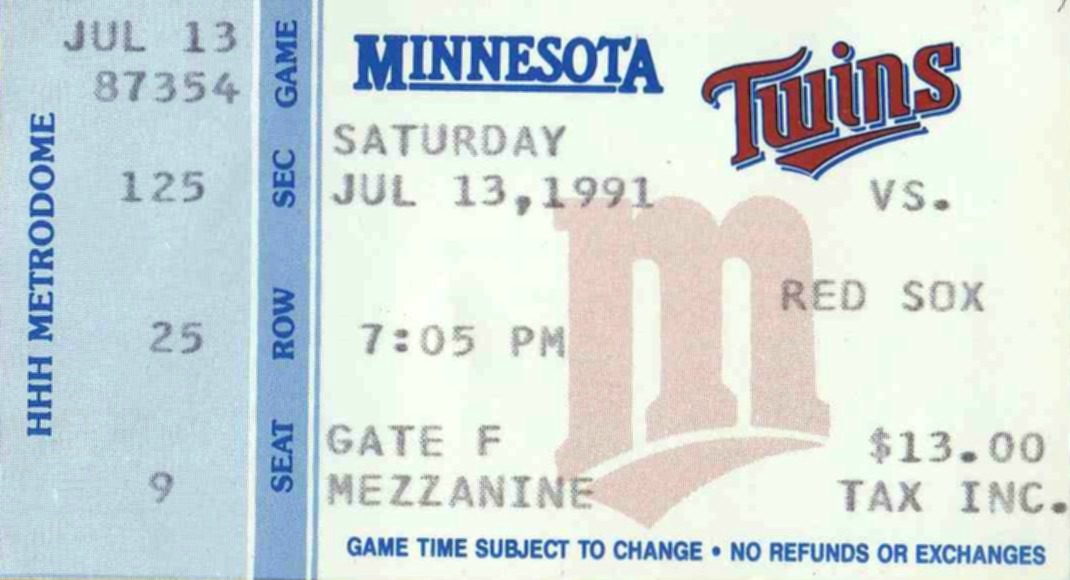
Twins vs. Red Sox — July 13, 1991

On the way to a vacation in Minnesota, we stopped for a night in the Minneapolis area. I left my family by the swimming pool at our hotel and drove into town for a Twins game. I found a parking spot right across the street. I walked around the outside of the stadium, then entered and walked around the inside.

metro2532a

metro1531a

Because I only bought one ticket, I was able to get a great seat behind home plate, 18 rows up, in a direct line with the mound and second base. I was in the middle of a row with people all around, but they were polite and knowledgeable and very excited about their first-place Twins.

I liked the park better than I expected to. It was my first indoor baseball game, but that didn’t bother me at all. The weird thing was the smooth carpet that covered everything including the warning track. The only dirt was in the small patches around the mound and the bases. When the ball was hit in the air, I lost it against the white roof.

The park looked a lot smaller than it is. I was amazed to discover there were 42,803 people there, and the park wasn’t full. The Twins won 3-1

metro1531b metro4534

I got mixed up after the game and ended up circling the entire Minneapolis/St. Paul area before finding the motel.

Posted in Baseball | Comments Off on Twins vs. Red Sox — July 13, 1991

White Sox vs. Royals — June 16, 1991

My wife and I went to this game with another couple. We left after church and got stuck in two traffic jams. We arrived at our seats just as the National Anthem was finishing. The seats were great — just behind the Royals’ dugout. The weather was fantastic too — 75 degrees, with a nice breeze off the lake and, after the fourth inning, in the shade. The White Sox lost 9-4.

newcom10526

soxroyals1529 soxroyals2530

Posted in Baseball | Comments Off on White Sox vs. Royals — June 16, 1991

Bird #341 — Cerulean Warbler

dendroica (from dendron, tree, and oikein, to dwell) cerulea (blue)

Thursday, June 13, 1991 — 9:45 am

Indiana Dunes State Park, Indiana — Trail 2, east of Wilson’s Shelter

Encouraged by my success with the Henslow’s Sparrow, I decided to go for the long-sought but never-seen Cerulean Warbler. I checked out Birds of the Indiana Dunes from the Des Plaines Library and read that they can’t be missed on Trail 2 in the State Park. I got to the dunes at 7:00, only to discover that the park didn’t open until 8:00. I drove to Kemil Road in the National Lakeshore and did some exploring. I was at the park minutes after it opened, paid my $2.00 and parked by Wilson’s Shelter. A jogger passed me just as I started on the trail, but I didn’t see another person for the next two and a half hours.

The woods were wet, with a lot of pools and tiny creeks everywhere. The trees were very tall, 80 feet or more (in my estimation), and some of the trunks were four feet across. There were more trees that topped off at thirty feet or so, and a lot of brush at ground level, but not so thick as to be impenetrable.

I had listened to the song on tape, and heard one singing at Kemil Road, so I knew what I was listening for. I heard one when I had been on the trail about 15 minutes. It was off the trail a bit, and way, way up in the trees. It was ventriloqual, and I kept walking back and forth on the trail trying to zero in on the sound. No matter where I went, it sounded like it was coming from where I’d been. After ten minutes, it sounded like the bird was moving away from me. I left the path and walked into the woods. Again, I couldn’t pinpoint the sound. I wandered around the area for forty-five minutes, always within ear-shot of the Cerulean, but never sure where it was. I stared up until my neck was aching. I was determined, and I kept on looking, but I hadn’t seen a hint of it when it stopped singing. I hung around for a few minutes, but I didn’t hear it again.

I was discouraged. I didn’t know how late into the morning they would sing. I wandered down the trail. About 15 minutes later, I heard another one singing right above the trail. I thought I could tell where the sound was coming from, but I couldn’t see anything. I was going nuts. It was right there, but I couldn’t find it. It moved into the woods, and I followed. I entered an open area where a big tree had fallen. The singing was coming from a tall tree that bordered the small clearing. To save my neck, I laid down on the trunk and stared upward. I finally spotted a bird and zeroed in. Cedar Waxwing. I was ready to scream. Five minutes later, the Cerulean stopped singing. I slogged on down the trail.

I had gone about 50 yards when I wandered into an Ovenbird’s territory. It was circling around me, flitting through the brush and calling. While I was watching it, I heard a Cerulean Warbler singing back where I’d been. I think it was the same bird I’d just been searching for. I went back to the spot, looked up and … surprise, surprise. There was a Cerulean Warbler. It was about 35 feet above me, flitting through the branches of a shorter tree. I had a split-second glimpse of white undersides and a black chest band, and then it disappeared into the foliage. I shortly spotted it again. It was moving rapidly, stopping every few seconds to sing. A minute later, it flew to an exposed branch in another tree, about 45 feet up. I managed to follow it to where it landed.

It started preening, giving me good views of its bright blue cap and dark side streaks. And now that I had my bird, my neck couldn’t take it any more. The bird looked like it was going to stay in the same spot for a while, so I laid down on the path and looked up at it. It continued preening, but every ten seconds or so it would pause to sing. It went over its chest and side feathers, giving me a brief look at a white wing bar. It didn’t stay long, and soon disappeared.

I was happy. Taking off a day from work, getting up at 5:00 a.m., driving for two hours, swatting mosquitoes, chasing an elusive noise through the woods, a seriously sore neck had all been worth it. I went away with an appreciation of why I had never “just happened” across one.

Posted in Wildlife | Comments Off on Bird #341 — Cerulean Warbler

Bird #340 — Henslow’s Sparrow

ammodramus (from ammos, sand, and dramein, to run) henslowii (given in 1831 by John James Audubon for his friend John Stevens Henslow, professor of botany at Cambridge University in England)

Saturday, June 8, 1991 — 8:20 am

Zion, Illinois — Illinois Beach State Park

I was on a mission. I knew this bird was mythical, and I wanted to prove it. It was supposed to breed in Cook County, but I’d never spotted one. It wasn’t for lack of looking. On one quest, I got myself stuck in the middle of a blackberry patch that stretched for miles in every direction. By the time I got back to my car, I looked like Swiss cheese. I pulled tiny thorns out of my body for hours.  I had been following directions to a field where they were supposed to be found, but not only did I not find the bird, I didn’t find the field.

They’ve been reported from Crabtree. They’ve been reported from Illinois Beach. I’d been both places dozens of times, but no Henslow’s Sparrow. I’d even gone to Illinois Beach twice earlier in 1991 and hadn’t seen one. But the hotline was reporting them from there, so I decided to try again. And this time I was determined to do it right. I spent the night before studying the field guides, got up early on Saturday, and listened to the song on tape the whole way up in the car.

I parked in the crater-filled lot at the end of Greenwood Avenue, about half a mile from the south border of the park. I hiked up the beach, spotting a Horned Grebe swimming off shore in Lake Michigan on the way. When I got to the prairie where the bird was reported, I began my search. I went about it very methodically. I started on the lake side, walking slowly. Every 50 feet I stopped and listened for two or three minutes. I repeated this over and over. I carefully checked every bird I saw and tracked down every song I couldn’t identify. I saw Tree Swallows, Barn Swallows and Bank Swallows. I saw Savannah Sparrows, Grasshopper Sparrows and Field Sparrows. I saw Eastern Meadowlarks, Western Meadowlarks and tons of Mourning Doves. But no Henslow’s Sparrow.

When I reached the pines at the north end of the prairie, I walked west for a hundred yards or so, then started back south again. I’d been at it for more than an hour. I hadn’t gone far when, on one of my periodic stops, I thought I heard something. I froze. I listened with every fiber of my being. I felt, more than heard, what I thought was a Henslow’s Sparrow. But a Grasshopper Sparrow was singing from a bush just a few yards behind me and drowning out the other song. I strained and strained, but I couldn’t pinpoint what I was hearing. I decided it was just a ventriloqual part of the Grasshopper Sparrow’s song.

As I was standing there, I realized I had never explored the part of the prairie off to the west of where I stood. Since one direction was as good as another, and since the bird was mythical anyway, I decided to head that way.

I went about five steps and heard the mystery sound again. I stopped, and as I did so, I spotted a sparrow perched on the tip of a small branch sticking up from a small bush in a low, wet area. I set up my scope and zoomed in on it. I had my Henslow’s Sparrow.

It was about 20 yards away from me, and about 30 yards from a scattered grove of small trees. It was facing away from me, but in clear view. I could see all the field marks except the streaked breast. The head really was olive green. It looked around nervously, often peering over its shoulder in my direction. Every 10 seconds or so, it lifted its head and gave its pathetic “tsi-lit” song. Even from 20 yards, and even though I was looking right at the bird, the song wasn’t loud or obvious. I checked the time, looked in my Peterson’s to double-check the marks and rechecked the bird. Still it perched there singing. I was loving it. I felt that somehow I had advance to a higher level of birding excellence.

I memorized the bird because I didn’t know if I’d ever see another one. I wanted it to turn around and give me a view of its front, but it never did. After seven minutes it flew off, dropping down in fluttering flight and disappearing into the foot and a half grass. I walked over to where it had been and broke off the top two inches of the branch where it had perched.

On my hike back across the prairie, I saw an Upland Sandpiper in a dead tree giving its eerie call. I flushed a Mourning Dove from under my feet. I looked where it had come from and saw two white eggs laying on a few loose strands of grass in a tiny depression under a tuft of grass.

Posted in Wildlife | Comments Off on Bird #340 — Henslow’s Sparrow