Dwight D. Eisenhower Boyhood Home

We visited the Dwight D. Eisenhower Presidential Library and Museum, which wasn’t as grand as it sounds because the museum was closed for renovations. There were a few museum displays in the library.

The principle attraction for us was Ike’s boyhood home. He was born in Texas in 1890. He moved with his family to Abiline, Kansas in 1898. The family lived in the home until Ike’s mother’s death in 1946. By that time, Eisenhower was famous as a general, so the house, with the family’s belongings, was immediately turned into a museum.

The house was small. Two bedrooms were added to the first floor in 1900, one for Ike’s parents and one for his grandfather. Ike and his five brothers slept in three small bedrooms upstairs.

Our tour was only of the first floor. There were about eight other visitors with us.

Two views of the kitchen.

The parlor

Mr. and Mrs. Eisenhower’s bedroom.

The family room where all eight Eisenhowers hung out.

Dwight and Mamie’s grave sites are in the Place of Meditation.

We got free passes to return after the museum reopens, and it was all interesting and well-done enough that we just might. I’ve always been a fan of Ike, partly because he was President when I was born, but also because he spent a lot of his time as President fishing and golfing instead of messing up the country like so many other Presidents have done.

Posted in Kansas | Comments Off on Dwight D. Eisenhower Boyhood Home

Space Foundation Discovery Center

This place wasn’t high on my list of places to see in Colorado Springs, but after living in the city for two years, I’m running out of museums. The Space Foundation isn’t large or well organized, and it seemed to be designed primarily to encourage kids to become astronauts. I wonder if it’s ever accomplished it’s goal?

Inside, there are displays on uniforms and food and weightlessness. There are scale models of satellites and rockets. There’s a room made up to look like the surface of Mars on which visitors could attempt to drive remote-control vehicles.

I was moving rapidly through the place, in danger of having spent $10 for a half-hour visit, when I stumbled onto the theater. A large white sphere hung in the center of the room, and on it a movie was projected. I took a seat and watched for a while. The movie turned out to be a screed on the imminent dangers of global warming. (There had been a six-inch snowfall the evening before and the museum opening was delayed by an hour — but still, you know, global warming.)

I was about to wander out when a kid in a Discovery Center T-shirt wandered in and narrated a show on the planets. He projected pictures of each of them onto the sphere and told us stuff about each. It was pretty interesting. And unintentionally funny. He asked for questions, but whenever somebody asked something he didn’t know, he said, “It involves complicated astrophysics and would take too long to explain here.” He must have said this at least six times during his half-hour talk.

Clockwise from top left: Mercury, Mars, Uranus, Death Star, Pluto (the white space at the bottom hasn’t been photographed by satellite), and Jupiter.

And so I’ve been to the Space Foundation. I’m not sorry I went, but I seriously doubt I’ll go back — unless I decide to become an astronaut.

Posted in Colorado | Comments Off on Space Foundation Discovery Center

Western Museum of Mining and Industry

I visited the Western Museum of Mining and Industry on Saturday morning and arrived just as a tour was beginning. Along with me on the tour were two couples and a father with three young sons who had never been told no. During the entirety of the tour, these three lads ran all over the place, demanded attention, touched stuff they weren’t supposed to touch, interrupted the guide and assumed that we were all fascinated by all of it.

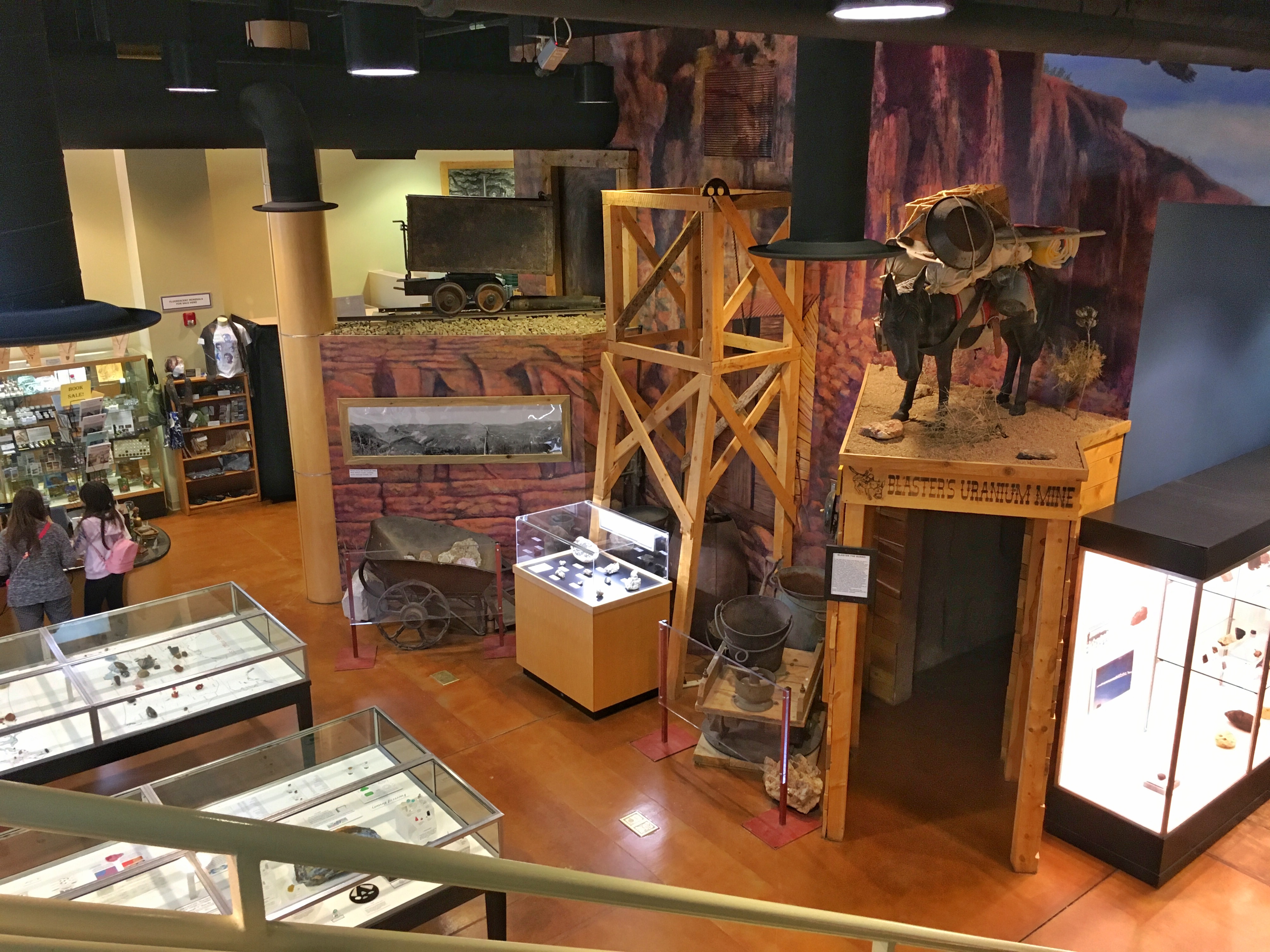
The patient, elderly gentleman who led the tour spoke slowly, but he was interesting and knew his stuff. The museum was well done. It told the story of mining in the western United States. There was a lot of equipment and machinery on display, much of it in working condition. But since none of it was actually hooked up to do the job it was designed to do, we pretty much just saw wheels, pistons, and gears moving around and around.

We were able to try our hands at panning for gold, although the guide told us there was really very little gold in the sand in the troughs. There were some tiny polished stones of various colors. I collected several, but threw them all away.

An assayer’s office

An escape pod used to rescue miners trapped underground.

There were several outbuildings and some pieces of equipment scattered around the grounds, but they’re only open and on display during special events or warm weather.

Except for the brats, it was a mildly entertaining way to while away a Saturday morning.

Posted in Colorado | Comments Off on Western Museum of Mining and Industry

Highlights from Recent Reading

Writers come in two principle categories — those who are overtly insecure and those who are covertly insecure …

Draft Number 4, by John McPhee


We also saw the Golden-fronted Leafbird, a bright green bird with an orange forehead about the size of a Mockingbird. [That’s a really big forehead.]

One More Warbler, by Victor Emanuel


Conscience drove Adam behind the trees of the garden; revelation brought him forth into the presence of God. The consciousness of what he was terrified him; the revelation of what God was tranquilized him. This is truly consolatory for a poor sin-burdened heart. The reality of what I am is met by the reality of what God is; and this is salvation. There is a point where God and man must meet, whether in grace or judgment, and that point is where both are revealed as they are. Happy are they who reach that point in grace! Woe be to them who will have to reach it in judgment! It is with what we are that God deals; and it is as He is that He deals with us. In the cross, I see God descending, in grace, to the lowest depths, not merely of my negative, but my positive condition as a sinner. This gives perfect peace. If God has met me in my actual condition, and Himself provided an adequate remedy, all is eternally settled. But all who do not thus by faith see God in the cross, will have to meet Him by and by in judgment, when He will have to deal, according to what He is, with what they are.

It is quite impossible that a divinely-quickened conscience can rest in aught save the perfect sacrifice of the Son of God. All effort to establish one’s own righteousness must proceed from ignorance of the righteousness of God. … Thus, in whatever way we view the matter, we see the sinner’s complete impotency, and, as a consequence, the presumptuous folly of all who attempt to assist God in the stupendous work of redemption, as all assuredly do who think to be saved in any other way but “by grace, through faith.”

[God] made it altogether a question between Himself and the serpent; for although the man and the woman were called upon individually to reap, in various ways, the bitter fruits of their sin, yet it was to the serpent that the Lord God said, “Because thou has done this.” The serpent was the source of the ruin, and the seed of the woman was to be the source of the redemption. … Looking at the matter from nature’s point of view, Eve might be called, the mother of all dying; but, in the judgment of faith, she was the mother of all living.

It was God’s wondrous mercy to allow [Adam] to hear what He said to the serpent, before he was called to listen to what He had to say to himself.

Notes on the Book of Genesis, by C.H. Mackintosh


Reno’s record also was superior to that of his closest friend at West Point, James McNeill Whistler, who piled up demerits with heroic aplomb and concluded one examination by defining silicon as a gas. Whistler reputedly said to Reno some years afterward that if silicon indeed had been a gas he probably would have stayed in the Army and become a major general; and Reno said yes, but then nobody would ever have heard of his mother. That must have been one of the cleverest things Reno ever said. Unlike Custer and Benteen — with their very different styles — he seems humorless. There is no levity in that dark face.

Son of the Morning Star, by Evan, S. Connell


The big round bullet that brought him down came from a muzzle-loading Lancaster rifle, possibly one of many weapons given to the Cheyennes by the government at the Medicine Lodge peace council. Barnitz himself had been at Medicine Lodge and was amazed: “Indians signed treaty. Presents distributed — among other things 65 new revolvers! — and hundreds of new butcher knives!”

Eight years later Major Reno wrote his official report of the Custer business while on the banks of the Yellowstone, concluding with these lines: “The harrowing sight of the dead bodies crowning the height on which Custer fell, and which will remain vividly in my memory until death, is too recent for me not to ask the good people of this country whether a policy that sets opposing parties in the field armed, clothed and equipped by one and the same government should not be abolished.”

A century later it is obvious that Major Reno’s question has not yet been answered.

Son of the Morning Star, by Evan, S. Connell

Posted in Reading | Comments Off on Highlights from Recent Reading

CU South Denver Museum

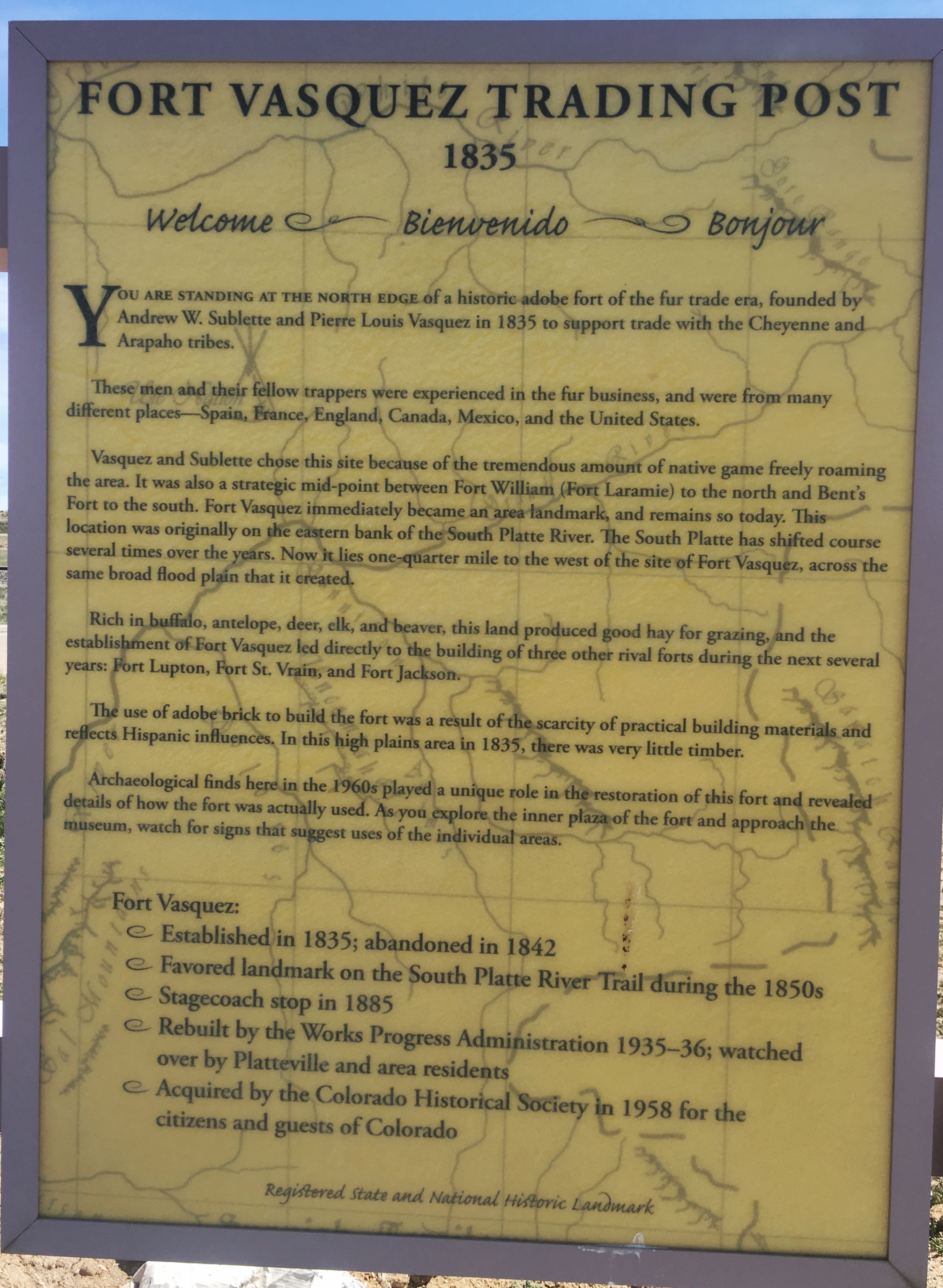
I discovered this museum while searching online for interesting things to do in Colorado. I never would have found it any other way because the word museum doesn’t appear in the name of the “museum” or on the signage anywhere near the building. My GPS took my to a large building in Parker. I walked across a plaza past several animal sculptures that at least felt museumish.

From behind a counter in the lobby, a young woman gave me a friendly greeting. I asked, “Is there a museum here?” She assured me that there was, and got very excited as she explained how I was to navigate the space. Rarely have I paid to see something I knew so little about.

The museum had three major areas. The first was a large room with a winding walkway that passed through several different environments — rain forest, tundra, desert, etc.

There were animal figures, and even a few human figures along the way. Many of them were animatronic, but a lot of them weren’t. And many of those that were were only minimally so. I had to watch very carefully to see any movement. Here are a few examples. The human figures would talk to me when I pushed buttons on a screen. The rest of the time, they just froze in place — except for an occasional blink or turn of the head. It was more than a little creepy. The exhibit wasn’t large, but it was impressive. I saw maybe four other real, live humans in the room while I was there.

The second section featured Colorado wildlife. There were mounted specimens of many of the local fauna, but as near as I could tell, none of them moved.

The third part of the museum was an art gallery, donated by some rich folks. I had this part entirely to myself.

One exhibit featured seven chimpanzee statues. I had some fun with these.

And that was pretty much it. The whole museum took me about an hour and a half and taught me nothing. But as a way to kill a Saturday morning when I was recovering from a flu-type bug, it was delightful.

Posted in Colorado | Comments Off on CU South Denver Museum