Battle of Lexington State Historic Site — Lexington, Missouri

In 1861, Confederate general Sterling Price captured a much smaller Union force after a three-day siege. The Confederates stormed the Union works after approaching by hiding behind bales of hemp which they rolled up the hill above the Missouri River. Much of the fighting took place around the Anderson House, which was used as a hospital by Union forces.

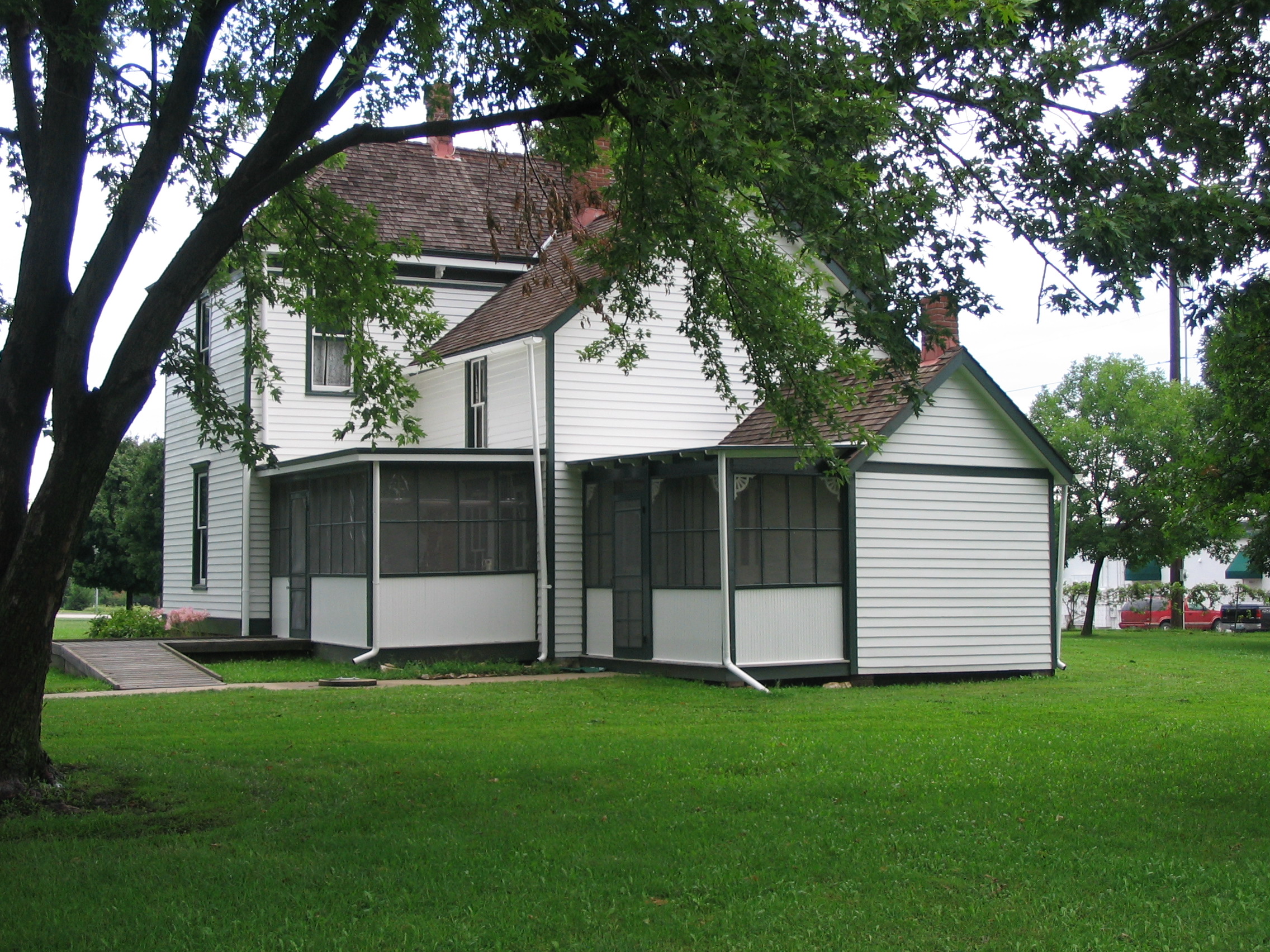
Anderson House - front viewAnderson house - back viewThe hill up which the Confederates rolled the hemp bales.

The house is open for tours, but I didn’t go in because the tour would have taken the better part of an hour and I had a long drive ahead of me. I looked at the displays in the visitor center, then walked around the house and around the short trail that followed the Union lines. It was a hot, muggy day, so I was glad the trail was short.

Posted in Missouri | Comments Off on Battle of Lexington State Historic Site — Lexington, Missouri

Harry S Truman Farm Home — Grandview, Missouri

I visited the Harry S Truman Farm Home, which is part of the Harry S Truman National Historic Site. It’s only open for tours during the summer and then only on Fridays, Saturdays and Sundays.

There were three old lady rangers manning (that’s probably the wrong word to use in this case) the site. One of them hobbled out and informed me that tours didn’t start until 9:30, but I was welcome to look around outside. I took some photos of the outbuildings and wandered about. At 9:15, another lady came out and said she’d give me the tour early!

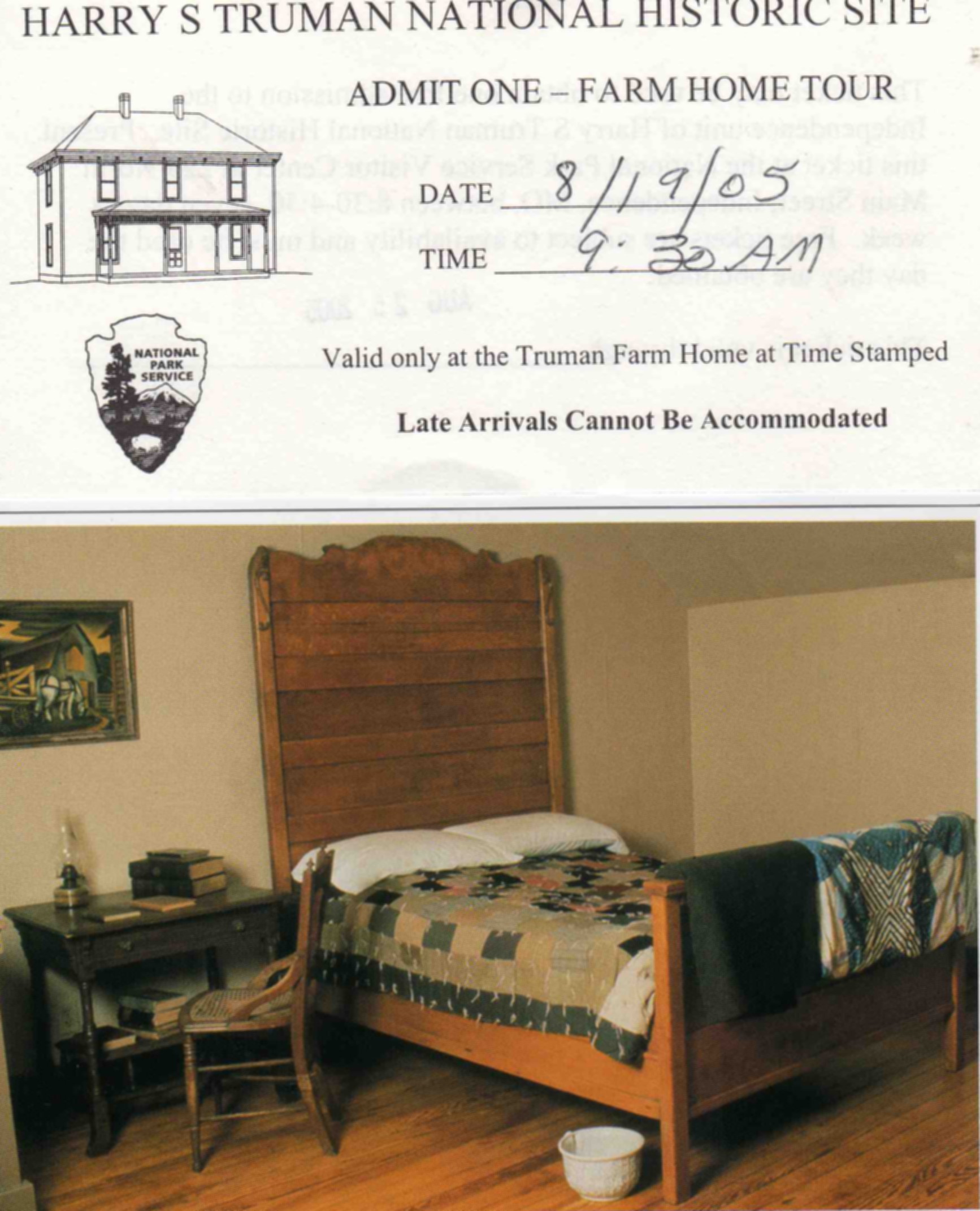
The tour took about 20 minutes — there are only three bedrooms upstairs and a parlor, family room and kitchen/dining room downstairs. Truman lived here for 11 years just before World War I, running the place for his grandmother.

The back of the postcard says: Harry Truman used this bedroom while on the farm from age 22 to 33. It was an oven in the summer and an icebox in the winter. In January, 1914, Harry wrote to Bess, “It was an awful task to rise in that ten-degree room. I finally did it but I believe some of the enamel is cracked on my teeth.”

Posted in Missouri | Comments Off on Harry S Truman Farm Home — Grandview, Missouri

Bird #420 — Fork-tailed Flycatcher

tyrannus (tyrant) savana (grassland)

Monday, May 16, 2005 — 2:25 p.m.

Cook County, Illinois — Paul Douglas Forest Preserve

I returned to my desk at work after lunch and found this IBET e-mail waiting for me:

There is a Fork-tailed Flycatcher at Paul Douglas F.P. It is a female type bird. Exit I-90 at Roselle Road, go north and take left on Central. Parking lot is on the right past Ela Road. If you walk northwest the bird was in the big meadow northwest of the pond.

I had tried for a Fork-tailed Flycatcher in southern Wisconsin in the fall of 2000 with no luck. I knew I wouldn’t get many chances, and this one was only five miles away from work. I walked over to my boss’s office, but he wasn’t in. I went back to my office and forwarded him the above e-mail with this addition:

I’m really sorry about this, but this bird usually doesn’t come north of SOUTH AMERICA. I’ll be back as soon as I can and I’ll get my work done. I promise. (He later told me he filed this e-mail away as one of the most interesting he’s ever received.)

When I got to the forest preserve, I saw another birder in the lot and stopped long enough to ask if I was in the right place. He pointed out a large copse of trees and said the flycatcher was just beyond it — he’d just seen it. He said I couldn’t miss it because there was already a trail worn in the grass from birders headed that way. I walked the half mile or so to the spot he indicated and found three people watching the bird. It was easy to spot as it flew back and forth from low perch to low perch in the prairie-like field. I saw it land on tiny bushes and on stalks of reeds. Occasionally it would fly down to the ground for a second or so but usually its flight was more horizontal and appeared to be in pursuit of insects. I’m pretty sure one of its dashes was in pursuit of a Cabbage White butterfly, but it didn’t come close to catching it. When the flycatcher perched, it sometimes wagged its tail, but I think this was to keep its balance in the breeze rather than habit. During the time I watched, it kept within an area of perhaps an acre. I was probably 35 yards away from it at its closest point.

While I was there, several other birders came and went, and more were arriving as I left. I was back at work within an hour.

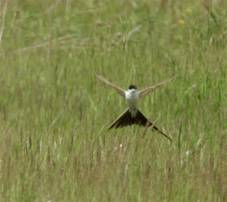
This picture was taken by another birder. I down-loaded it off the Internet, but this is the very bird I saw.

Posted in Wildlife | Comments Off on Bird #420 — Fork-tailed Flycatcher

Reptile-Amphibian #12 — (Western) Fox Snake

elaphe vulpina

Thursday, May 5, 2005 — 12:40 pm

Ringwood, Illinois — Glacial Park

I was birding along the loop trail on the first nice day after two weeks of cold-for-the-season weather. I had just come down off the kame, headed for the bog when I heard the unmistakable sound of a snake in the grass. It was about six feet off the trail in the foot-high grass under a lot of oak trees.

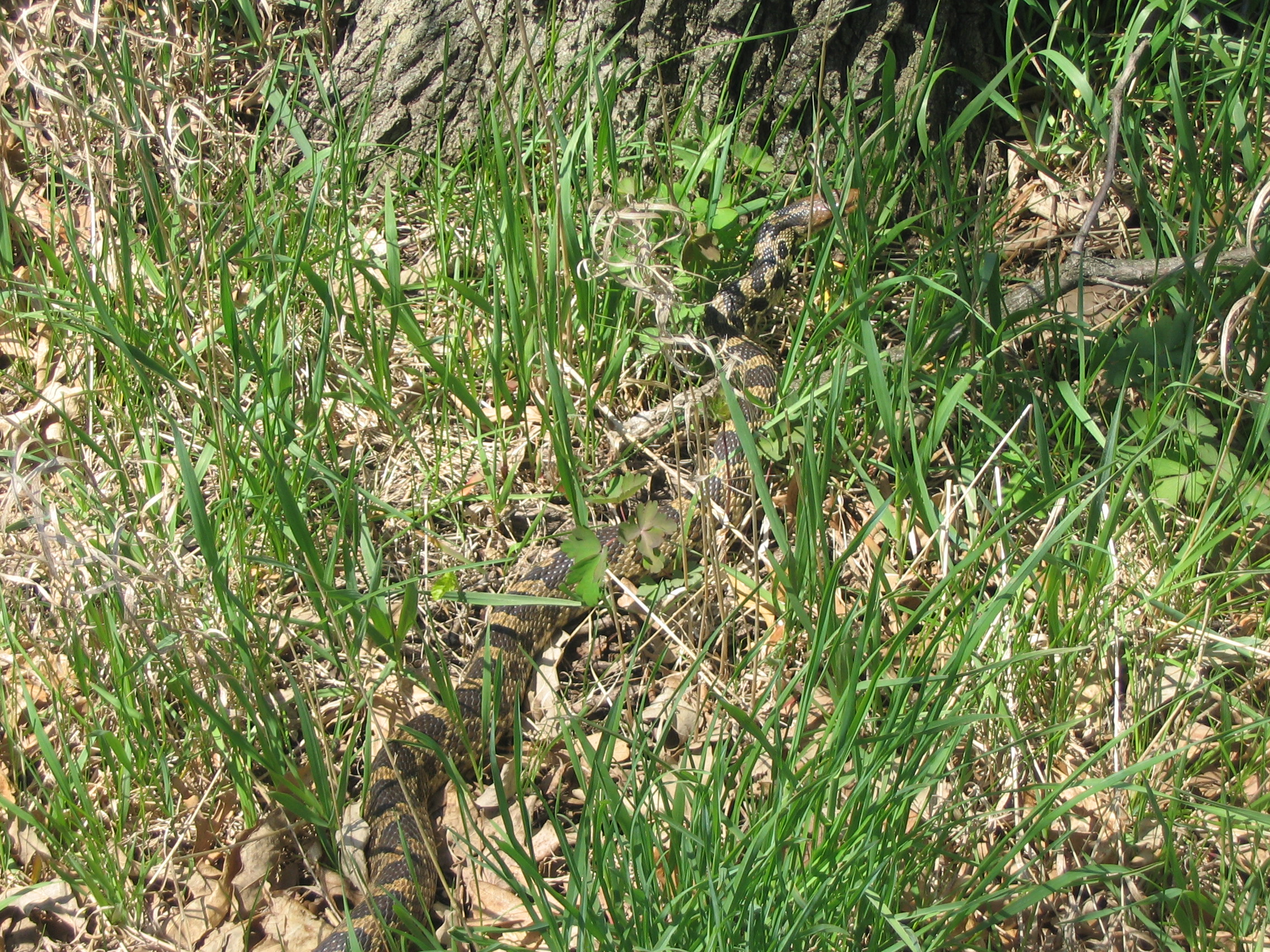
It was moving slowly, and when I stepped off the trail, it stopped. I walked around the base of the large tree it was near so I could get a good look at its head. I took some pictures while it stayed motionless. As I bent over to get closer, I heard a dry rattle that startled me for a second. I soon saw that it was vibrating its tail in the leaves. It did this repeatedly every few seconds.

It happened to be lying on a stick. I picked up the other end to raise its head and get a better look. When I put the stick down, the snake stayed in the same position, with its head and about six inches of its length off the ground.

I walked around behind it to get a better look at the tail, and it crawled off around the oak, rattling as it went. I stepped forward to head it off, and it slowly coiled up the front third of its body. It never made an aggressive move toward me and remained rather sluggish the entire time I looked at it. As I walked back to the trail, I could hear it moving off through the leaves again.

It was about three feet long and maybe two inches wide at its thickest point. The head was an unpatterned olive yellow. The body was a dull yellow with brown marks.

Posted in Wildlife | Comments Off on Reptile-Amphibian #12 — (Western) Fox Snake

Bird #419 — Northern Hawk Owl

surnia (etymology unknown) ulula (imitative of the bird’s call from Pliny’s name for the screech-owl)

Monday, March 7, 2005 — 10:58 a.m.

Harrington Beach State Park, Wisconsin

This Hawk Owl was seen almost daily at Harrington Beach State Park, about 30 miles north of Milwaukee, for the better part of a month. I wasn’t doing much birding this winter, and so kept putting off a trip to see it. But people kept reporting it, and it is a very rare bird this far south. I began to feel guilty about not going. I decided to take a day off work and go.

My car had 208,300 miles on it and had been breaking down regularly, so the drive was something of a risk. I brought my wife’s cell phone, a stack of CDs, and my digital camera. I left home at 7:45 and drove up Route 31. When I stopped for gas in McHenry, I was struck by how gloomy and overcast the day was. The wind was whipping across the parking lot so hard it made it difficult to stand upright. I almost gave up. I paused on the way out of the gas station, debating what to do. Then the thought struck me that, when I was younger, nothing would have stopped me from making the effort. Was I a man or a mouse? And I’d already taken the day off. I turned north.

As soon as I got north of Milwaukee, it started to rain. When I got to Harrington Beach State Park at 10:15, it was half raining, half snowing and completely miserable. I paid $6 for two hours in the park. The guy at the entrance booth said he’d seen the owl the evening before, and he gave me a map on which he had circled the most-likely location.

It isn’t a large park. The western two-thirds is grassy with stands of small trees. The eastern half is more thickly wooded. I drove back and forth on the main road three or four times. There was one other birder in the park, also driving around. At one point, when I pulled into a lot, he pulled in next to me. He told me he’d been there since 7:30 and hadn’t seen the owl, but he’d seen it on four previous days. He said it wasn’t always along the main park road, so after he left I drove around some of the other areas of the park.

When I got back to the spot the ranger had circled, I slowed down and soon spotted the owl about 40 feet back from the road. The field guides all said it usually sits shrike-like at the very top of a tree, so that’s where I’d been looking. But when I spotted it, it was about six feet off the ground in a small stand of trees, right at the edge of a small opening.

I parked and watched and took pictures for the next half hour. I was too far away to get a good shot, so in desperation I held the camera up to my telescope. What came out wasn’t great, but it was much better than I expected.

The other birder pulled up behind me for about two minutes, then pulled next to me. He rolled down his window and said, “patience pays off,” then left the park. (He’d driven around for three and a half hours to look for two minutes …)

Anyway, the owl didn’t pay much attention to me. It frequently swiveled its head around 180°, to look for prey I suspect. After five minutes or so, it dropped down, flew a short way, then rose up to land further back in the stand of trees about 25 feet off the ground but still not at the top. It looked around some more, preened a bit, then hopped to another branch a few feet away.


While I was watching the owl, the cell phone rang. It was my wife, worrying about whether the car had blown up or stranded me somewhere. She was much more worried about me making it home than she was excited about me seeing the owl. I was frustrated because I wanted to share my excitement with somebody, so I held the cell phone up to my telescope (it isn’t a camera phone), but she wasn’t impressed.

My car was faithful, and I made it back home without problems. I was very glad I’d been a man and made the trip.

Posted in Wildlife | Comments Off on Bird #419 — Northern Hawk Owl