Bird #376 — Little Gull

larus (ravenous seabird) minutus (small)

Thursday, June 10, 1999 — 3:10 pm

Manitowoc, Wisconsin — Lake Michigan

A few years ago, a book came out called America’s 100 Most Wanted Birds.  I didn’t buy it because it mostly listed birds that would take a year of my salary to find. But I did check it out of the library. One of the birds was the Little Gull, and the place to see it was Manitowoc, Wisconsin. That seemed easy enough. And frustrating, since I’ve been in Manitowoc twice in the last five years and didn’t know to look for it.

Anyway, we were heading up to Wisconsin for a week, and I decided to go by way of Manitowoc. After eating lunch at Culver’s on the west side of town, we got to the harbor around 2:00 p.m. The book said to look for the dredge-spoil fill containment area. I had no idea what that was. We drove along the shore a mile or so and saw many Bonaparte’s Gulls sitting on piers and pilings.  These got me excited for a few minutes, then discouraged when it occurred to me that I was going to have to sort through hundreds of very similar-looking gulls. I went back to the maritime museum and parked. My wife and daughters wandered around the park by the river mouth looking over the harbor. On the south side of the river, I saw a large black mound. I thought this might be what I was looking for, so I walked back along the river, over the bridge, and back toward the lake. Whatever that black mound was, it contained no Little Gulls or other birds. I walked back.

I noticed a large, swirling flock of gulls out past the breakwater beyond a marina, so I walked up the shore to the north to see if I could get closer. After about a mile, I passed the marina and found a breakwater leading out toward the gulls. I also discovered another parking lot right by the breakwater. Oh, well. About 100 yards out into the lake, the breakwater split. Further out toward the harbor mouth, the two sides joined again, forming a large rectangle impoundment of about five acres. Half of the area was open water and half was filled with dirt (dredge-spoil fill, I suspect). Most of the dirt was covered with a thick growth of weeds, but there was a large flat between the weeds and the water.
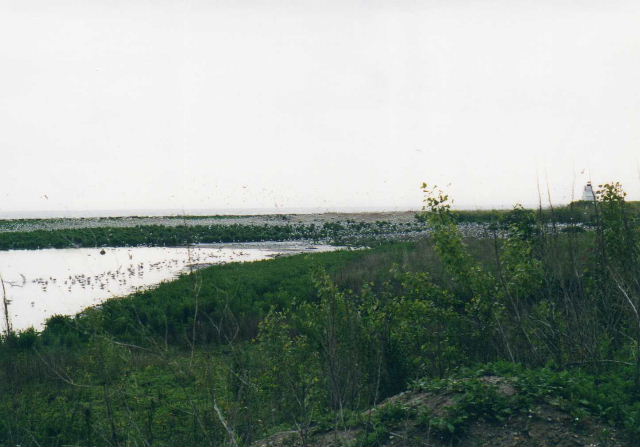
Gulls were everywhere. Most of them were Ring-bills (some with young), with about 200 Bonaparte’s mixed in. I saw at least one Herring, but I wasn’t looking very hard at the large gulls, so there were probably a lot more. I walked along the breakwater to the harbor mouth, stopping regularly to scan for Little Gulls. When I got to the far end, along the river, I could see the girls perhaps half a mile away sitting on a bench. They looked bored, and I began feeling guilty.

I started back, scanning as I went. I spotted a black-headed gull that seemed different than the many Bonaparte’s, and I soon was convinced it was a Little Gull. It was noticeably smaller and shorter-necked. The black hood came down further on the nape, so the black cut horizontally across the neck. It was walking on the mud right at the water’s edge. It was chased by a Bonaparte’s Gull and flew a short distance down the shore. I soon noticed three others, one with a black hood and two in winter plumage. They mostly walked along the shore, picking at the mud. They were often chased by Bonaparte’s. Several times they flew up and circled over the water in the north end of the impoundment. I saw one of the black-headed ones strutting with its neck extended. When they flew, I heard a piping “peepeepeep” call. All four were first-year birds.

Posted in Wildlife | Comments Off on Bird #376 — Little Gull

Bird #375 — Barred Owl

strix (screech owl) varia (variegated)

Friday, June 4, 1999 — 7:30 am

McHenry County, Illinois — Moraine Hills State Park

The only birds that breed in Northern Illinois that I hadn’t seen in my first 20 years of birding were the Eastern Screech-Owl and the Barred Owl. I’ve heard both of them on occasion, but never found one. Although this was disappointing, it had its good side. I knew that I could get a lifer anytime I went outside.

Today it happened. I got to Moraine Hills about 6:45 and walked the trail around the swamp. My major priority was exercise, and by 7:30 I had gone three-quarters of the way around. I saw a lot of birds and a very young fawn. I got to thinking about how good a place it is to bird.  But I thought that I had never seen a lifer there, and probably wouldn’t.

I was walking a stretch of path that is bordered on both sides by muddy ditches. There is a patch of scrubby woods on the east, beyond the ditch on that side. The ditch on the west side is a backwater of the Fox River, and is separated from the main channel by a muddy, wooded sheep pen.

And then I saw it. No fanfare. No suspense. No challenge. A Barred Owl was perched on a horizontal branch about 12 feet up in a small tree six feet off the path. It was in plain view and looking right at me. I knew what it was the moment I saw it. I didn’t think, “Hey, a big bird.  Hey, it’s a Barred Owl.”  I thought, “Hey, it’s a Barred Owl.” I stopped about 50 feet away, and we looked at each other. As I studied it and wrote down the markings, it studied me and occasionally blinked. It was an immature.

After about four minutes, it must have decided I was harmless. It closed its eyes and looked totally relaxed. I wanted to get a look at its back, so I walked quietly and steadily along the path, passing within 15 feet of the owl. It turned its head and watch me go by. I stopped about 30 feet on the other side, and it turned its head 180 degrees to look at me.

At this point, an old guy came jogging along the path. I looked away from the owl so he wouldn’t see what I was looking at. He said hello to me and jogged on past the owl without spotting it. It spotted him, however, and turned its head and stared intently as he passed. I walked back toward it and stopped just below, about 15 feet away. It stared at me for two or three minutes, bobbing its head slightly every few seconds. It then leaned forward and let out a stream of whitewash. Immediately after, it flapped off and landed clumsily on a thin branch in a small maple on the other side of the backwater. It was perched horizontally and bobbing its head a lot more. It still looked at me for several seconds, then turned its head and looked up. I soon saw why. An American Crow flew over and landed in the top of a nearby tree. The owl pivoted its head and watched intently.  The crow gave a few desultory calls and a second one showed up. I figured they saw the owl when I flushed it. I didn’t want to give it anything more to worry about, so I walked on down the trail. I heard the crows call a few times, but there was nothing like a full-scale mobbing.

Just before its short flight, it gave out a squeaky hiss. It repeated this sound during its flight and a few times on its new perch, spaced maybe 10 seconds apart.

Posted in Wildlife | Comments Off on Bird #375 — Barred Owl

Bird #374 — Neotropic Cormorant

phalacrocorax (from phalakros, bald, and kora, crow) brasilianus

Monday, May 17, 1999 — 12:05 pm

Barrington, Illinois — Crabtree Nature Center

This Neotropic Cormorant showed up on IBET. It was first reported last Thursday. This morning I saw it was still being reported on Sunday, so I told my friends I was going at lunch. One of them said, “Unless it’s raining.” I replied, “Unless it’s thundering, I’m going.” And then, ten minutes before we were going to leave, the skies opened and it poured.  I called and told the guys I was still going. As I was walking across the parking lot to my car, there was a big flash and a boom of thunder. We went anyway. The rain was acting like a typical summer shower, intense and brief, and it didn’t disappoint. By the time we had reached Crabtree, it had slowed to a drizzle, and as we started walking, it stopped.

We set up in the blind on Crabtree Lake and began scoping the mud flats.  On the left side, there were about 10 Double-crested Cormorants lined up. None of them looked small, so I shifted and looked at the flats on the right side of the island. I immediately saw a cormorant that looked considerably smaller than the first 10. It was pretty far away, but we saw enough to convince us.

It was standing on the mud, looking leisurely back and forth. Its head, neck and bill were slimmer and smaller than the Double-crested Cormorant’s. It was dark, with some dark brown plumage on the back and wings. Its throat pouch was much smaller than that on the Double-cresteds. It looked pale orange and came to a point below and behind the eye. I saw no white border on the pouch, but I wasn’t close enough to say for sure there wasn’t a thin, pale one that blended with the pouch. Its lores were black. While I was watching it, a Double-crested Cormorant was swimming back and forth in front of it, within a few feet. It gave me a great chance to compare the two species, and I could plainly see the larger, orange throat pouch that cut straight down from the bill and the yellow lores of the larger bird.

At one point, the Neotropic Cormorant bent forward and let loose a stream of white gush. As it did so, it cocked its tail upward, and I could see that it was proportionately quite a bit longer than the tail of the Double-cresteds. Apart from that exciting moment, it didn’t do much. It poked its bill into its wing feathers a couple times and briefly spread its wings a couple times. When it did this, I could get a good sense of how much smaller this bird was.

There was one odd thing. The bird had a distinct white collar around the neck near the base. I’m not sure if this was white feathering, or a bald spot, or maybe even a band, but at times I got the impression it didn’t go all the way around the neck. After we all got our fill, we walked the trail past Sulky Pond, but we didn’t see much else.

Posted in Wildlife | Comments Off on Bird #374 — Neotropic Cormorant

Bird #373 — Roseate Spoonbill

ajaia (Brazilian name for the bird) ajaja (ditto)

Tuesday, May 4, 1999 — 4:30 pm

Canaveral National Seashore, Florida

On Route 402, between the entrance booth and Playalinda Beach, visitors are only allowed to stop at occasional pullouts every quarter mile or so along the road. Since that was all I could do, that’s what I did. I pulled over at each one and scanned the area. For the most part, the pullouts were located by large patches of open water in the marshes. I was seeing Great Egrets, Snowy Egrets, Great Blue Herons and Tricolored Herons all over the place. They’re OK, but I was searching for better game.

Finally, at a pullout about half a mile from the ocean, I found what I was looking for. On a tiny grassy hammock about 50 yards from the road, I saw a ball of pink. I had my Roseate Spoonbill. It was standing motionless with its bill tucked into its back feathers, but there was no doubt about its identification. It had a white neck and chest, light pink wings and a bright pink shoulder. It looked up for just a moment and I saw its pale gray bill with a round, flat bulge at the tip.

A Brown Pelican was sleeping on another hummock, and a Tricolored Heron was fishing nearby. As I was watching the spoonbill, a car pulled up close behind me.  I looked in the mirror and saw another car had pulled up behind it. An officer climbed out of the third car and walked up to the second car. He told the driver he was going too fast for park roads and asked to see his license and registration.  This was all going on just a few feet behind where I sat with my window open. I felt a bit funny sitting there, so I drove on to the beach.

At 6:00 in the evening, I was driving west on 402, near where I had seen the Reddish Egret. I saw two spoonbills flying over the marsh, headed toward the ocean. The excitement had slackened by this time. It was too early to leave, and to late to go somewhere else, so I decided to take the Black Point Wildlife Drive again. I didn’t see much more than I saw the first time. In fact, the two trips were almost identical in terms of birds seen, although some clouds had moved in, the breeze had picked up and it was a stunningly beautiful evening in the low 70s.

At the pool where I had seen a bunch of stuff earlier, I saw a bunch of stuff again; 8 Red Knots, 34 American Avocets, 13 Black Skimmers, 2 Black-necked Stilts, 2 Mottled Ducks, 4 Short-billed Dowitchers, 3 Dunlins, several each of Greater Yellowlegs, Semipalmated Sandpipers, Black-bellied Plovers, Great Egrets, Snowy Egrets, Tricolored Herons, a White Ibis and a Roseate Spoonbill. I hung around the area for half an hour or so, drinking it all in. At the beginning, the spoonbill was standing near the edge of the pool with the egrets. Later, it waded out into the center of the pool and began sweeping the water with its bill, going back and forth with the bulge just under the surface. I was surprised at how small the spoonbill was when I saw it standing with the egrets. For some reason, I had the impression they were closer to crane size.

When I finished with the wildlife drive, I left the refuge. I stopped at a small park just east of the bridge over the Indian River and watched the gulls, terns and pelicans fishing in the river. The sun was setting purple and orange over the mainland and porpoises were chasing small fish just off shore. It was the perfect ending to a great day of birding.

Posted in Wildlife | Comments Off on Bird #373 — Roseate Spoonbill

Bird #372 — Florida Scrub-Jay

aphelocoma (from apheles, smooth, and kome, hair, “without crest”) coerulescens (blue)

Tuesday, May 4, 1999 — 4:00 pm

Merritt Island National Wildlife Refuge, Florida

I drove the Black Point Wildlife Drive, then headed for the Haulover Canal to see a manatee. I looked for twenty minutes without success. I drove back south on State Route 3. Just south of the bridge there was an inactive roadblock that is used to close off that part of the refuge before and during shuttle launches at Cape Canaveral (visible to the south). As I passed the booth, I saw two birds perched on the wires (visible as a tiny black dot in the photo) on the east side of the road. I saw enough to get me excited, so I cut onto a rutted dirt road that paralleled Route 3 and drove back. The area was very unattractive, with bushes and small trees up to 15 feet tall.

The two birds were Scrub-Jays. They were being blown about somewhat by the wind, but were otherwise inactive. After a few minutes, one disappeared into the nearby brush, followed shortly after by the other one. I saw their gray breasts, blue wings and long blue tails, and their overall jay shape, but I wasn’t satisfied. But the neat thing about the four lifers I saw this day is that I had multiple chances at all of them.

I turned east on Route 402 into Canaveral National Seashore. Immediately after passing the entrance booth, I passed a sign that read “Scrub Jay Nesting Area.” Moments later, a jay flew across the road right in front of the car and landed in a bush. Because of the proximity to the space station, stopping is illegal on that road, so I couldn’t pursue it. I spent the next hour or so near the ocean, then drove back on the same road. At about the same place where the jay had flown across, I saw a fourth one. This bird was standing in the grass right along the pavement. I couldn’t stop, but nobody was behind me so I slowed way down. I got a great look at its white throat and eye-brow and sturdy jay-like bill. The view only lasted a brief moment, but I got a perfect look from five feet away.

I had one more shot, still on Route 402, back on the refuge. But this time there was somebody behind me so, once again, I couldn’t stop. This last bird was also perched on the wire. The wind was blowing pretty hard and it was hanging almost, but not quite upside down with its tail pointing horizontally below the wire.

Posted in Wildlife | Comments Off on Bird #372 — Florida Scrub-Jay