Bird #471 — California Gnatcatcher

polioptila (from polios, gray, and ptilon, feather) californica (of California)

Thursday, February 19, 2015

Crystal Cove State Park — Orange County, California

This was one of my target birds for the trip. It’s an endangered species and can only be found in certain types of scrubby, dry, coastal habitats in Southern California — right where the ridiculous sprawl of Los Angeles consumes the landscape. It was my primary reason for going to the North Etiwanda Preserve on Wednesday morning, and when I struck out there, I figured I’d missed it.

It was approaching eleven o’clock. The beach down below was getting crowded with people. I had a long drive back to Ontario and a plane to catch. The path I was on paralleled the highway and curved downhill toward the parking lot. My birding adventure was almost over.

IMG_0505

Then I spotted a couple White-crowned sparrows in a bush on the edge of the bluff. As I was looking at them through my binoculars, I saw a smaller bird fly into the bush. It was a gnatcatcher, and it had a definite black crown. It could only be a California Gnatcatcher, but it wasn’t acting at all like a rare, endangered species.

IMG_0375

It’s the only gnatcatcher with a black cap found along the coast. But the defining characteristic is the underside of the tail — black with white tips to the feathers. I saw this clearly without question through my binoculars, but never got a better photo of it than what can be seen in this next shot. You can get a hint of the pattern if you enlarge the photo.

IMG_0374

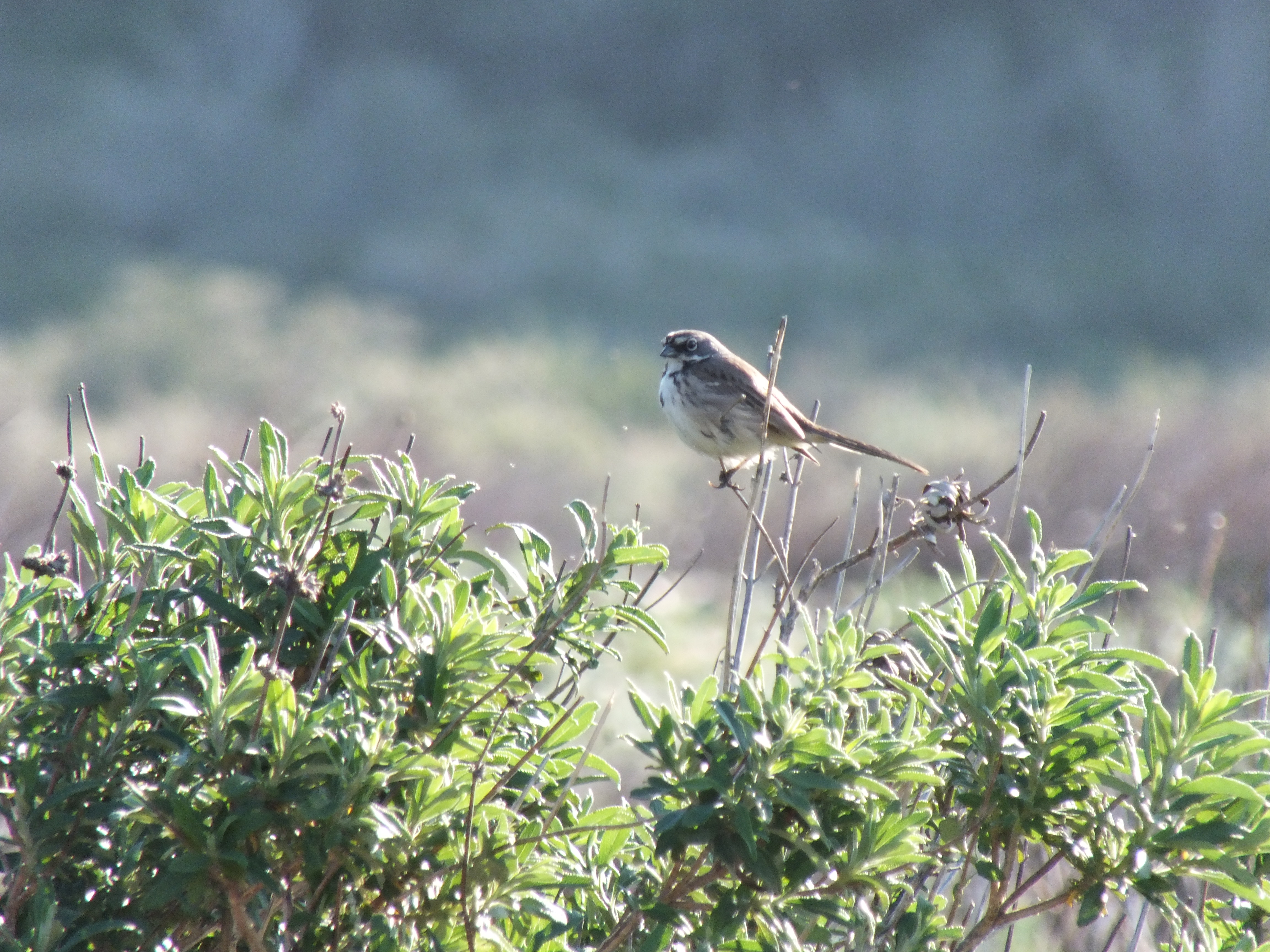
It flew off into the brush out of sight, but I could hear its cat-like calls from time to time. I continued down the path. About three minutes later, I spotted it and a female chasing each other through the bushes. They flew across the path into the narrow strip between the path and the road. For a minute, I thought they were building a nest there, but I think they were just collecting stuff for a nest elsewhere. The male popped up on a branch a few feet away and stayed just long enough for me to get one photo.

IMG_0385

The gnatcatchers were soon off again, chasing through the bushes on the ocean side. I soon lost sight of them, although I heard the call a couple more times.

Kinda funny how birding works sometimes. Spend a morning out in the wild looking for a bird where it is supposed to be, only to find it the next morning along a busy highway where it isn’t expected.

Posted in Wildlife | 2 Comments

Bird #470 — Allen’s Hummingbird

selasphorus (from selas, light, and phoros, bearing) sasin (origin not known) English name for Charles A. Allen, 19th-century California bird collector

Thursday, February 19, 2015

Crystal Cove State Park — Orange County, California

I had a mid-afternoon flight home. I wasn’t about to sit around my hotel for eight hours, so I decided to head for the coast to get in a few more hours of birding. Crystal Cove State Park, in Orange County, seemed like the best bet. I could avoid driving through the worst of the congestion and, while it would take me two hours to get there in morning traffic, it would only take an hour to get back at midday. And there were two lifers that were listed as common on the park bird list — California Quail and Wandering Tattler.

I parked near the Crystal Cove Beach Cottages and walked south along the beach for about a mile. It was high tide and in a few places there was very little room between the surf and the bluff. I was able to walk right up to several species of shorebirds, but saw no Tattlers. When I got to the end of the park, I could walk back the way I’d just come and, probably, see all the same birds, or I could climb the trail to the top of the bluff and walk back along the edge. I opted for the latter.

The morning had been foggy and gray, but by this time the sun was out and the view was spectacular.

IMG_0376

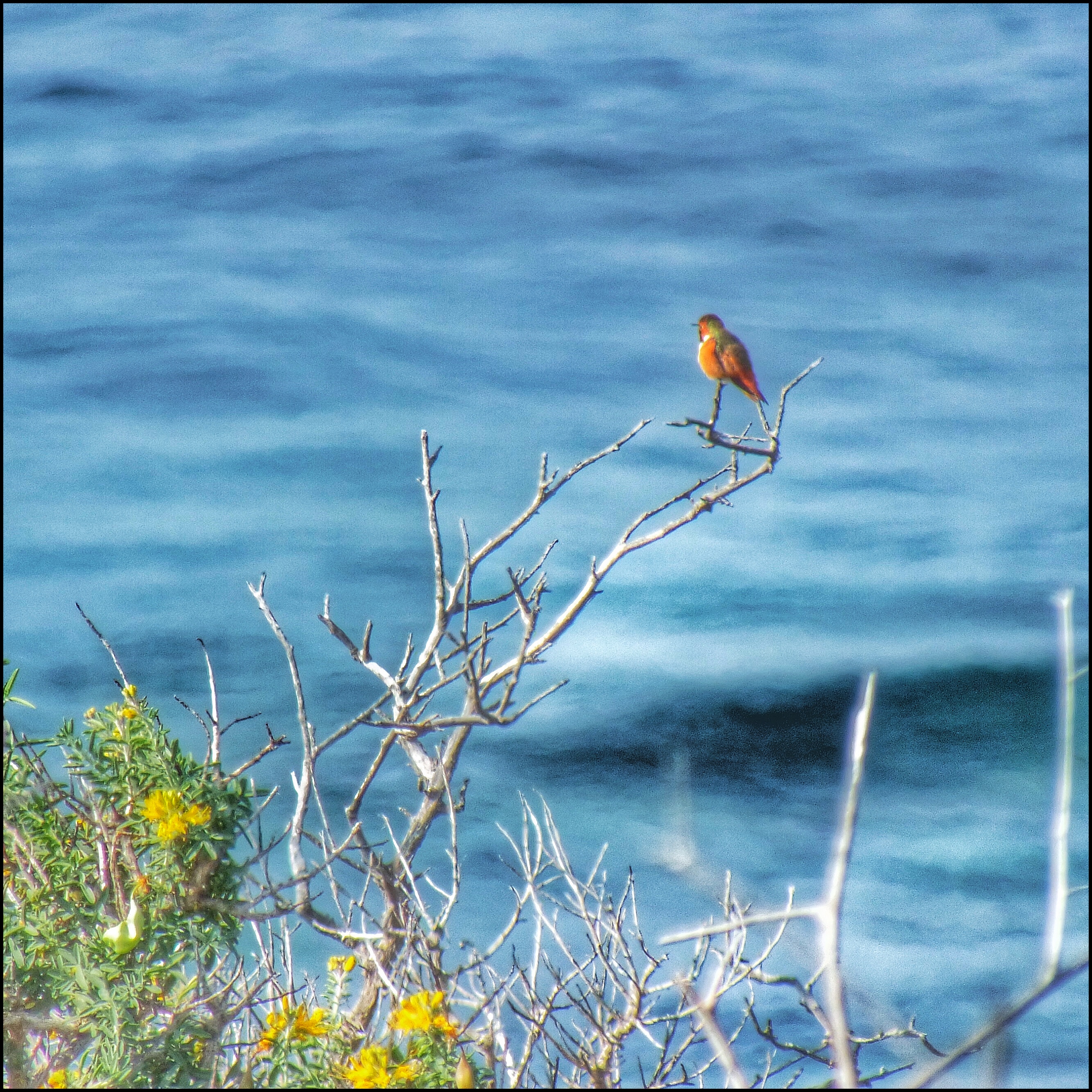
I’d been seeing Anna’s Hummingbirds everywhere I’d been birding, and I was seeing a lot of them here too. When I spotted a tiny bird in a bush right at the edge of the bluff, I assumed it was another Anna’s. It wasn’t. It was a male Allen’s Hummingbird. It perched cooperatively facing away from me while I got a good look, then turned around and gave me a good view from the front. It was about 20 yards away from the path and my camera kept focusing on the bush in front of it, so my photos aren’t very sharp.

IMG_0371

IMG_0372

It sat there for about five minutes. You can see it in the lower left corner of this photo I took of Brown Pelicans flying by.

IMG_0515

It’s a little embarrassing to admit that, after I identified it, I wasn’t sure if I’d seen one before. But a check of my list convinced me I had another, unexpected, lifer.

Posted in Wildlife | Comments Off on Bird #470 — Allen’s Hummingbird

Crystal Cove State Park

I had a late afternoon flight home on Thursday. (It turned out to be much later than I’d expected — I arrived home at 6:00 a.m. on Friday.) I had to find something to do in the morning, and I was pretty excited about my five lifers so far. I decided to do more birding. I contemplated driving back down to Santa Rosa Plateau, but that didn’t seem very exciting. I even considered driving two hours up into the mountains for a shot at a White-headed Woodpecker, but that seemed extreme. I decided on the coast, an hour and a half away (thanks to morning traffic) but only an hour back. I picked Crystal Cove State Park for two reasons — Wandering Tattler and California Quail. I didn’t see the first (it was peak high tide) and never got to a part of the park where I could expect to see the second.

I parked across the highway from Crystal Cove and walked through the small community of seaside cabins.

IMG_0466

IMG_0467

I wandered south along the beach for about a mile. In places, there was barely room to walk between the surf and the bluff.

IMG_0455

IMG_0465

IMG_0458

IMG_0468

There were birds about, and some good ones too. Here’s a Black Phoebe that was hawking insects on the side of the bluff.

IMG_0469

A Western Gull. It’s hard to find a place on the coast where you can’t see these.

IMG_0456

Heermann’s Gull, a Southern California specialty.

IMG_0479

Left to right: Black Turnstone, Sanderling, Willet and Black-bellied Plover

IMG_0457

A closer look at the Sanderling and Black Turnstone.

IMG_0459

Black-bellied Plover in winter plumage.

IMG_0478

A Whimbrel.

IMG_0480

And a Willet. I’m always amazed at how much tamer birds are on the coast than inland.

IMG_0502

Royal Terns.

IMG_0481

IMG_0477

IMG_0503

I walked a trail to the top of the bluff and briefly considered heading off to the inland part of the park. But distance and time convinced me that the wise course would be to head back. I saw a trail above the bluff and, luckily as it turned out, decided not to go back along the beach. The tide had gone out some, but not enough to expose the tide pools.

IMG_0504

IMG_0514

Anna’s Hummingbird. Sometimes you just get lucky and click the shutter at the right moment.

IMG_0511

A mile, and two unexpected lifers, later I was back at Crystal Cove.

IMG_0509

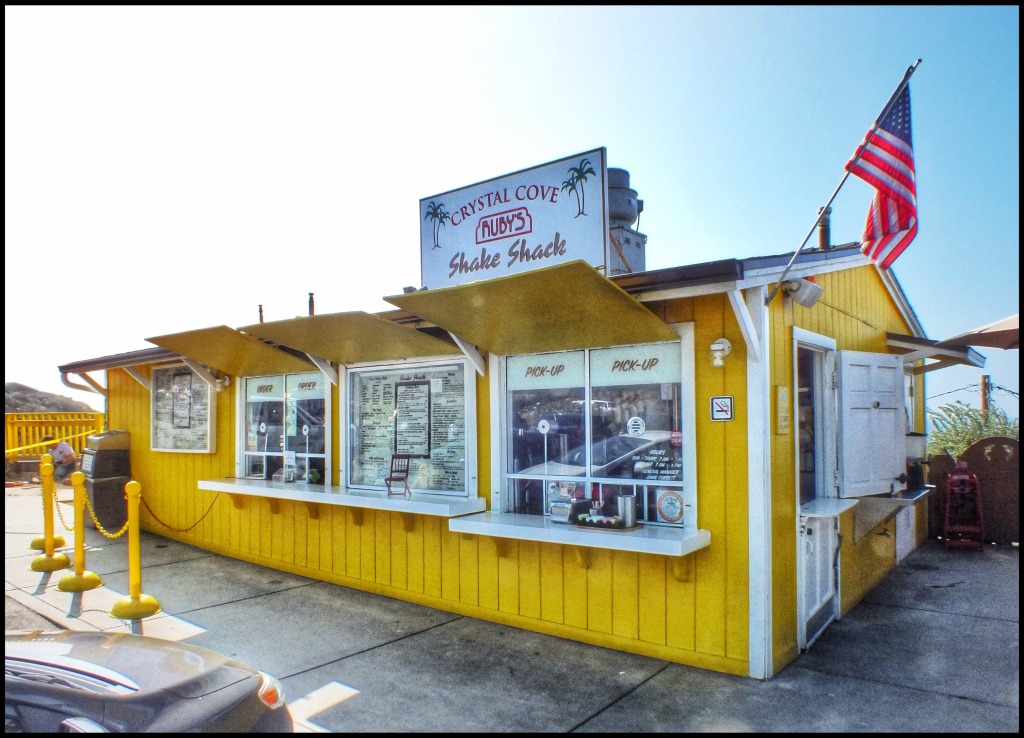
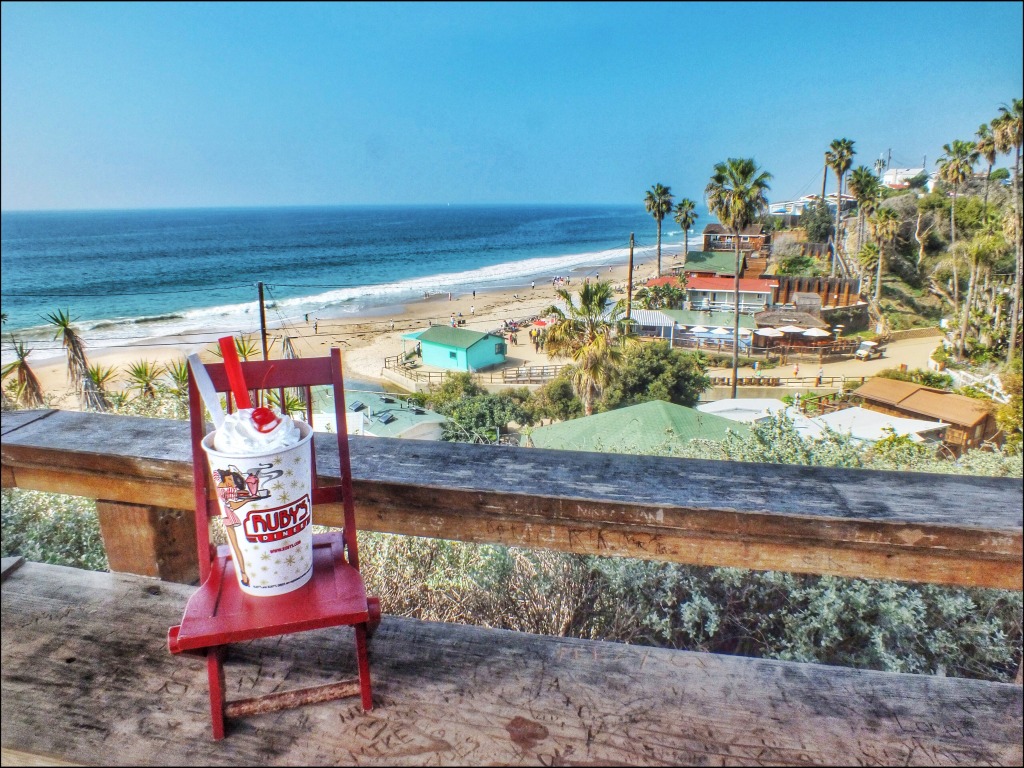
There’s a diner there called Rudy’s Shake Shack. It has an outdoor patio overlooking the ocean.

IMG_0339-1024x738

IMG_0337-1024x768

I got a cheeseburger and a dark chocolate shake which were awesome. But I probably wouldn’t have noticed even if they were awful. This was my view.

IMG_0510

IMG_0506

IMG_0508


Posted in California | Comments Off on Crystal Cove State Park

Bird #469 — Bell’s Sparrow

artemisiospiza (from artemisio, ?, and spiza, finch) belli (named for John G. Bell, a naturalist who was a friend of Audubon)

Wednesday, February 18, 2015

North Etiwanda Preserve in Rancho Cucamonga, California

This place had the essentials — it was close enough to Ontario to get there and back before I had to start working, and two would-be lifers are seen there regularly.

The Preserve consists of a large, rocky sage and brush-covered area at the base of the mountains north of Rancho Cucamonga.

IMG_0434

I arrived early and had the place to myself for the first twenty minutes. Other people — hikers, not birders — began showing up soon afterwards. But it never got crowded except on the side trail to a small waterfall.

I wasn’t there long before I spotted a Bell’s Sparrow singing in a small bush off the trail. I soon saw others, probably about 10 in total, some of which were very close and many of which were singing.

IMG_0369IMG_0367

IMG_0380

Posted in Wildlife | Comments Off on Bird #469 — Bell’s Sparrow

North Etiwanda Preserve

Like Santa Rosa Plateau, North Etiwanda Preserve had the advantage of being close enough to get to easily while offering the possibility of lifers. I saw one, and for much of the time I was there, had a good time. The last mile or so was a bit bleak and hot.

IMG_0492

I was the first visitor of the morning and had the place to myself for a while. The preserve is a wedge of rising field sandwiched between the city of Rancho Cucamonga and the mountains.

IMG_0434

The trail was rocky and shade was non-existent, but it was only about 60° when I arrived. Looking west across the sprawl of Los Angeles suburbs.

IMG_0435

IMG_0436

In attempt to make items of historical interest out of junk, there were several signboards giving details on past efforts to get water from the mountains. Remains of pipes and pumps and whatnot were scattered about here and there.

IMG_0437

IMG_0438

This chimney is all that remains from a house that was here at some point.

IMG_0444

Another view of the house from a point further up the slope, with Rancho Cucamonga peaking through the smog.

IMG_0447

A side trail — that turned out to be quite a bit longer than I’d expected — promised a view of a waterfall.

IMG_0489

IMG_0446

And indeed, there was a waterfall, which I expect is quite nice by California desert standards. Ninety percent of the people I saw on the preserve were on the trail to the falls. I only stayed long enough to take this photo because I was still hoping to see another lifer.

IMG_0449

When I got back to the main trail, it was warming up. I soon entered an area where a fire had consumed all the sage and other scrub not long before and the landscape was unattractive and the birds scarce.

IMG_0445

IMG_0487

On a knoll, I found a photo labeling the various geographical features that would be visible if not for the ever-present smog. When it was clear enough to take the photos on the sign, I have no idea.

IMG_0490

The white ridge of rocks cutting across the center of this photo marks an earthquake fault.

IMG_0488

One thing I took away from here — I would not want to be out on those shadeless flats when it was any hotter than it was on this day.

Posted in California | Comments Off on North Etiwanda Preserve