Walk to Wisconsin (chapter three)

I didn’t stay long at McDonald’s — perhaps 15 minutes. I noticed that while I was sitting there, I wasn’t getting any closer to my goal, and I had decided to press on. I stopped at a nearby Jewel and bought a bottle of water and a package of cookies. I picked up the trail again and headed north.

The north side of McHenry is growing quickly. I thought this photo captured the nature of the area well. A dirt farm field, then a housing development, then a silo. That silo belongs to a farm that has gotten smaller and smaller. It is now sandwiched between a big box store and the houses. There’s probably two acres of farm left, with a muddy pasture with three cows — smack in the middle of suburbia.

The path took me past McCullom Lake, where I’ve been birding many times. Although it’s surrounded by residential area, it is often filled with ducks, grebes, and loons in the spring.

I was near McCullom Lake when two older folks, probably in their late 60’s or early 70’s, biked by in the other direction. They both wore bright blue T-shirts that said “Safety Watch” on the front and back. I know I felt much safer.

I was now out in the country again. The sun was out, and I was hot and still sore. Lunch hadn’t really rejuvenated me to any noticeable degree. The path stretched ruler straight up this long, long hill.

To my total surprise, when I got to the top of the hill, I got a second wind. My feet still hurt, but my hip decided it might as well get with the program and stop hurting. After another two miles through scenery that looked just like that in the shot above (just downhill) and I arrived at Well #8 Buffalo Box (whatever that means?).

When I got to Ringwood, I knew I’d make it the whole way. To celebrate, I pulled out the cookies I purchased in McHenry and compared the actual product with the picture on the package. (I also ate one of them.)

I can see why they don't put a picture of the actual product on the package.

The thrilling town of Ringwood hasn’t painted its name on its water tower. I did manage to find the town name in front of the tower.

I decided this wasn’t good enough and that I was the one to do something about it. I borrowed a Sharpie, climbed the tower and made things right. (Unfortunately, I made a slight spelling error and Sharpies have indelible ink.)

North of Ringwood, the path surface changed from blacktop to crushed gravel.

For some strange reason, the powers that be decided to start the mile numbering all over again. The kid in the black shirt, also visible in the above photo, was behaving oddly. He didn’t look at all the sort to be walking a hiking trail, and he kept looking back over his shoulder at me. He was in no hurry, and I kept getting closer and closer. The path along this stretch runs through woods, and there was nobody else around.

Just before I caught up with him, he stopped alongside the trail and pretended like he was tying his shoes. He didn’t so much as glance at me as I walked by. A few moments after I went by, he started walking behind me. This made me rather nervous, but he didn’t walk any faster that he’d been doing all along, and I soon lost sight of him.

The path ran through Glacial Park, a huge McHenry County forest preserve. I’ve birded there many, many times, but I don’t get there as often as I’d like to because it’s so far from home. And now I’d walked there. The sky was clouding over quickly, and I felt a few raindrops as I crossed the prairie.

It was raining hard when I crossed the bridge over Nippersink Creek, but under the trees, the mosquitoes were out in force. What remained of my second wind was gone by this time.

Here’s the creek as seen from the bridge.

The longest I’d ever walked in a single day was 21.1 miles — around Lake Geneva. It was somewhere in Glacial Park that I passed that mark. Tune in tomorrow for the final chapter of my saga.

Posted in Stories | 2 Comments

Walk to Wisconsin (chapter two)

When yesterday’s post ended, I was a little north of Crystal Lake. For the next three or four miles, the trail runs alongside a huge sod farm. Although this pan makes the trail look curved, it runs as straight as an arrow for this entire stretch.

Obviously, one of their employees didn’t get the word about “green side up.”

Every half mile, a marker was embedded in the trail to remind me how little progress I was making.

As I entered McHenry, the trail ran alongside backyards and vegetable gardens.

In a small marshy area in the middle of McHenry, I spotted this deer. It was only 15 feet or so off the path, but almost hidden in the reeds. We stared at each other for a couple minutes, and then she decided to take off.

When I took the water tower photo, I was pretty close to halfway done with my walk.

Here’s a closeup of the top of the water tower. As I walked by, one of the guys was shouting like he was pretending he was falling off.

I walked past the Metra coach storage area. Shortly after I took this shot, I passed the woman in the pink shirt up ahead. She jumped when I went by and said, “I didn’t know anybody could be quiet enough to sneak up on me.”

It was now 12:10. I’d walked for four hours without a break and I’d gone about 15.5 miles. And I was tired. All of the walking I’d done so far was on a blacktop surface. My feet hurt and my right hip was killing me. I seriously considered calling my wife and asking her to come pick me up. After all, it wasn’t like I’d trained for this.

Then I thought about how far I’d come and the rather uninteresting terrain I’d passed. I knew I’d very likely never want to make the effort again. I decided to find somewhere to eat lunch before I made up my mind.

When I came to Route 120 in McHenry, I stood and looked over my options. To the right, there was an I-Hop, a Tommy’s Red Hots and a Taco Bell. To the left, there was Burrito City, Pizza Hut, McDonald’s and Burger King. I opted for McDonald’s. Say what you will  … it’s better walking food than a burrito.

Route 120 in McHenry

I bought a Big N Tasty with cheese, a large fries (for the salt), and a large Diet Coke. According to the message on my cup, I made the right choice.

As I ate, a gentleman with a yellow jumpsuit and rather startling red hair asked if he could get his picture taken with me because he’d heard about my walk and knew I would soon be famous. I wasn’t that thrilled about it, as you can see, but I reluctantly agreed.

Come back tomorrow for chapter three.

Posted in Stories | 3 Comments

Walk to Wisconsin (chapter one)

On the Saturday before Memorial Day, I woke up with an urge to do something I hadn’t done before. The weather forecast was for a high in the low 70’s with increasing cloudiness and a 20% chance of afternoon rain. That seemed like something I could deal with, so I walked to Wisconsin.

I left home at 8:10 in the morning with a bottle of water and some trail mix. This is Lake Killarney. I’d walked about three miles at this point.

Lake Killarney

Last month, when I asked for ideas of things to photograph near home, one friend suggested water towers with town names on them. I decided to log today’s walk with water towers. Here’s the first — Crystal Lake.

Approaching Crystal Lake

My route ran along a busy commercial route for a couple miles. That’s where I spotted this herd of bears. I always wonder about things like this. Are there really people who drive somewhere and suddenly say, “Hey, look! Wooden bears. Let’s go buy one”?

I passed the Palmer House, about which I know nothing more than you do.

Palmer House

Instead of taking the shortest route, I headed west to the McHenry County Bike Path — because miles walked on that path count towards the Century Hiking Club and because a path is a more pleasant place to walk than a roadside. I picked up the path near downtown Crystal Lake. I’d walked almost exactly eight miles at that point and had been walking for almost exactly two hours.

Stearn's Woods

The path runs through Stearns Woods for a couple miles. This is a Crystal Lake forest preserve, and it’s by far the hilliest section of the entire trail. Four or five years ago, I had a near-maiming and dismemberment here. I had just purchased a new bike and was riding it for maybe the second time. I came whipping down this very hill (below) and around this very bend to discover a family with about six kids standing across the entire path just staring at me. Not one of them moved. I had three choices:

  1. Smash through the middle of them.
  2. Slam on my brakes and wipe out on the asphalt.
  3. Veer off the path into the woods.

Option one was the most inviting, but I decided on a combination of 2 and 3. I went off the path onto that very narrow strip of gravel, skidded, missed a tree by a fraction of an inch and somehow bounced back up onto the path. Both feet had been jarred off the pedals. I wobbled back and forth for a little ways and finally recovered. I turned back to look at the family. They were still standing in the same spot, staring vacantly at me as though I were a show put on for their amusement and not a very good one, at that.

Stearn's Woods

This is what passes for a forest preserve in these parts.

Stearn's Woods scenery (?)

North of Crystal Lake, the tail runs alongside an active train track. The brochure says it is “one of the country’s longest trails along an active rail corridor.” I’m not at all sure why that’s an accomplishment. For much of the way, a fence with two strands of barbed wire runs between the track and the trail. I’m guessing some bicyclist complained, because every few miles there’s a sign on the fence that says, “barb wire strands required by railroad.”

As for being “active,” the only traffic I saw on the tracks during my seven hours on the trail was a pickup truck.

This was one of several places where the barbed wire fence (required by the railroad) stopped and the trail ran right next to the tracks. You can see the fence starting up again behind the purple Ds.

I was about 10.5 miles from home at this point.

Tune in tomorrow for chapter two.

Posted in Stories | 4 Comments

Learning About Art — Part Three

I have discovered that I have little to no interest in art created prior to the Renaissance. With that in mind, I’ve decided to list the major art movements/periods that have taken place since that time and attempt to explain them in my own words, as I understand them.

Renaissance — From the end of the Roman Empire until the 1400s, artists were consumed with thoughts of God, heaven and hell. Secular art was considered pagan. This might seem like a good thing at first, but most people’s view of God during this time was determined by the Catholic Church, and men had certainly lost sight of grace. The Renaissance was a return to the culture of the Greek and Romans, with an emphasis on humanity. Artists discovered perspective and were able to give depth to their paintings. Figures were drawn heroically, with muscles. Michelangelo and de Vinci are the most famous artists from this period.

Gothic — As the Renaissance progressed, artists quit trying to emulate the Greeks and Romans. People were drawn to look naturally, the first time this was really accomplished. Culture focused on the individual, which resulted in a demand for portraits.

Mannerism — Now (middle and late 1500s) that the rules of perspective and composition were widely known, artists began breaking them. Proportions were exaggerated and perspective was distorted.

Baroque — At root, this was the Catholic Church’s response to the Renaissance. The church used dramatic art to attract people back to its folds. Protestant countries used the same heroic style to promote patriotism. Rubens, Rembrandt and Vermeer painted during this period.

Rococo —  In the 1700s, the Baroque style went loco. Artist used bright colors, gold filigree and a lot of sensuality. In England, the period was a little more sedate, as can be seen in the paintings of Gainsborough and Reynolds.

Neoclassical — The philosophers of the Enlightenment pushed man’s reason as the way out of the wars, injustice and poverty of their day. This was reflected in art that was created to teach, with a simplicity that deliberately countered the excess of Rococo.

Romanticism —  Artists in this period were concerned about teaching their viewers to care about their fellow men. Paintings showed injustice against the weak or poor. Philosophers thought man was good at heart but that society was evil. They pushed the idea of the “noble savage,” and artists followed. Goya’s paintings fall in this category.

Realism — As the name implies, artists in this period painted life as they saw it — the common laborer, the view out their back door. Winslow Homer is an example.

Impressionism — This term began as in insult but was adopted by the artists themselves. They weren’t worried about the details of their subjects, just the general impression. They used quick brushstrokes that gave paintings a blurred, unfinished look. They concentrated more on how the light fell on the scene than on the scene itself. Monet and Renoir are famous Impressionists.

Post-Impressionism — Since the Impressionists broke the rules of color, form and subject, the Post-impressionists took it to the next level. Instead of painting with thick brushstrokes, they painted with tiny dots or reduced their subjects to elemental shapes. Gauguin and van Gogh were Post-impressionists.

Cubism — Cubism attempts to show all sides of an object at the same time. Images are broken down into abstract shapes. Picasso is the best know Cubist.

Futurism — An attempt to incorporate speed, or at least the essence of speed into painting and sculpture. They also tried to blend humans with the environment to show the interaction of the two.

Dadaism — A deliberate attempt to create art that rejects all styles and programs that existed up to that point.

Surrealism — An attempt to create art from the subconscious alone. Think Salvador Dali.

Abstract Expressionism — From drawing the subconscious, the next logical step is to draw from the unconscious. Jackson Pollock is the most famous artist in this movement. He once said, “When I am in my painting, I’m not aware of what I’m doing. It is only after a sort of ‘get acquainted’ period that I see what I have been about.”

Pop Art — Andy Warhol pioneered the effort to combine art with culture, advertising and money-making.

And that’s where I am in my current studies. I actually understand a little of what I’m talking about, although I probably haven’t explained it very well. And I probably couldn’t look at a painting and identify which period it came from. But there’s this — even though I haven’t really begun to study individual paintings yet, I already have gained an appreciation for (some) art that I never had before.

Isn’t this exciting? Stay tuned.

Posted in Miscellaneous | Comments Off on Learning About Art — Part Three

Learning About Art — Part Two

I have not been idle in my ongoing quest to become educated, artwise. I’ve continued reading Art History for Dummies and have made it into the twentieth century.

I have also purchased my own copy of 1001 Paintings You Must See Before You Die, by Stephen Farthing. Say what you will about determining a set number of good paintings and I will agree with you. It turns out that the author agrees too — that’s why he lists 1,001 and not just 1,000 — to indicate that the list goes on. But I figured (correctly) that most of the really famous artists and paintings would be included and thought this would be the easiest way to make my way through them. I’ve decided not to read about more than six paintings each time I pick up the book so that I have some chance of keeping them distinct from each other. Occasionally, when I get to a painting that I find appealing or interesting, I’ll blog about it. I fully realize that the only way to view a painting is in person, but that’s not going to happen. Even if I had the financial resources to visit museums all over the world, that’s not how I’d choose to spend my money. So what I will do is, when I find an interesting painting in the book, I’ll look on the Internet or in books for the best reproduction of it I can find.

I’ve also had several fascinating conversations about art with artistic friends and have come to a few conclusions:

  • Art is subjective.  I’m not required to like any work, no matter the consensus of the experts.
  • Art does not have value in and of itself. It’s value comes from the impact it has on the artist and the viewer. But I haven’t totally settled in my mind what the impact should be which leads me to my next point …
  • Many people believe that, to be art, a work must create a response in the viewer — change him in some way. They believe that if it doesn’t do this, it isn’t art but simply decoration. I’m not sure I agree. I think God created some things purely for our enjoyment and gave us the ability to do the same for others. I hesitate to devalue something because its appeal is aesthetic.
  • As someone with a biblical perspective, I have the right, and even more the obligation, to reject art that is disrespectful toward God or His creation, including humanity. Evil might be art, but it’s bad art.
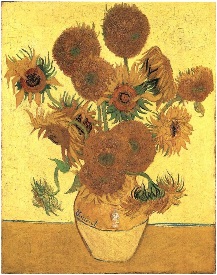
  • And, on a lesser note, I believe that many of the most valuable works of art are such because of the fame of the artist or the work and not because of the appeal of the piece itself. Van Gogh’s Still Life: Vase with Fifteen Sunflowers is, in my opinion, a classic example. It sold, in 1987, for almost $40 million. (And many experts think it’s a forgery!) Personally, I wouldn’t hang it in my house, or even in my garage. What do you think?

Posted in Miscellaneous | Comments Off on Learning About Art — Part Two