
Where did Nevil Shute get the name for the device created to break through the Atlantic Wall? It seems that a British actor named Charles Macklin, back in 1755, was bragging that he could recite any paragraph from memory after seeing it once. His buddy, poet Samuel Foote, decided to test his skills. He wrote a poem titled The Great Panjandrum and showed it to Macklin. Here it is.
So she went into the garden
to cut a cabbage-leaf
to make an apple-pie;
and at the same time
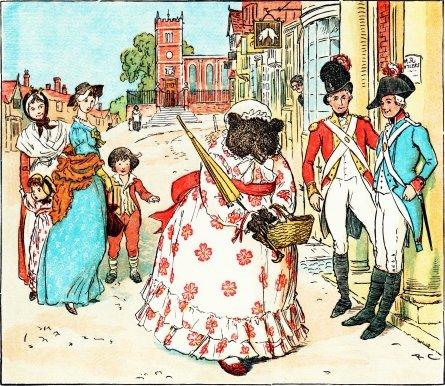
a great she-bear, coming down the street,
pops its head into the shop.
What! no soap?
So he died,
and she very imprudently married the Barber:
and there were present
the Picninnies,
and the Joblillies,
and the Garyulies,
and the great Panjandrum himself,
with the little round button at top;
and they all fell to playing the game of catch-as-catch-can,
till the gunpowder ran out at the heels of their boots
Nobody thought to record whether Macklin passed the test.
The poem has given a word to the English language — Panjandrum: a very important person: an important or influential (and often overbearing) person.
The poem also became very popular with teachers who wanted to give their students memory exercises and was included in many books of children’s rhymes. Here’s a picture of the great she-bear from one of those books.
The rest of the illustrations can be found here.