
I wasn’t able to find much information about this painting on the Internet, but I did find several places where you can buy it as a poster. It is a fresco, painted around 1457 on the wall of the Santo Stefano Cathedral in Prato, Italy. The artist was Fra Filippo Lippi.
Lippi was abandoned by his parents as an infant, raised in a friary and ordained as a friar. His art gained him the attention of the Medici family and the pope, but he fell out of favor when he had an affair with Lucretia Buti, a nun. She became pregnant, and they may have married. Rumor has it that Lippi may have died from poisoning at the hand of relatives of another woman he had a fling with.
Anyway, this painting is from a series known as “Scenes from the Life of St. John the Baptist,” although I’m not sure life is the appropriate word in this case.
You know the history — Herod was living with his brother’s wife, Herodias. John told Herod he was living in sin. Herodias didn’t care for this and forced her husband to throw John in prison. She wanted him killed, but Herod was afraid to do anything because John was a prophet and beside, he kinda liked the guy. Then Herod threw a birthday party for himself and the local bigshots. His daughter-in-law, Salome, danced as part of the entertainment, and Herod, in a moment of rashness, promised the girl she could have anything she wanted, up to half his kingdom. Prompted by her mother, the girl asked for John’s head on a platter. And so it was done.
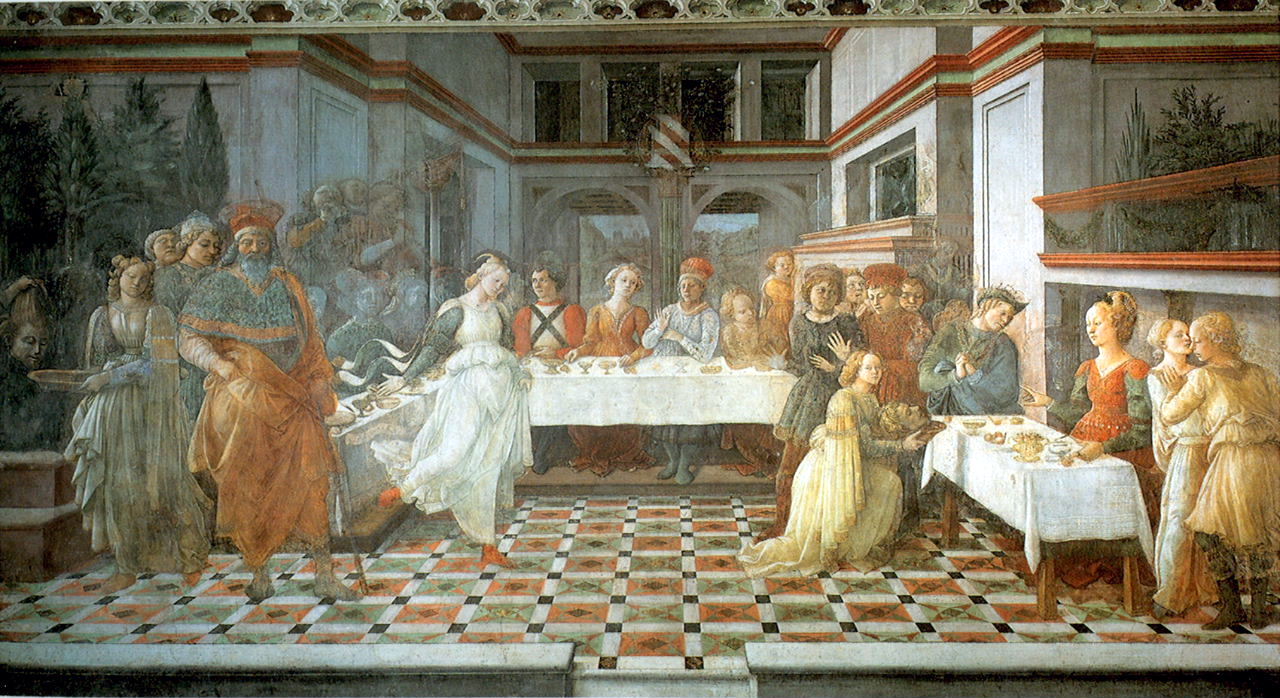
I suspect that’s Herodias on the right, looking at the head with unfeigned malice. Herod is on the left, looking stern. Salome is still dancing in the center of the room. She’s usually pictured as a seductress, but Lippi shows her as downcast and, perhaps, in mourning for what she has done. Salome is a portrait of Lucretia Buti, Lippi’s girlfriend/wife, which says something or other about something or other. Apparently, John had two heads (there’s a second one on the extreme left). Either that, or Herod was throwing a beheading party.
I just read something about this. I think the reason there are two heads is because this painting was painted during the relatively early years of the Renaissance period, and Lippi was merely holding onto the previous era’s art standards. From my limited understanding, before the Renaissance, artists would often combine a number of different moments in the same composition where one part of a scene represented one stage of action, while another part of the same scene represented a later stage.