
elanoides forficatus
Kelso, Arkansas — Baxter Road
Sunday, August 28, 2022 — 11:14 am
I woke up late on this Sunday, expecting to spend another day sitting around the cabin in London, watching Magnum P.I. reruns and reading while we wait to take occupancy of our house. I saw that a few Swall0w-tailed Kites were being seen regularly in Desha County, almost three hours to the southeast. That’s a long drive, but it would be a lifer and a bird I’ve long wanted to see. And I had nothing but time.
I took off around 8:00 and arrived at the location in a storm. The rain came down fairly heavy for maybe 20 minutes, and then it got very humid. The eBird reports said that the birds had been seen over a soybean field at the corner of Routes 1 and 138. I stood at that corner and watched for maybe 20 minutes but saw no raptors of any kind. Then, above a row of trees off to the east, I saw … something. I got to wondering if perhaps the kites had chosen a different field to fly over today.
I found a narrow side road nearby and headed east. I’d gone maybe half a mile when I came to a large sign stating that, from that point on, it was a private road and violators would be prosecuted. I was about to turn around when I noticed a large bird flying off to the north. I grabbed my binoculars and knew immediately that I had my lifer. There were two Swallow-tailed Kites circling above the field and the row of trees. I had a hard time finding them in my camera but managed one shot that is barely good enough to prove I really saw them.
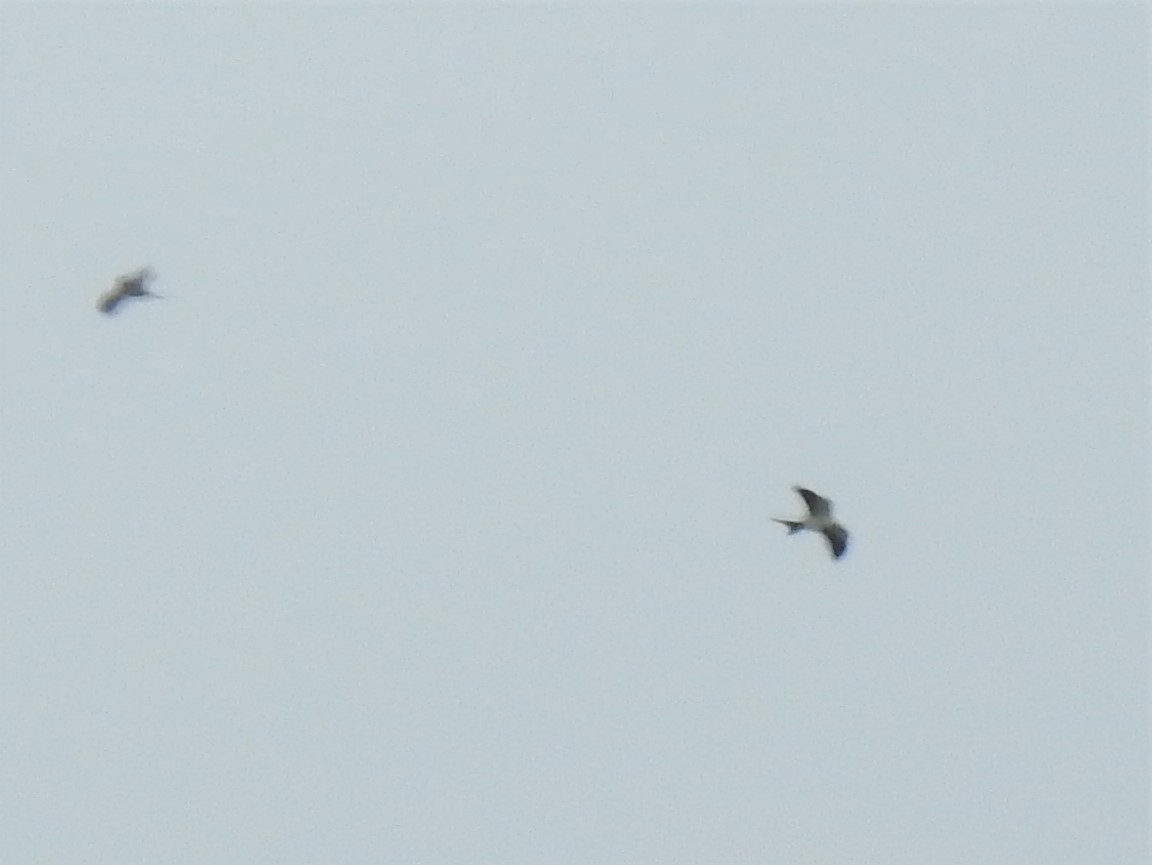
They seemed to be heading further north, so I drove back to Route 1 and looked for another road to drive down. I tried two, one of which ended in somebody’s driveway and another that kept getting muddier and muddier. I decided it would be wise not to go further. I got one last glimpse of the kites high up and further east — I’m guess they foraged near the Mississippi River this day. I hung around the area for another 45 minutes or so and saw several Mississippi Kites, but that was it for the Swallow-tails.
They were quite a bit bigger than Mississippi Kites, with long forked tails. They were pure white on the leading edge of the wings and on the belly and black on the trailing edge of the wings and on the tail. They were circling for altitude when I saw them, and tilting from side to side.
It certainly wasn’t the view I was hoping for, but I saw enough to know they are stunningly beautiful birds, and I want to see them better.