
The most famous work of art in the world was painted in 1503 by Leonardo da Vinci, who was born in a Tuscan village, moved to Florence, Italy and developed into the quintessential Renaissance man. The painting wasn’t called Mona (Madam) Lisa until the 1800s. The Italian title (La Gioconda) and French name (La Joconde) both mean “the playful one.”
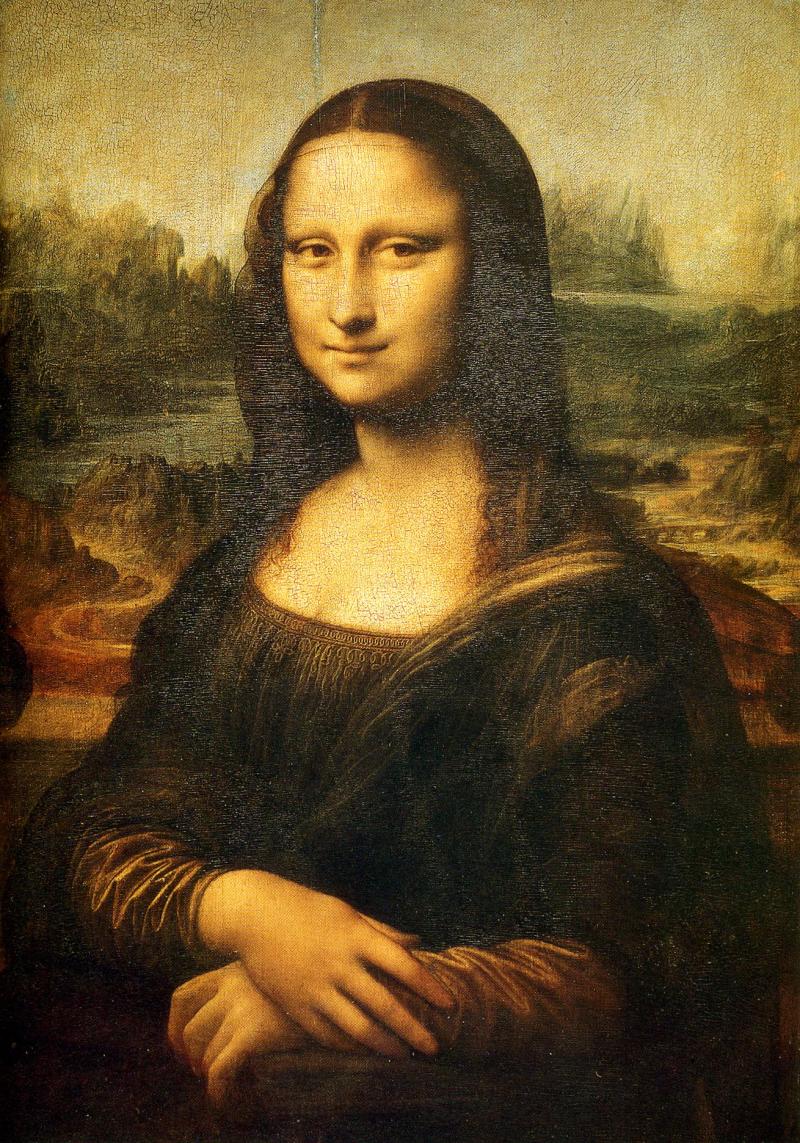
Lisa Gherardini married Francesco del Giocondo, a silk merchant in Florence when she was 16. When her portrait was done, she was 24 and had two sons.
The painting drew attention immediately, in part because de Vinci pioneered several techniques, including:
- contrapposto — positioning a figure so that the body above the waist is twisted on a different axis from the lower body.
- sfumato — applying several layers of translucent paint to create an appearance of depth
- chiaroscuro — contrasting light and dark in painting
- pyramidal composition — arranging the subject of a painting in a geometrical shape
It was also among the first portraits to be placed in front of an imaginary landscape.
Part of its fame also comes from its history.
- It was owned by Francois I, a French king.
- It hung in Napoleon’s bedroom in the Tuileries.
- In 1911, it was stolen by an Italian carpenter named Vincenzo Peruggia who worked in the Louve. It was recovered two years later when the thief tried to sell it to an Italian antiques dealer. His motive, he claimed, was simply to return the painting to Italy.
- In 1956, a Bolivian named Ugo Ungaza Villegas threw a rock at it and made a small dent near Lisa’s left elbow.
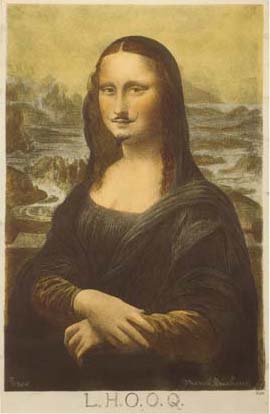
- The most famous work by Dadaist, Marcel Duchamp, is a cheap copy of the Mona Lisa with a beard and mustache.
I appreciate the painting (the original, not Duchamp’s) more after having studied it, but I’ve never found it particularly moving. I always thought Lisa was a bit strange looking and I just realized why — she has no eyebrows. It’s not known whether she plucked them as a fashion statement, or if they were erased during an early restoration.