Where to See a Magpie

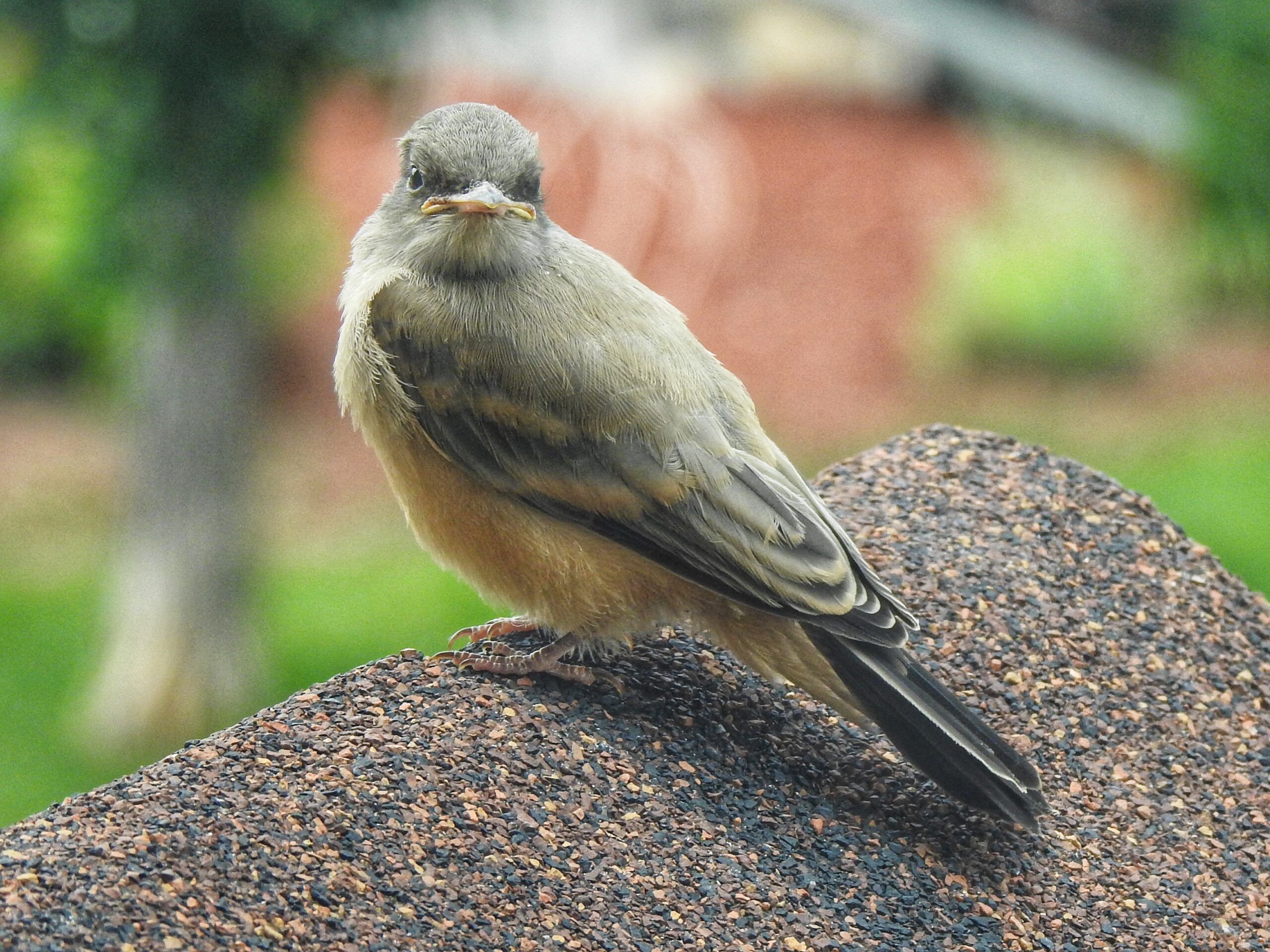
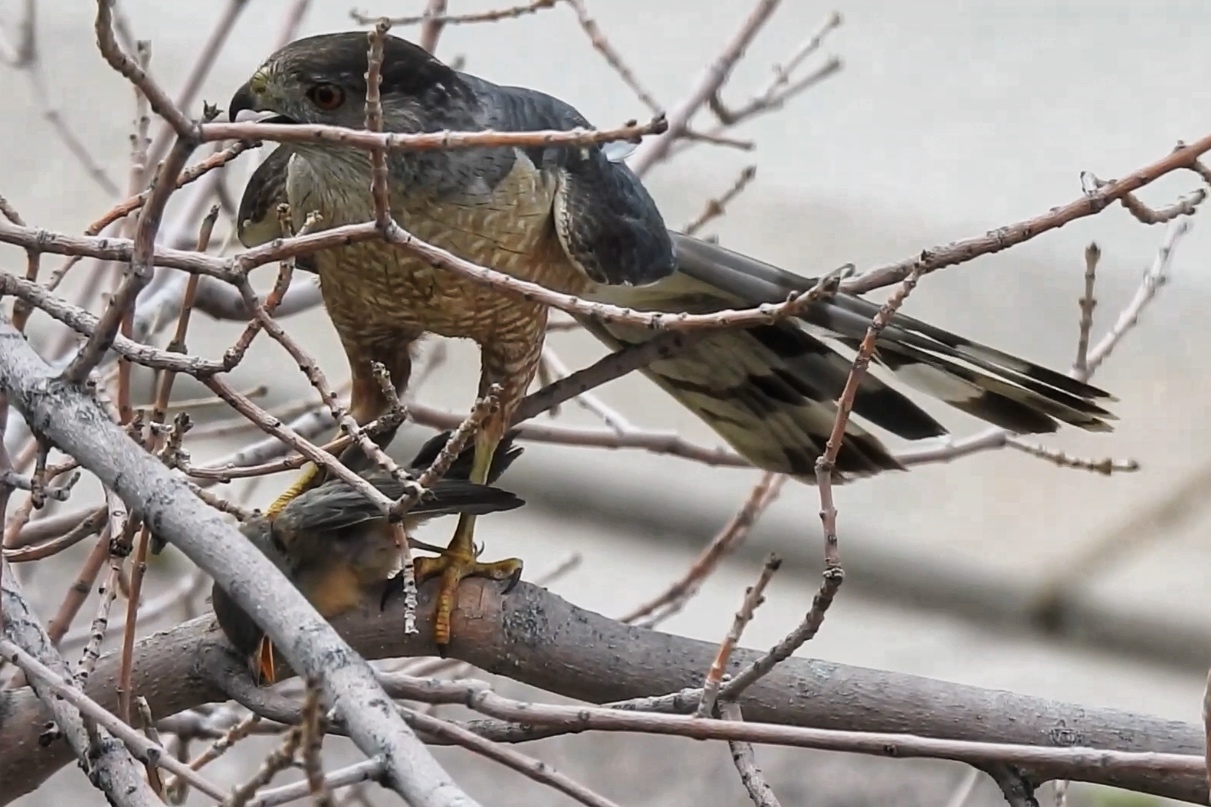
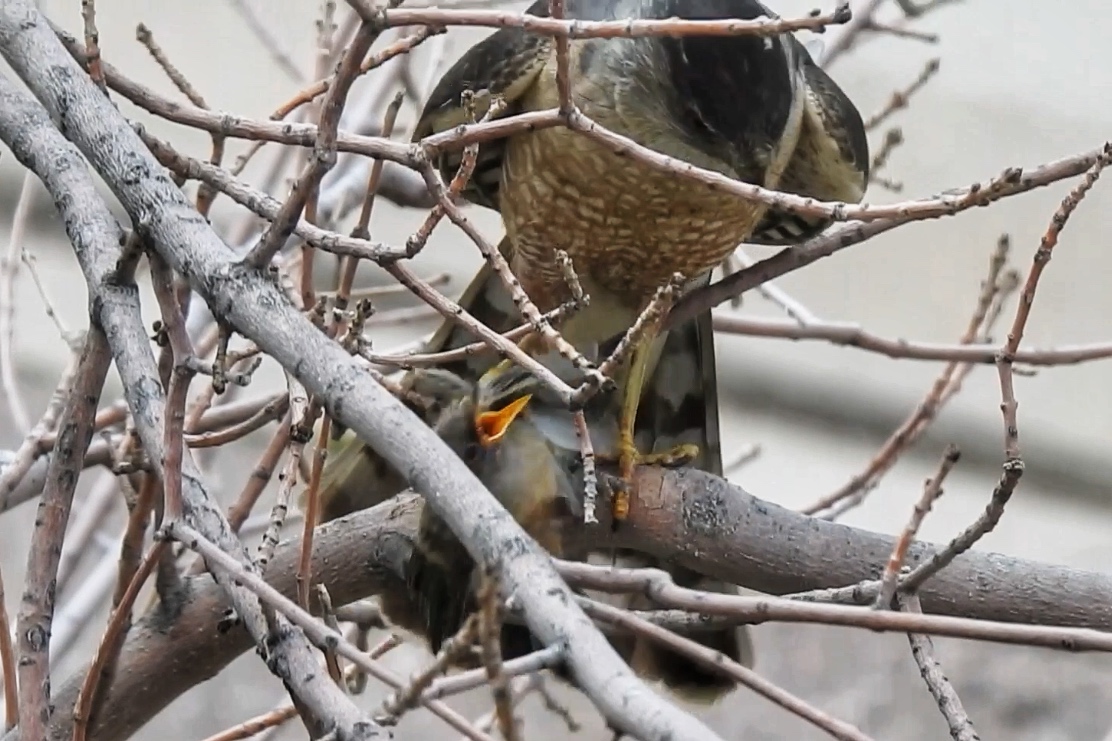
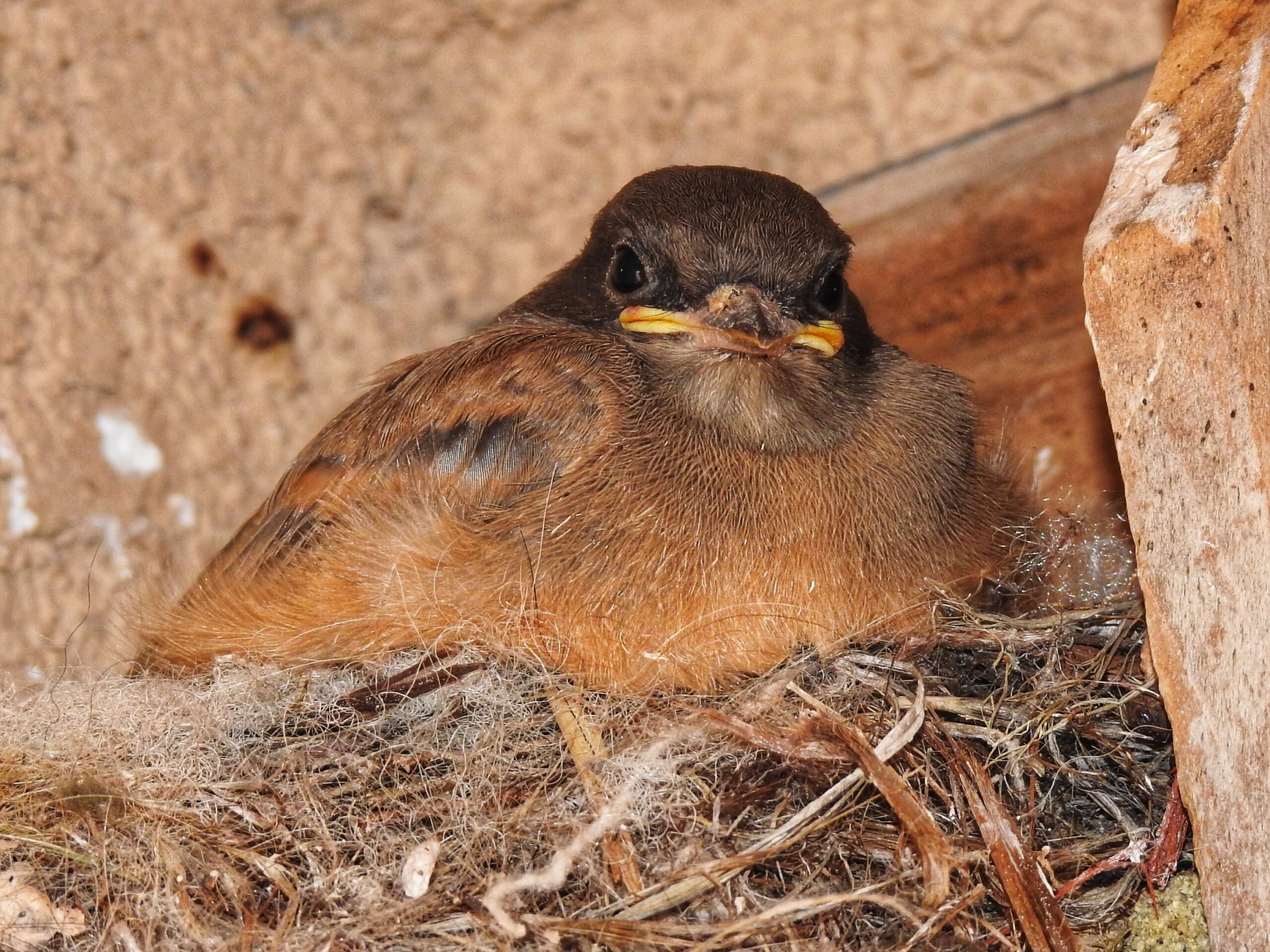
If you had one day to see a magpie, and seeing a magpie was your life’s ambition, I would take you to the creek. In the evening, the magpies gather in the branches of a dead willow. Mostly they just look around, but sometimes they laugh out loud, a hoarse, high-pitched laugh that can be heard half a mile away. Now and again, one flies out over the prairie as though it has somewhere to go, but it’s not anywhere important because it soon flies back.

But on some evenings, the magpies aren’t in the willows by the creek. Instead of laughter, there’s only the quiet whisper of the creek. If you were with me on one of those days, I would take you for a ride. We’d go to a place where magpies can always be seen. It’s like a magical magpie place.

Locals call it the Target parking lot.

Posted in Birds | Comments Off on Where to See a Magpie

Last Seen

I keep a lot of bird lists. Birds seen this year. Birds seen on my daily walks. Birds seen along the creek down the road. My ultimate list is my life list — a list of all the bird species I’ve seen in my life. Another way of thinking of it is my “First Seen” list. I’ve seen, for example, thousands of House Finches, but the one on my life list is the first one I ever saw.

I’m guessing that I’ve already started another list. My “Last Seen” list. Someday I’ll see the last House Finch I’ll ever see before I die. Maybe I already have. I hope not. Accidents happen. But what about Ruffed Grouse? I used to see Ruffed Grouse regularly when I visited my parents in northern Wisconsin. Now that I live in Colorado, I haven’t seen a Ruffed Grouse in several years. Will I ever see another one?

Chances are I won’t live in Colorado forever. The birds that have become so familiar to me here — Rock Wrens, Spotted Towhees, Bushtits — will I ever see them again after I move?

I wonder how long my “Last Seen” list is now?

Posted in Birds | Comments Off on Last Seen

Local Birds

Now that fall migration has begun, I’ve been wandering along the creek in the afternoons.

Olive-sided Flycatcher. I failed to get a photo of the one I saw Sunday, but this one landed on a snag not 40 feet away from me and posed.

Another one taken in the same general area two nights later.

I spent the better part of an hour stalking this Wilson’s Warbler. There was also a Virginia Warbler in the same stretch of bushes, but it stuck to the middle of the scrub oaks and I never got a shot.

Rock Wren. My first for El Paso County, which of course makes it my first for Black Squirrel Creek and for my Walking from Home list.

Posted in Birds | Comments Off on Local Birds

Highlights from Recent Reading, Etc.

The way to know the divine purpose about this present evil world, is not to be mixed up with it, in its schemes and speculations, but to be entirely separated from it. The more closely we walk with God, and the more subject we are to His Word, the more we shall know of His mind about everything. I do not need to study the newspaper in order to know what is going to happen in the world: God’s Word reveals all I want to know. In its pure and sanctifying pages I learn all about the character, the course, and the destiny of the world; whereas, if I go to the men of the world for news, I may expect that the devil will use them to cast dust in my eyes.

from Notes on the Book of Genesis, by C. H. Mackintosh (1879)


To make salvation dependent, in the most remote manner, upon anything in, or done by, man is to set it entirely aside. In other words, Ishmael must be entirely cast out, and all Abraham’s hopes be made to depend upon what God had done and given in the person of Isaac. This, it is needless to say, leaves man nothing to glory in. If present or future blessedness were made to depend upon even a divine change wrought in nature, flesh might glory. Though my nature were improved, it would be something of me, and thus God would not have all the glory. But when I am introduced into a new creation, I find it is all of God — designed, matured, developed by Himself alone. God is the actor, and I am a worshiper; He is the blesser, and I am the blessed; He is “the better,” and I am “the less” (Hebrews 7:7); He is the giver, and I am the receiver. … Human religion gives the creature a place, more or less; it keeps the bondwoman and her son in the house; it gives man something to glory in. On the contrary, Christianity excludes the creature from all interference in the work of salvation — casts out the bondwoman and her son, and gives all the glory to Him to whom alone it is due.

from Notes on the Book of Genesis, by C. H. Mackintosh (1879)


Borrowing [words from another language] is not a one-way street. For instance, in Kashmiri you may hear a word like bathroom or window, and in Serbo-Croat shrapnel or scout. In French … there is le weekend, along with les bluejeans, le rip-off and the calque gratte-ciel (skyscrapter), which are seen by purists as grave embarrassments. The Swahili madigadi is a version of the English “mudguards,” and the same language takes the delightful word kiplefti, meaning “traffic island,” from the English “keep left.” In Yoruba, a square root is sikua ruutu. Russian borrowings from English include the slightly sinister biznismen, as well as dzhemper (“jumper”) and vokzal (“station”). The last of these is a corruption of Vauxhall, the name of an area in south London once famous for its pleasure gardens; a Russian delegation of the 1840s stopped there and took this word displayed on a sign, to be the generic name for a station.

from The Secret Life of Words, by Henry Hitchings (2008)


From an early stage pamphlets attacking coffee were frequent, and they were nationalistic in flavour, for the beverage was associated with Turks and other Muslim “infidels,” and the democratic nature of the coffee house meant it was typically linked with the political opposition. In 1675 Charles II issued “A Proclamation for the Suppression of Coffee-Houses” to counter their “very evil and dangerous effects” the meetings held in them helped spread “False, Malitious and Scandalous Reports,” and they had become “the great resort of Idle and disaffected persons.” The word coffee is recorded in Dr. Johnson’s Dictionary, which says it is “originally Arabick, pronounced caheu by the Turks, and cahuah by the Arabs.” Actually, qahwah is more like it — the Turks pronounced it kahveh — and the bracing drink seems related etymologically to an Arabic verb meaning “to lack appetite.” The term cafe caught on in the nineteenth century as coffee-drinking, having become a polite form of public sociality, needed to be detached from the imagery of subversion.

from The Secret Life of Words, by Henry Hitchings (2008)


Attempts to proscribe biased or insensitive language are often classified as political correctness, and involve replacing terms that are perceived as denigratory with artificial alternatives. The thinking here is clear enough: the ways in which we refer to ethnicity, sexual orientation, gender and disability can convey deep hostility or bias, and a more sensitive approach can eradicate not only the disparaging language but also the very attitudes and prejudices that underpin such disparagement. Yet, to quote the British journalist Melanie Phillips, the purpose of such acts of verbal hygiene is “less to protect the ostensible targets of prejudice … than to demonstrate the moral purity of the expurgators.” This cultural sensitivity, which tends to be most visible in academia and social work, can mutate into patronizing tokenism, a licence for political ineptitude or inertia, and a grotesque repression of personal freedoms. At its most extreme, political correctness is capable of destroying family life and rewriting history.

from The Secret Life of Words, by Henry Hitchings (2008)


He told him his uncle Ed Alison had gone up to the preacher after the funeral was said and shook his hand, the two of them standing there holding onto their hats and leaning thirty degrees into the wind like vaudeville comics while the canvas flapped and raged about them and the funeral attendants raced over the ground after the lawnchairs, and he’d leaned into the preacher’s face and screamed at him that it was a good thing they’d held the burial that morning because the way it was making up this thing could turn off into a real blow before the day was out.

His father laughed silently. then he fell to coughing. He took a drink of water and sat smoking and shaking his head.

Buddy when he come back from up in the panhandle told me one time it quit blowing up there and all the chickens fell over.

from All the Pretty Horses, by Cormac McCarthy (1992)


Loyalty to any one sports team is pretty hard to justify. Because the players are always changing. … You’re actually rooting for the clothes when you get right down to it. You are standing and cheering and yelling for your clothes to beat the clothes from another city.

People will love a guy. Then the guy will get traded. He’ll come back on another team —they hate him now. This is the same human being in a different shirt. “Boo! We hate him now!” We’re rooting for laundry here.

Jerry Seinfeld


Matt Hancock, the U.K.’s Secretary of State for Health and Social Care, requested an investigation into Public Health England’s handling of the daily count.

“It came after Oxford University experts revealed a significant proportion of the daily out-of-hospital death toll relates to patients who recovered from the virus weeks or months earlier” the Telegraph reported. “Under the previous system, anyone who has ever tested positive for the virus in England was automatically counted as a coronavirus death when they died, even if the death was from a car accident.”

from dailywire.com

[Just more evidence that the entire world has gone collectively insane this year.]


Things I’ve Learned

  • There have been 1,523 baseball players whose Major League career lasted for only one game.
  • Only 10-20 percent of laughter is in response to humor.
  • We are one of the first generations in history who don’t have to taste our cutlery. This is because of a thin layer of chromium oxide that coats the surface of stainless steel and keeps your tongue from touching the surface.
  • In a scientific study, couples who were very much in love had their brain activity and heart rate monitored when they kissed and when they ate chocolate. While kissing set their hearts pounding, the effect did not last as long as when they ate chocolate. The effect of chocolate on their brains was also more intense and longer lasting.
  • There are more words in the English language with Greek prefixes and suffixes than there are words in the Ancient Greek language.
  • It is thought that word “honeymoon” refers to the belief that the sweet (honey) romance of a marriage lasts about a month (a “moon”).
  • In their final home game in 1971 — the final game at RFK Stadium before they moved to Texas and became the Rangers — the Washington Senators lost 9-0 by forfeit when rowdy fans stormed the field in the ninth inning. At the time, the Yankees were at bat with two outs and the Senators were winning 7-5.
  • Joachim Neader, the German hymn writer who wrote “Praise to the Lord, the Almighty, the King of Creation,” liked to visit a valley near his home for inspiration. Some time after his death, the valley was renamed in his honor. the valley became famous in 1856 after some “early” human remains were discovered there and named Homo Neanderthalensis — the Neanderthal Man.
  • In 1974, Major League Baseball quietly switched from horsehide-covered baseballs to cowhide-covered baseballs — because there were no longer enough dead horses running around.
  • The three most frequently sung songs in America are, in order, “Happy Birthday,” “The Star-Spangled Banner,” and “Take Me Out to the Ballgame.”
Posted in Books and Literature | 1 Comment

Pikas

I spent a couple hours at Loveland Pass, looking for White-tailed Ptarmigans. I saw vast numbers of people, including a wedding party taking photographs. In the very few places where I managed to get away from the crowds, I managed to get close to several Pikas.

I drove through Bailey and ate lunch at Coney Island Boardwalk. The food was pretty good, but I loved the restaurant mostly for the sign in the front window that read, “We don’t wear masks. If this is a problem for you, eat somewhere else. You have been warned.”

Posted in Mammals | Comments Off on Pikas