
I left the house at 6:30 and headed west to Winnebago County. By the time I got out of the car at Sugar River Forest Preserve, I had 17 birds on my list:
American Robin; Red-winged Blackbird; Common Grackle; Canada Goose; Mourning Dove; Great Blue Heron; European Starling; American Crow; Barn Swallow; Ring-necked Pheasant; Rock Dove; Blue Jay; Cooper’s Hawk; Northern Cardinal; Killdeer; Savannah Sparrow; Eastern Bluebird. 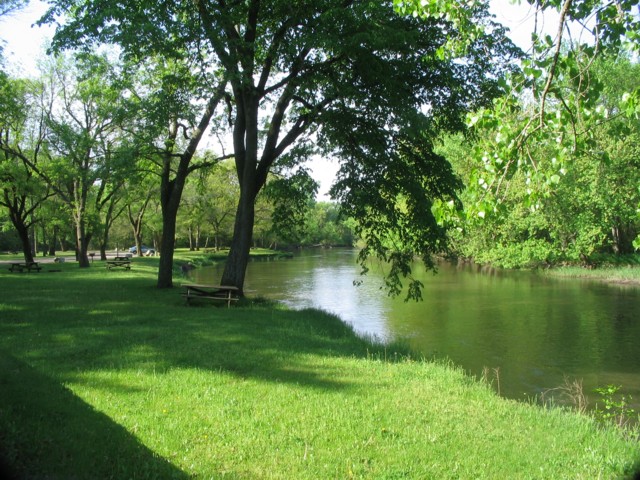
I love Sugar River. There are great birds there, including several species that are almost impossible to see anywhere else in Northern Illinois — and best of all, there’s very rarely anybody else around. That was true today too, up until the end when a school field trip showed up as I was leaving. I covered myself with bug spray to discourage the mosquitoes that attacked as soon as I left the car. During the next four hours I saw:
Swainson’s Thrush; Chipping Sparrow; Tennessee Warbler; Gray Catbird; Rose-breasted Grosbeak; Chestnut-sided Warbler; Magnolia Warbler; Wood Duck; Yellow-rumped Warbler; White-breasted Nuthatch; Bay-breasted Warbler; Mallard; House Wren; Prothonotary Warbler; Sandhill Crane; American Goldfinch; Eastern Phoebe; Nashville Warbler; Gray-cheeked Thrush; Indigo Bunting; Black-capped Chickadee; Tufted Titmouse; Song Sparrow; Red-bellied Woodpecker; Eastern Wood-Pewee (and I hadn’t even left the picnic area where I parked my car yet) Eastern Towhee; Yellow-throated Warbler; White-throated Sparrow; Northern Rough-winged Swallow; Common Yellowthroat; Cape May Warbler; Black-throated Green Warbler.
I’ll pause to explain my next sighting. Wild Turkeys are all over Winnebago County, and one of the most reliable places to see them is in a farm field next to one of the trails at 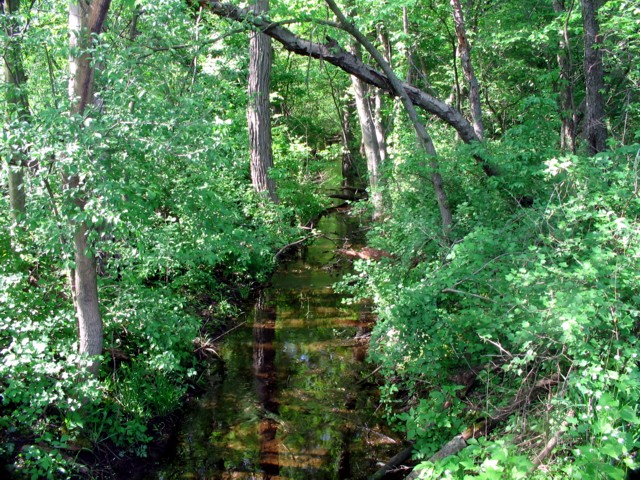 Sugar River. I was walking slowly along this trail, looking carefully along the edges of the field when there was an explosion right behind me. A tom Turkey had been drinking in a creek about 15 feet from where I stood (right). I surprised it — I didn’t see it and it didn’t see me. It flushed, calling loudly and making a racket with it’s wings. In addition, as it flew through the dense woods, it broke off dozens of branches with its wings. It was a massive amount of noise to be made by a bird, and having it happen right behind me when I wasn’t expecting it … It was startling. Back to the list:
Great-crested Flycatcher; Northern Waterthrush; Lincoln’s Sparrow; Swamp Sparrow; Scarlet Tanager; Hairy Woodpecker; Brown-headed Cowbird; Blue-gray Gnatcatcher; Pileated Woodpecker; American Redstart; Downy Woodpecker; Blue-headed Vireo; Red-eyed Vireo; Ovenbird; Hooded Warbler; Turkey Vulture; Cerulean Warbler.
I drove from Sugar River to Rock Cut State Park, near Rockford. On the way I saw Eastern Kingbird and Red-tailed Hawk. At Rock Cut, I added: 
Warbling Vireo; Baltimore Oriole; Yellow Warbler; Palm Warbler; Canada Warbler; Blackpoll Warbler; Blue-winged Warbler; Wilson’s Warbler; Wood Thrush; Yellow-throated Vireo; Field Sparrow; Brown Thrasher.
That was a discouragingly-low total — I’d hoped for a lot more from Rock Cut, but it was the heat of the day and nothing was moving. Still, I was at 80 birds and thought I had a chance at 100. I called my wife and told her I wouldn’t be home until dark, then headed for Moraine Hills State Park near home, stopping at Garden Prairie on the way. The fields south of town often flood and are sometimes good for shorebirds. The sun was in the wrong place to see much, but I did find one puddle that included Pectoral Sandpipers and Least Sandpipers. Also on the way to Moraine Hills, I saw a Chimney Swift.
Moraine Hills was a mistake. There were very few birds around, and it was crawling with people. I added: Great Egret; Tree Swallow; Common Moorhen; Mute Swan; Hooded Merganser and White-crowned Sparrow.
It was now 6:30. I was tired (I’d walked 9.4 miles so far) and thirsty. I stopped and bought a pint of pink grapefruit juice and guzzled it. I knew I could drive down to Younghusband Prairie and Paul Douglas Forest Preserve and see some of the stuff I saw yesterday, but that would mean another hour of driving and while I had a fair chance of hitting 100, it was very unlikely I’d break my all-time record of 106. I gave up and went home with 90 — not a good total for the way the day began. I think my problem was the weather — it was too nice. The birds stopped in the morning to eat and rest, then took off again. The best spring migration days are the cold, wet ones when the birds hang around and forage low in the woods. Still, it was a thoroughly-enjoyable day, as is any day that includes a Pileated Woodpecker and 22 warblers.