Davy Crockett

As part of my ongoing, sporadic look at pop culture fads of the past, I explored the Davy Crockett craze. It wasn’t the first pop culture fad, but it was the first that was generated by TV.

I began with a three-part serial on ABC as part of Disney’s show Disneyland in 1954. The episodes were filmed in color but appeared in black-and-white on TV because ABC didn’t broadcast in color at that time. They were part of a joint project with the opening of Disneyland, to promote the Frontierland section of the park.

When the first three episodes gained so much popularity, Disney wanted to make more. The problem was that their hero had died at the end of episode three. Not to worry. They made two more episodes in 1955 — prequels that explored the legend of Davy Crockett. Unlike the stories in the first three shows, these were almost entirely fiction. I can better understand how they could appeal to kids. There was more rollicking adventure and fewer morality lectures. Crockett is teamed with Mike Fink, another frontier legend, to track down some bad guys and kill them, but there’s no blood and no real danger. By the time these episodes were televised in late 1955, the craze was almost over.

The first three episodes — Davy Crockett, Indian Fighter; Davy Crockett Goes to Congress; and Davy Crockett at the Alamo — were stitched together and shown in theaters as the color movie Davy Crockett: King of the Wild Frontier in 1955.

The fourth and fifth episodes — Davy Crockett’s Keelboat Race and Davy Crockett and the River Pirates — were combined into the color movie Davy Crockett and the River Pirates in 1956.

Sixty-three years after they debuted, with all the “sophisticated” options available now, it’s difficult for me to understand the show’s popularity. The leads, Fess Parker as Crockett and Buddy Ebsen as his (fictional) sidekick George Russel, always looked like they were viewing the events around them with cynical detachment. There was zero character development. The fight sequences were wooden and unconvincing. The battle of the Alamo apparently featured 15 Texans against 35 Mexicans.

Occasional footage, particularly that of animals — was obviously spliced in from other movies. Sometimes the setting changed back and forth from, for example, the river where Crockett was wading and the river where an alligator was swimming. In one scene, a gator swam up behind Crockett and apparently nipped his behind. Crockett turned and smashed his rifle butt into the water. We get another angle of a gator thrashing in the water, but it’s alone. There’s no Crockett to be seen. Then, suddenly, we’re back to Davy smashing his rifle butt into the water.

There are estimates that more  than half the people in the United States who were watching TV when the second episode aired were watching ABC. The craze caught Disney by surprise, but it didn’t take them long to flood the market with coonskin caps, trading cards, lunchboxes, and hundreds of other items. Disney failed to trademark Davy Crockett, which allowed anyone to put the Crockett name on anything. It’s estimated that as many as 4,000 different items were sold with some connection to Davy Crockett, including coffee, furniture, and women’s underwear.

Just before the original episodes aired, it was discovered that there wasn’t enough footage to fill the allotted time. A song was written quickly to fill the gaps and help tell the story. Twenty-three versions of “The Ballad of Davy Crockett” came out in 1954. All together, they sold over 10 million copies. Three of them — Bill Hayes, Fess Parker, Tennessee Ernie Ford — all released within a three-week window in early 1955 — were on the top 10 chart at the same time.

Several parodies of the song came out quickly. And then there was this — Davy Crockett Mambo“.

One theory about the cause of the fad is simply the timing. Because of the Baby Boom (the oldest members of that generation were nine in 1955), there were more children around than ever before. That, coupled with the growth of TV and the high-for-the-time production values of the show, caused the craze. I was born in 1958, four years after the nuttiness began. The fad was long over, but I grew up with an awareness of Davy Crockett, the song, and coonskin caps even though I never saw the show.

It wasn’t until Batman in 1966 that another TV show created such a stir.

In an attempt to find out more about the real Crockett, I read David Crockett: the Lion of the West, by Michael Wallis. Turns out he was as popular during his lifetime as he was in the 1950’s, and for no more substantial reason.

Crockett’s father was a failure at everything he tried. At times, he resorted to loaning out his own children to bring in cash. David was hired out to a complete stranger when he was 13, to take a load of goods from Tennessee to Pennsylvania. He grew up young and learned to shoot and live in the woods. Always likable, but no better at making a living than his father, Crockett bounced around from place to place ahead of his creditors. He was married twice and had a slew of children, but neglected his wives and children to roam the woods or to head off with Andrew Jackson to fight the Creek Indians.

Still, his honesty and friendliness made him a likely candidate for local office and, eventually, the state legislature. He liked to talk and tell tales of his own exploits killing bears, and, on the frontier, these were popular qualities. When he was elected to the U.S. Congress, his manners were  in stark contrast to the eastern elites in that assembly, and his homespun stories began to spread. Crockett milked this for all it was worth, although he was not as stupid as the stories made him seem, and he never showed up in Congress in buckskin and a coonskin hat, at least not until later.

During his third term, a popular play, The Lion of the West, or a Trip to Washington, by James Kirke Paulding, hit the stage. The hero was a buckskin-clad hunter named Colonel Nimrod Wildfire who began his performance by introducing himself as “half horse, half alligator and a touch of the airthquake — that’s got the prettiest sister, fastest horse, and ugliest dog in the District, and can out-run, outjump, throw down, drag out, and whip any man in all Kaintuck.” The resemblance to Crockett was unmistakable, and the play was a huge hit.

Crockett decided to take advantage of the craze and wrote an autobiography called A Narrative of the Life of David Crockett, of the State of Tennessee. It too was an immense hit. He traveled around the eastern U.S. promoting it and was a big draw wherever he went. Unfortunately, his book tour took place while Congress was in session, which his opponents milked for all it was worth. Crockett lost the next election and decided to head to Texas to try his hand as a failed land speculator. He ended up at the Alamo, and the rest is history.

Even in the later half of the 1800’s, there were books and plays about Crockett. When Disney chose him to be the feature of their mini-series, he was a known commodity, although nobody could have predicted the extent to which the fad took off.

I also read The Davy Crockett Craze, by Paul F. Anderson which explored the TV show in depth and included photos of many of the Crockett items sold in the ’50’s. There wasn’t a whole lot in the book that I hadn’t already discovered online.

Between the time I watched the movies and read the biography of Davy Crockett, we went to the National Western Stock Show. A booth there was selling, among other fur products, coonskin caps. I had to buy one for my own.

Posted in Pop Culture | Comments Off on Davy Crockett

Bird #486 — Yellow-billed Loon

gavia (loon) adamsii (named for Edward Adams, English surgeon-naturalist who served on voyage to Arctic in search of Sir John Franklin during which this species was discovered)

Tuesday, January 9, 2018 — 9:20 am

Arapahoe County, Colorado — South Platte Reservoir

This bird showed up on the Colorado hotline on Saturday when I was up in Victor seeing my lifer Black and Gray-crowned Rosy-Finches. I should have driven the 45 minutes north of my house to see it on Sunday afternoon, but it didn’t occur to me until it was too late. When I complained to my wife, she said, “You have vacation days. Take one and go see it.”

I dropped my wife at work on Tuesday morning and drove up. As I passed the reservoir on Highway 470, I could see a large group of birders standing on the berm along the lake. By the time I exited and found my way to the spot, they were all walking down the hill to their cars. But they assured me the loon was there.

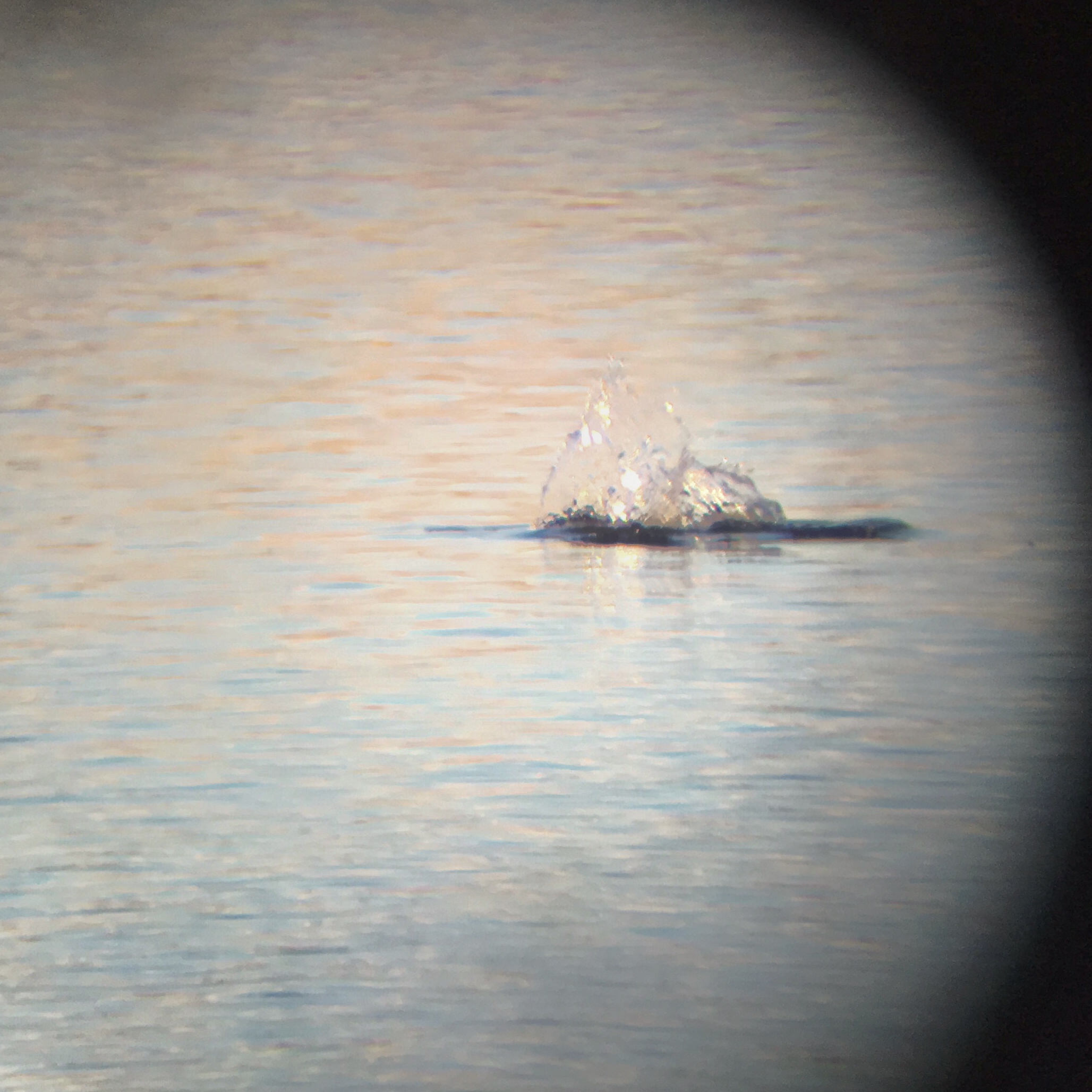
I hiked up the berm and set up my scope. Within a minute or two, I found the loon. It was about 200 yards out. It spent more time under the water than on the surface, and when it dove, it sometimes came up 50 yards from where it went under. It began every dive with a little jump. Here’s my best photo, taken with my phone held up to my scope. You can see the pale bill and dark patch on the ear that are diagnostic for this species.

Most of the time when I looked, I just saw water. Or this …

I realized I left my phone in my car, so I was on my way down to get it when a woman came up. I pointed out the bird to her. When I got back to the lake, we got to chatting. Turns out she used to live in Illinois and worked in the Schaumburg Library where I’ve been many times.

I watched the loon for several minutes as it gradually moved further away .

Another large group of birders showed up, all of them over 70. I guess that figures, seeing as it was a weekday morning. It was pretty obvious many of them were there for the social aspect — which is just fine. But some of them wouldn’t be able to tell a loon from a parakeet.

Yellow-billed Loons nest in the arctic and generally winter along the coast of Alaska. They’ve been recorded from downstate Illinois, but I don’t recall one ever being seen near Chicago. They show up a bit more often in Colorado, but it’s a rare bird by any measure this far south and inland. In this photo, the loon can just be made out as a tiny light dot on the left. That’s downtown Denver in the background.

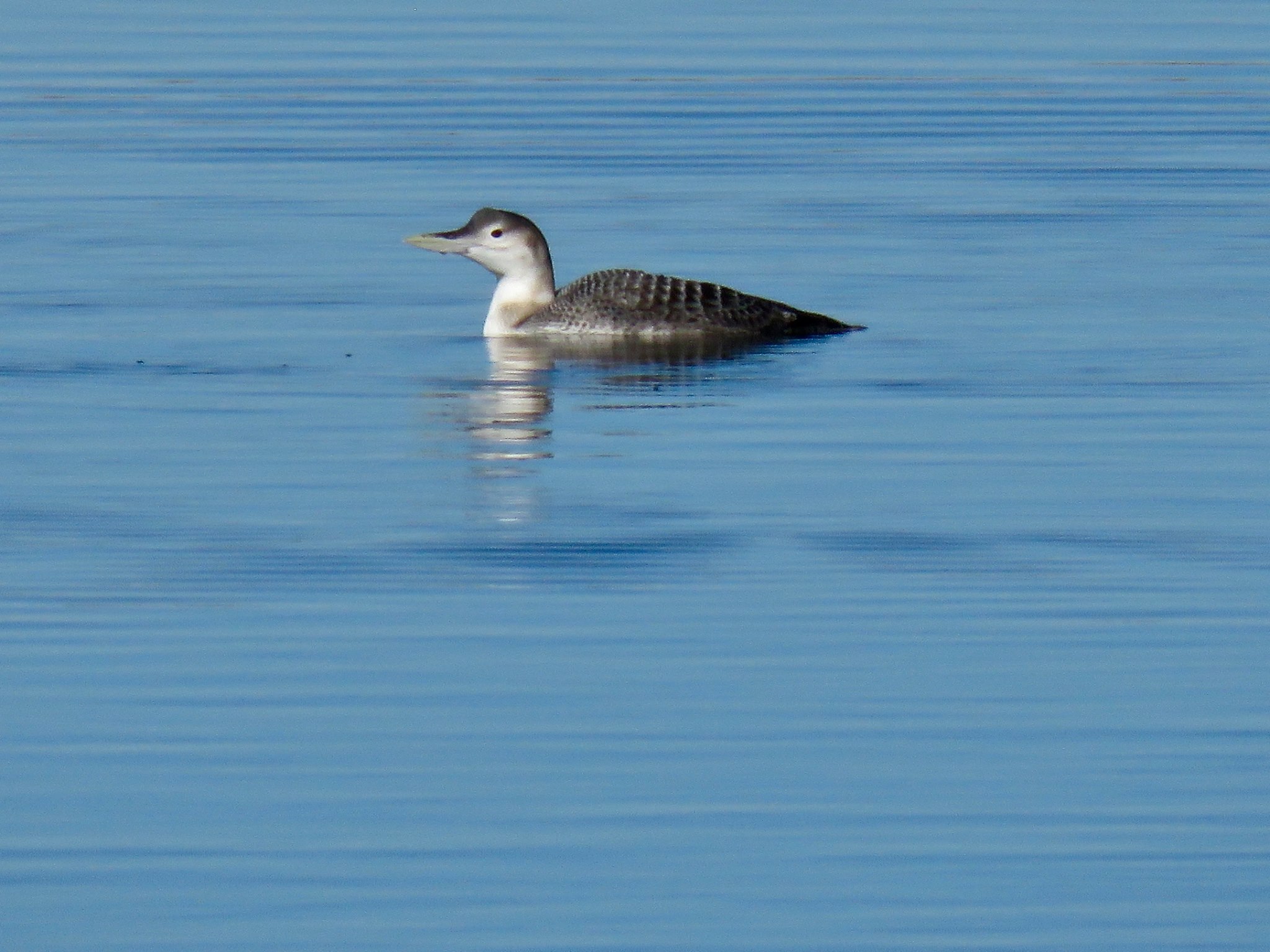
Here are some photos I stole off the internet of the very bird I saw, taken by people with far nicer cameras. I could see it almost this well through my scope. Note the straight culmen (upper ridge of the bill), another key mark.

I wandered along the shore for a ways and spotted several Common Goldeneye, a Bufflehead, a raft of Ruddy Ducks, and two Greater Scaup. A White-winged Scoter flew down to my corner of the lake and landed about 30 yards out.

As it turned out, I didn’t need to take a day off to see it — the bird was still in the same place three weeks later. But you never know …

Posted in Wildlife | Comments Off on Bird #486 — Yellow-billed Loon

Mueller State Park

I’ve driven past Mueller State Park at least a dozen times, but I’ve never stopped. Today, when I went up to Victor and found the rosy-finches before 11:00, I had plenty of time to check it out. I stopped in the visitor center and asked a ranger to recommend a trail of about two or three miles that wouldn’t kill me. She suggested I take Trail 7 and circle back on Trail 11, with some side trips on shorter trails.

Mine was the only car in the lot at the trailhead, and for the next two+ hours I didn’t see another human. Much of the time, in fact, I couldn’t hear any human-caused noise, although an occasional airplane flew high overhead.

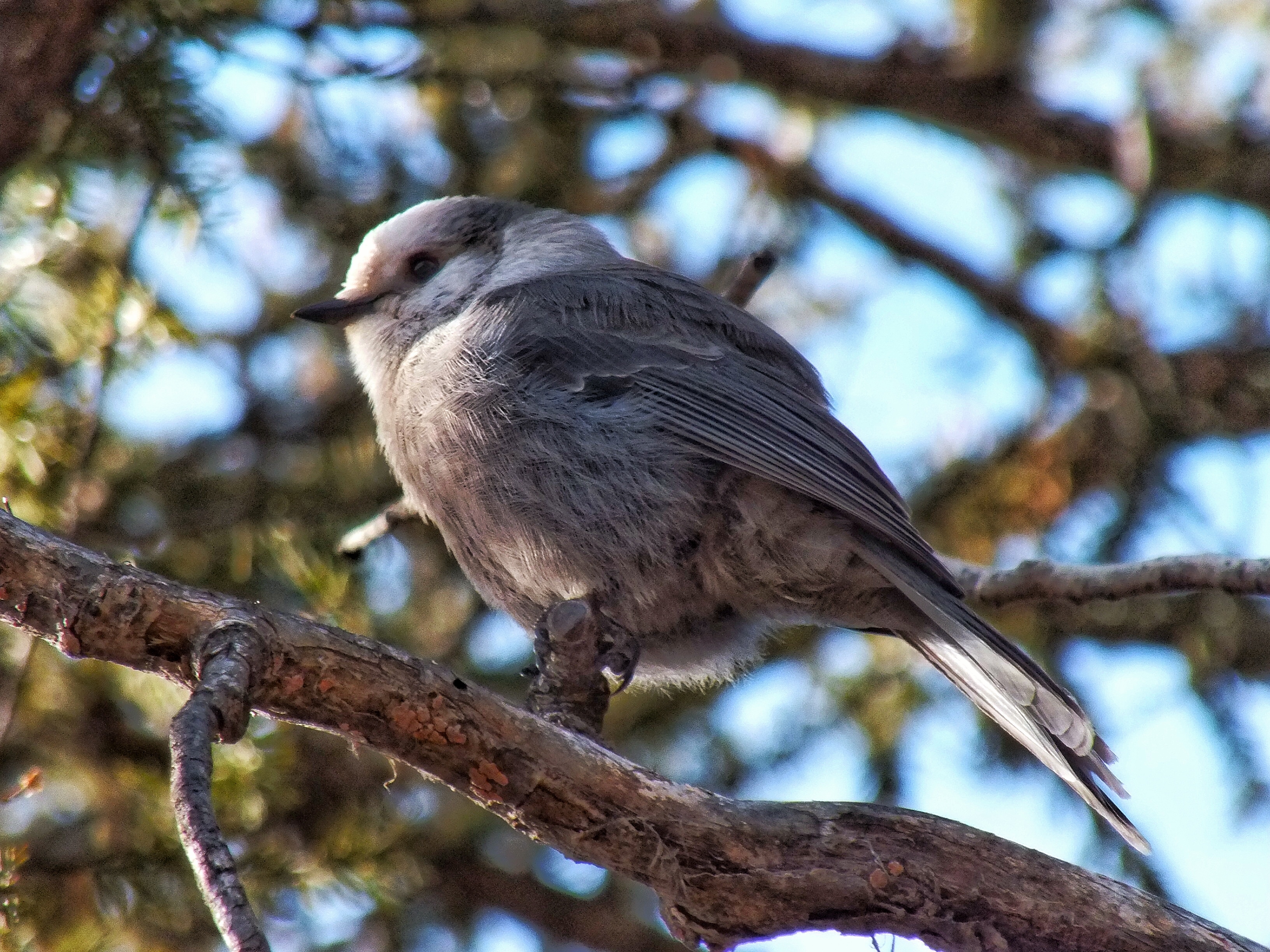
The trail cut through a picnic area. I heard a couple Mountain Chickadees and made a whispy noise to attract them. It worked better than I expected. The chickadees came, and so did a Gray Jay. It silently glided to a branch just above my head and then, when it saw I had no food, flew down to the ground about 30 feet away, then silently disappeared back into the woods.

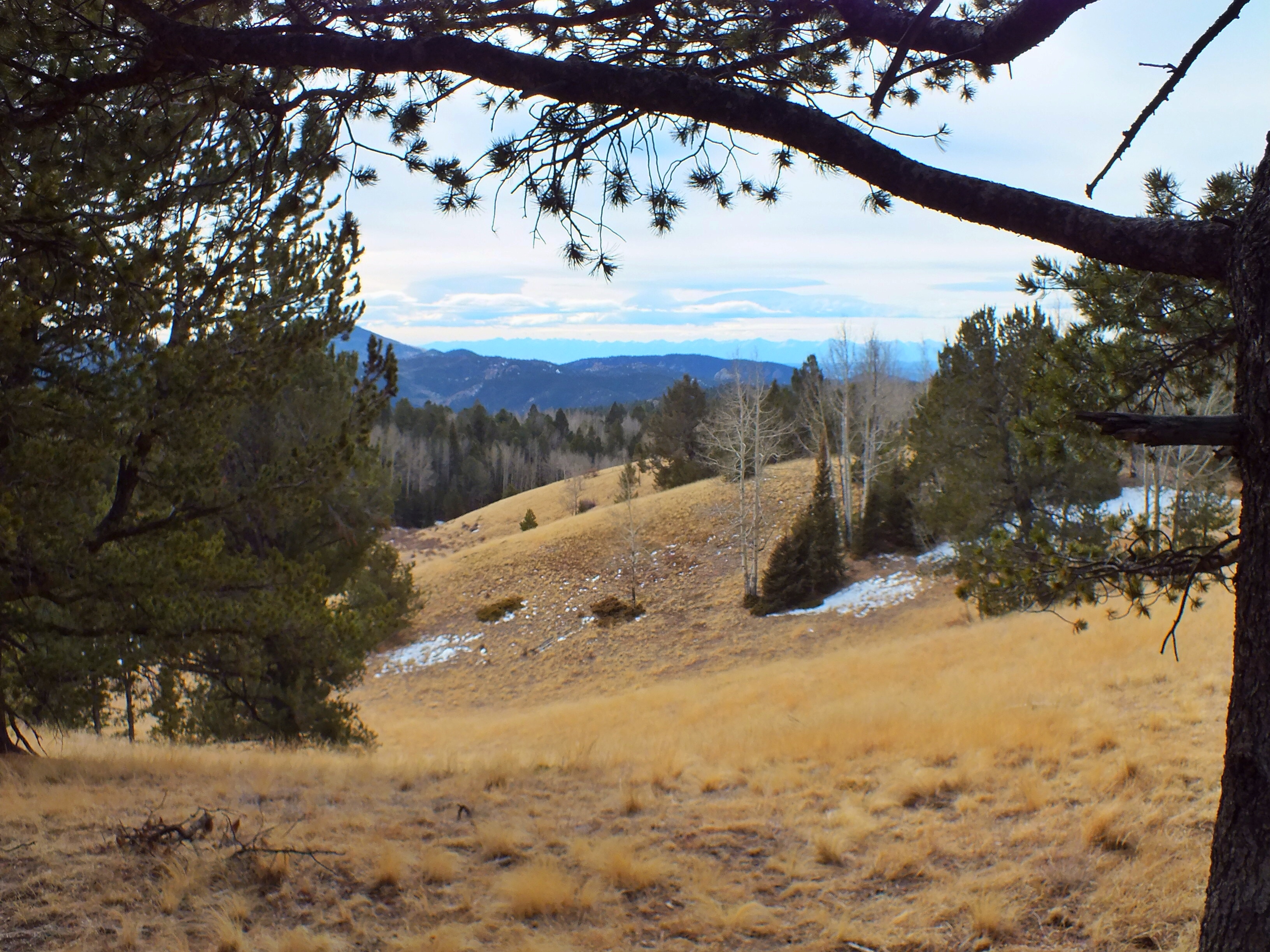
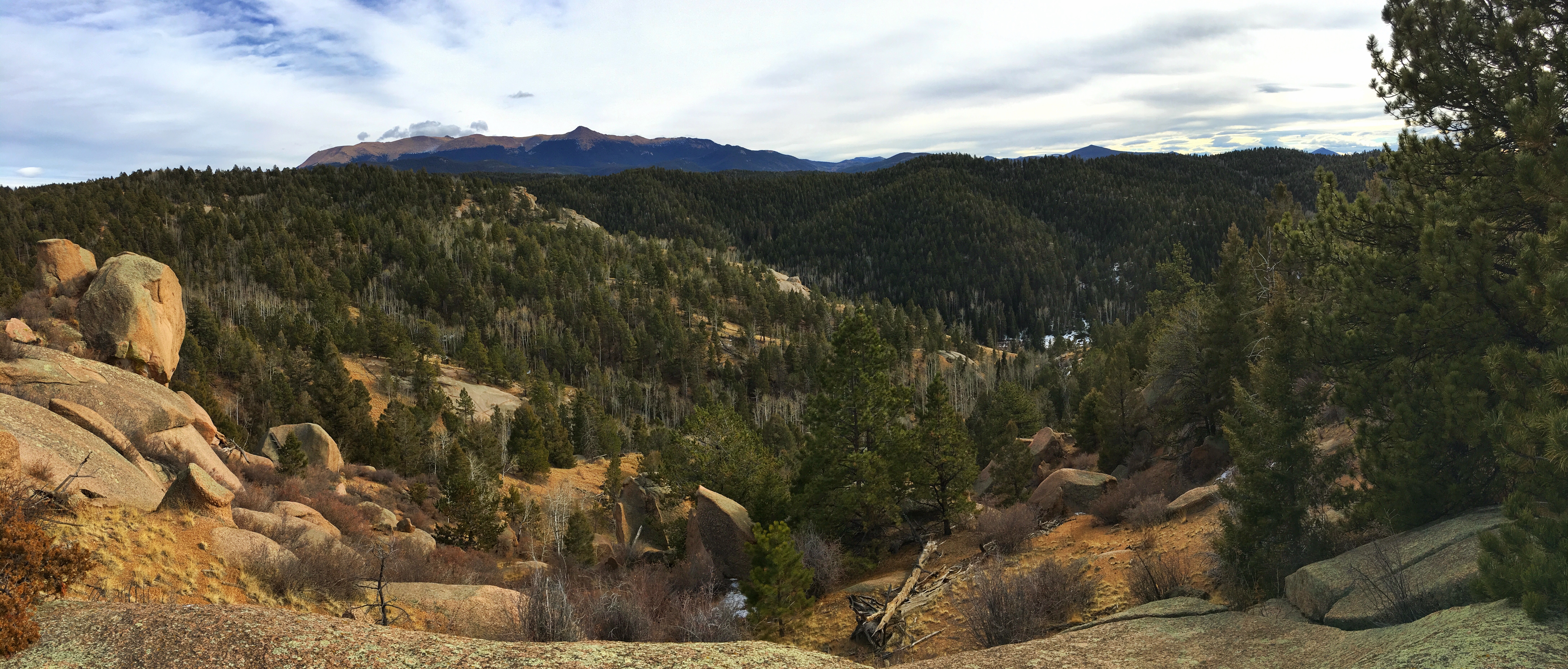
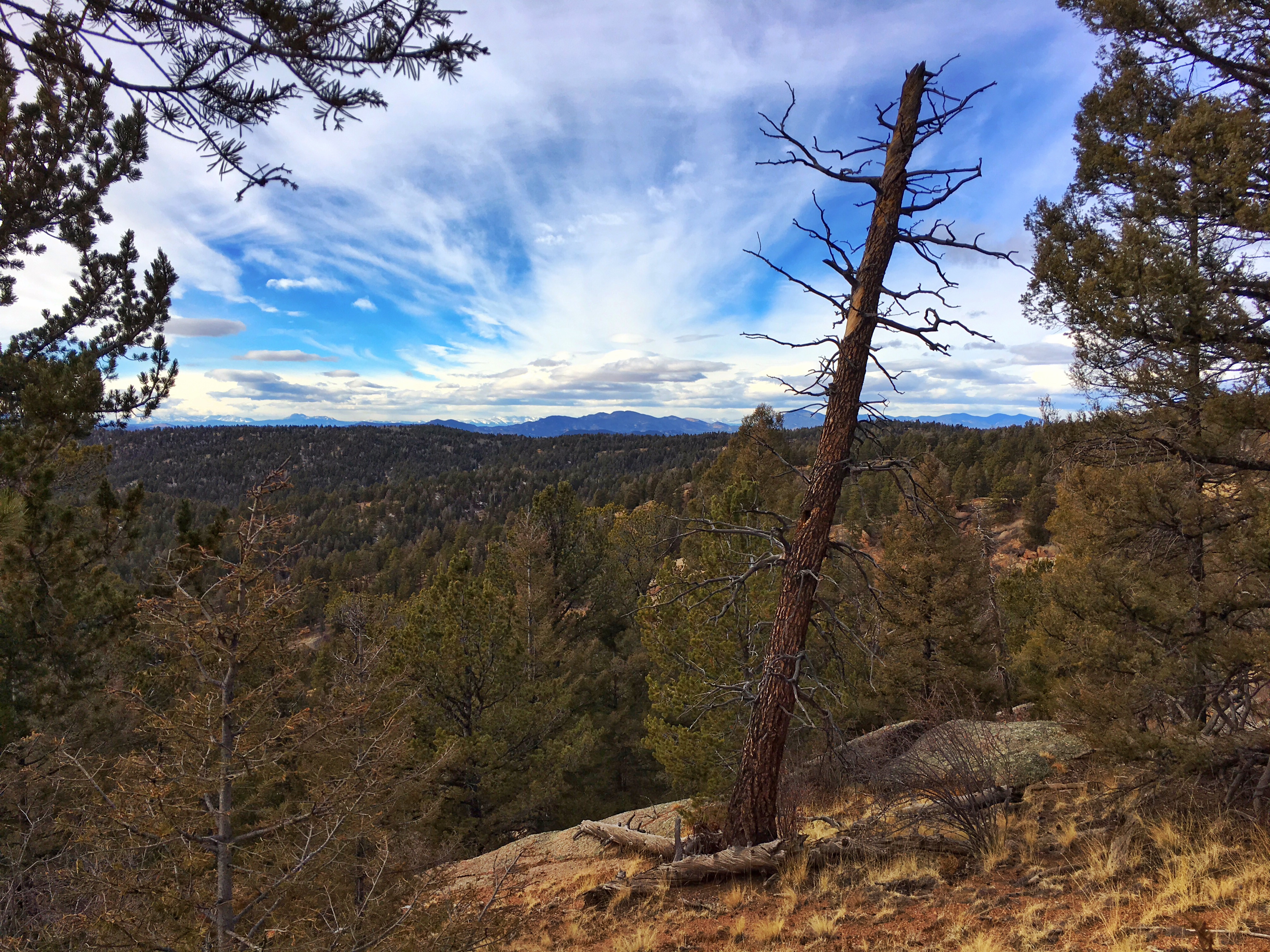
The trail ran along a ridge with long views of distant mountain ranges.

To the south, Pikes Peak dominated the horizon, but since I was already above 9,500 feet, it didn’t seem as high as it does from home.

The side trails all led to rock outcroppings with amazing views.

The trail dropped down off the ridge and ran through dense woods.

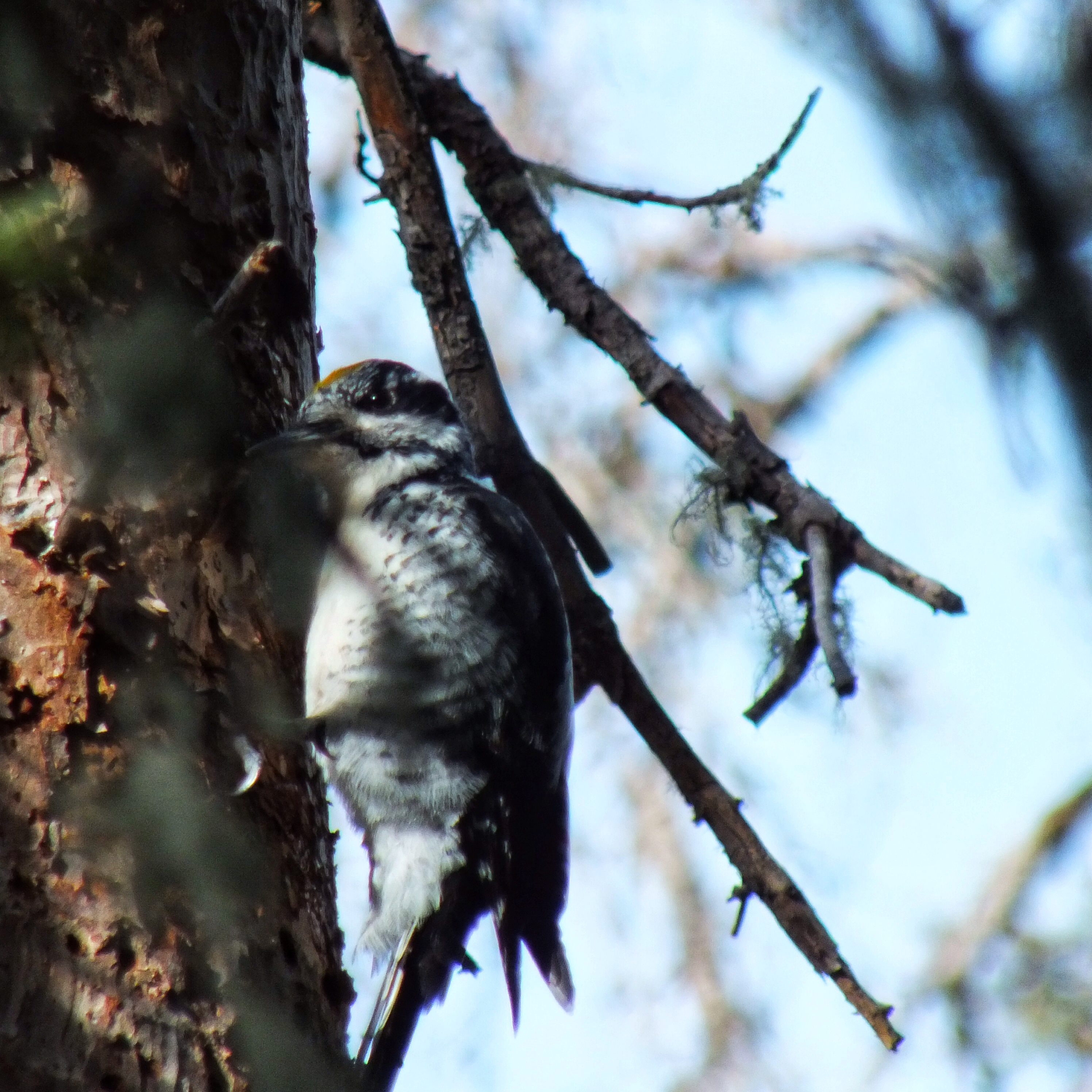
I stopped often to listen for birds, but there weren’t a lot around — nor did I expect there to be this time of year. I did track down four Steller’s Jays, a Hairy Woodpecker, and this male Three-toed Woodpecker.

I had to pass under him and climb a hillside to get a shot that showed his small yellow crown.

When I got back to the picnic area where I started, I called for the Gray Jay again. It took longer this time for it to come, but come it did. And I was ready this time.

Mueller is a stunning park, and I will certainly return and check out some of the other trails. The hike wasn’t a piece of cake, with some steep hills made more challenging by the altitude, but it was very much worth the effort.

Posted in Wildlife | Comments Off on Mueller State Park

Bird #485 — Gray-crowned Rosy-Finch

leucosticte (from leuko, white, and stictos, varicolored) tephrocotis (from tephros, gray, and otos, ear)

Saturday, January 6, 2018 — 10:05 am

Victor, Colorado — Diamond Avenue

When I first spotted the flock of rosy-finches in the aspen next to a house with a feeder, I could see that most of them were Black Rosy-Finches. But when I got right across the street, I was able to pick out four with body feathers that were brown instead of black or gray.

There are three populations of Gray-crowned Rosy-finch. One sub-species sticks exclusively to the coast along the Bering Sea. The other two breed high in the mountains from Alaska down to the Pacific Northwest and northern Rockies. The population that breeds further west is known as Hepburn’s. It has an extensive gray hood, like this bird.

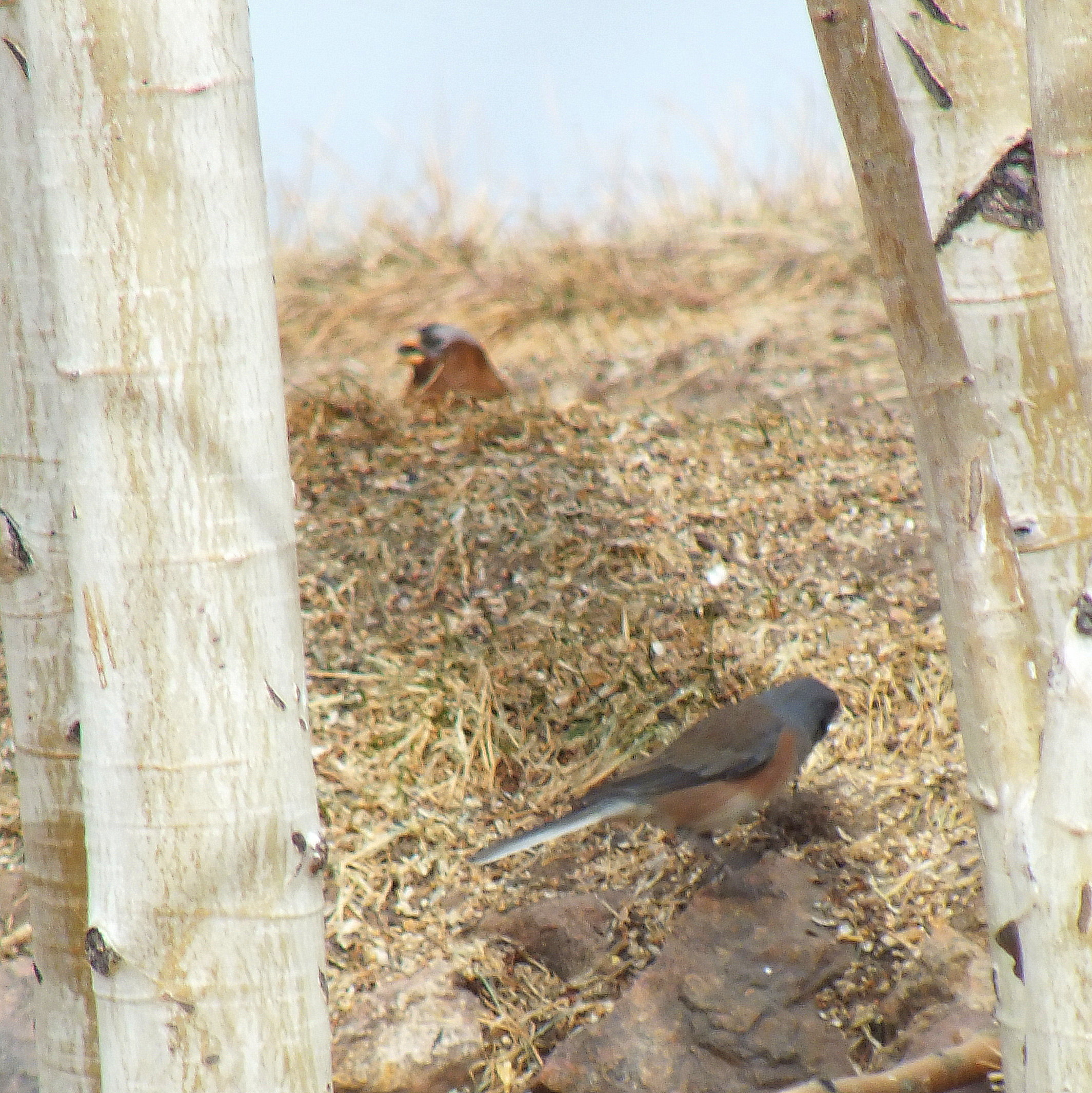
The interior population has more of a gray cap than a hood. This next photo isn’t a good one, but it is the only shot I got of an identifiable interior Gray-crowned Rosy-Finch. (The bird in the foreground is the pink-sided form of Dark-eyed Junco.)

I’ve included them both because I saw somewhere online that a further split may be coming, separating Hepburn’s and the interior race into separate species. If that happens in my lifetime, I’ll have gotten three lifers today.

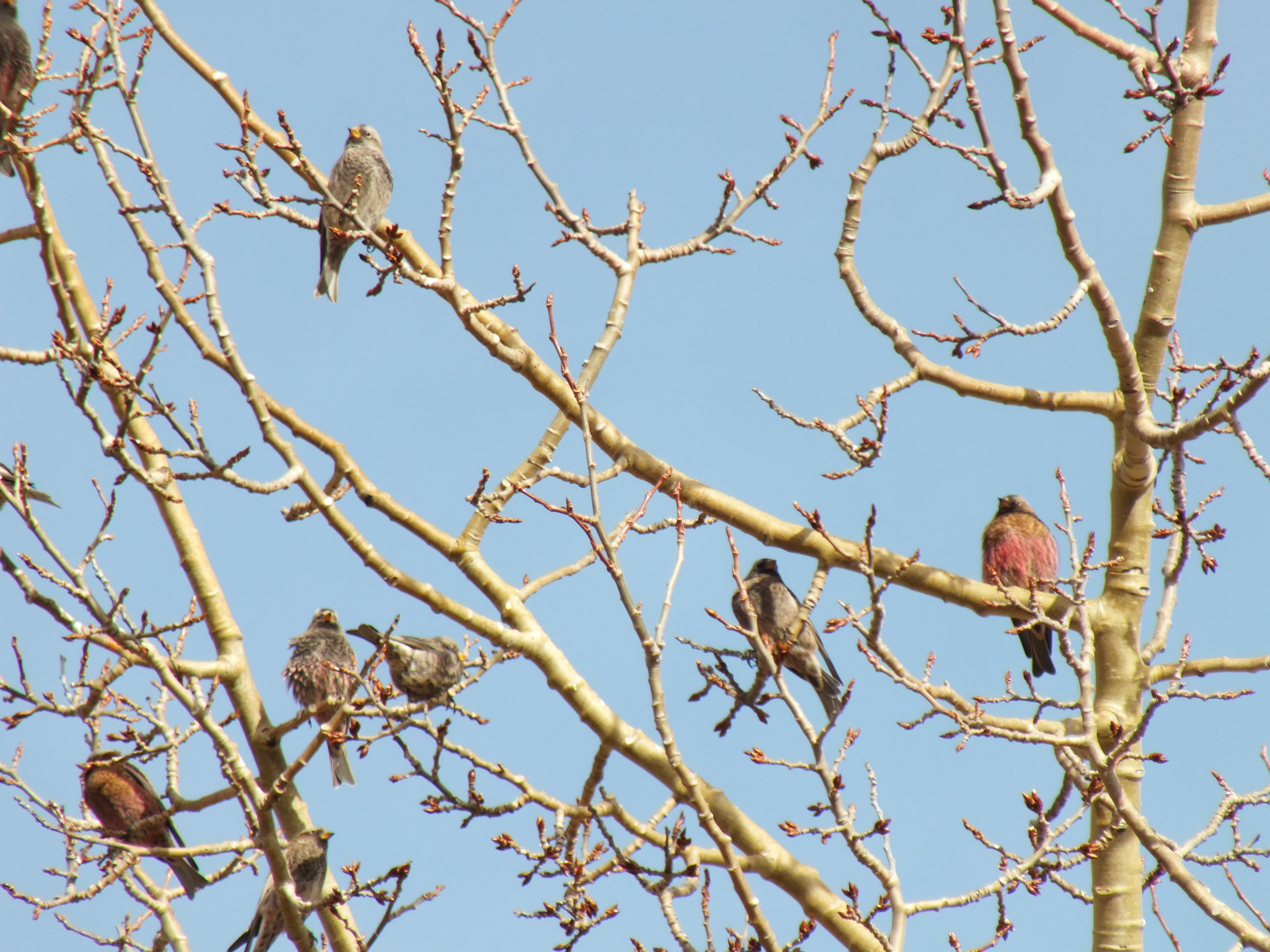
Apart from the color, there was nothing that stood out about the Gray-crowns. The whole flock stuck together, either sitting in the aspens, landing briefly on the ground, or circling the neighborhood. After I got back from lunch around 11:00, the flock had grown to over 70 birds, including several Brown-capped Rosy-Finches Here are a few of the shots I took of the flock.

I’m pretty sure the three birds lined up one above another in the middle of this next photo represent all three species, with the Gray-crowned (interior race) on top, the Brown-capped in the middle, and the Black on the bottom.

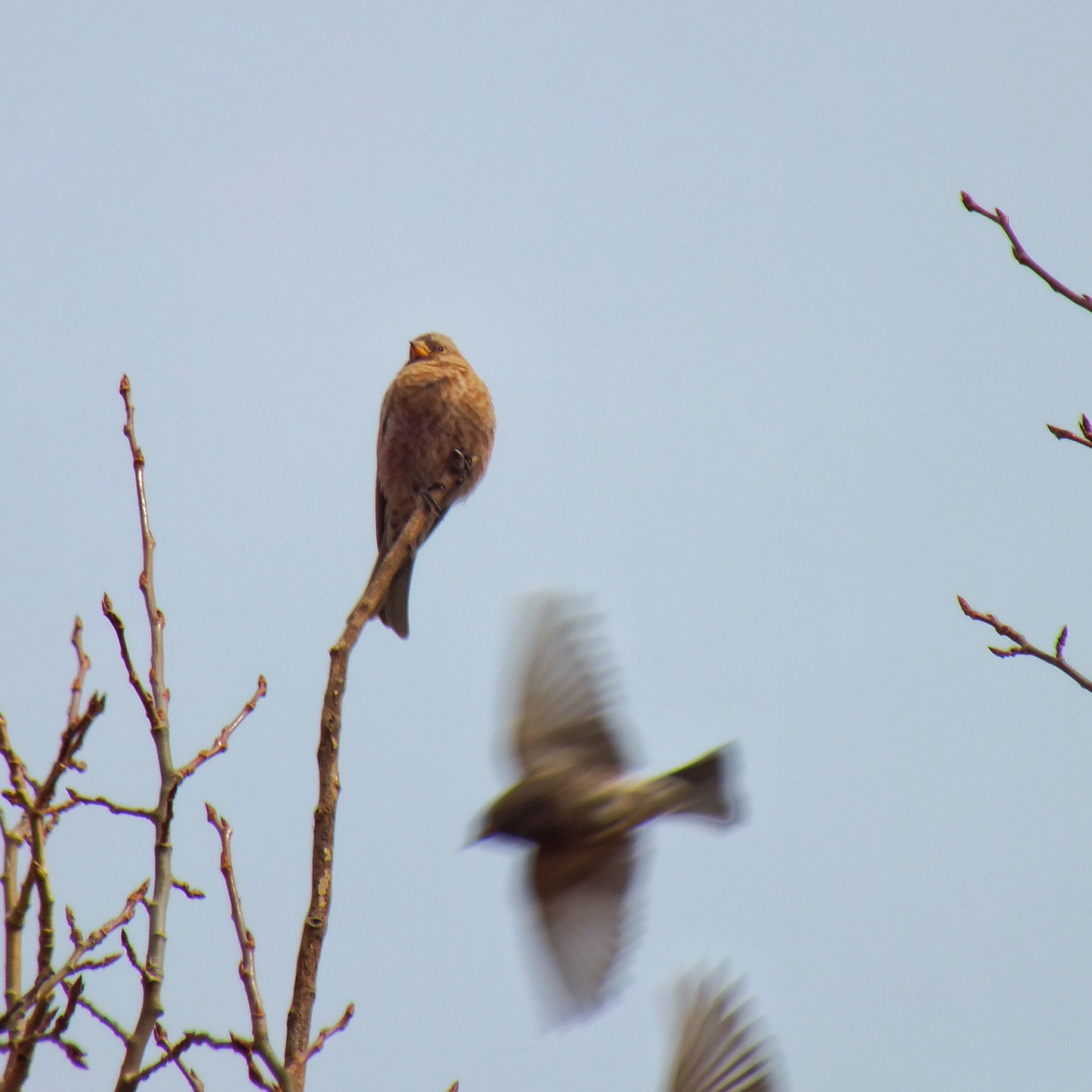
A Brown-capped, I’m pretty sure. It was often hard to see at the angle I had, but this one does not appear to have the gray head of the Gray-crowned.

The bird in the lower left of this next photo is also a Brown-capped.

The entire time I looked at the birds, two Mule Deer rested contentedly next to the blue house, not more than 30 feet from where I stood.

Posted in Wildlife | Comments Off on Bird #485 — Gray-crowned Rosy-Finch

Bird #484 — Black Rosy-Finch

leucosticte (from leuko, white, and stictos, varicolored) atrata (black)

Saturday, January 6, 2018 — 10:00 am

Victor, Colorado — Diamond Avenue

Black Rosy-Finches breed above timberline in mountains northwest of Colorado, but in the winter, they migrate southeast and hang out high in the mountains of Colorado with the other two species of rose-finches. All three species have been reported regularly in Victor, on the other side of Pikes Peak about an hour and a half from my house. The forecast was for temperatures near 50° so I headed up fairly early in the morning. I parked downtown and walked up and down the streets of the decrepit gold-mining town looking for birds while trying to look inconspicuous.

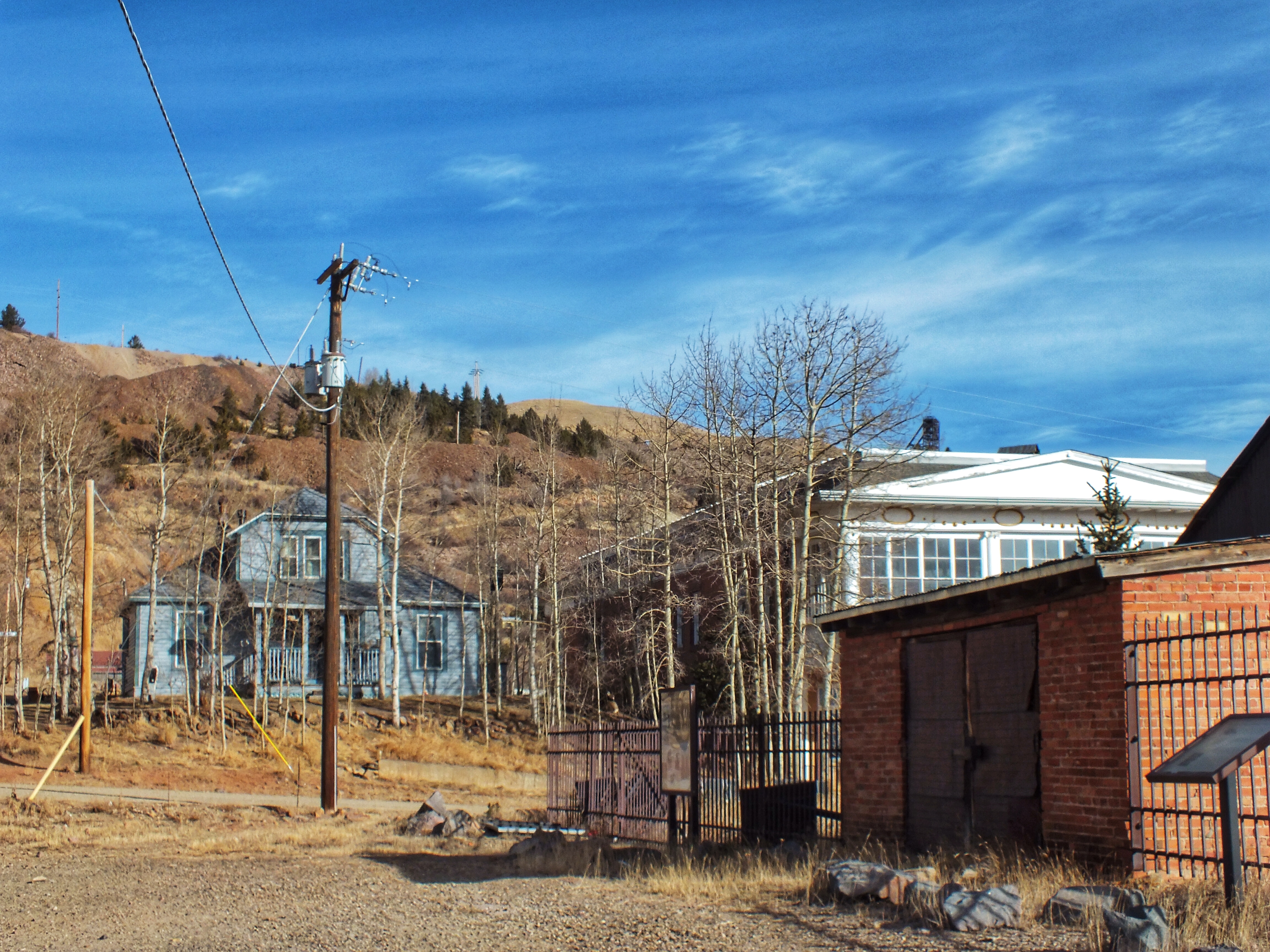
After about an hour I spotted the flock in an aspen next to an old building that I think is now divided into apartments or somesuch. The finches were there because of the feeders in front of a blue house next door. Here’s where I was when I first spotted them. The brick building on the right is an old rope-making factory from gold mining days. The bare hills in the background contain an active gold mine,

I leaned against a wall across the street for about 20 minutes and watched the finches. Locals kept driving by and staring. Most of them waved. All of them were obviously wondering what I was doing.

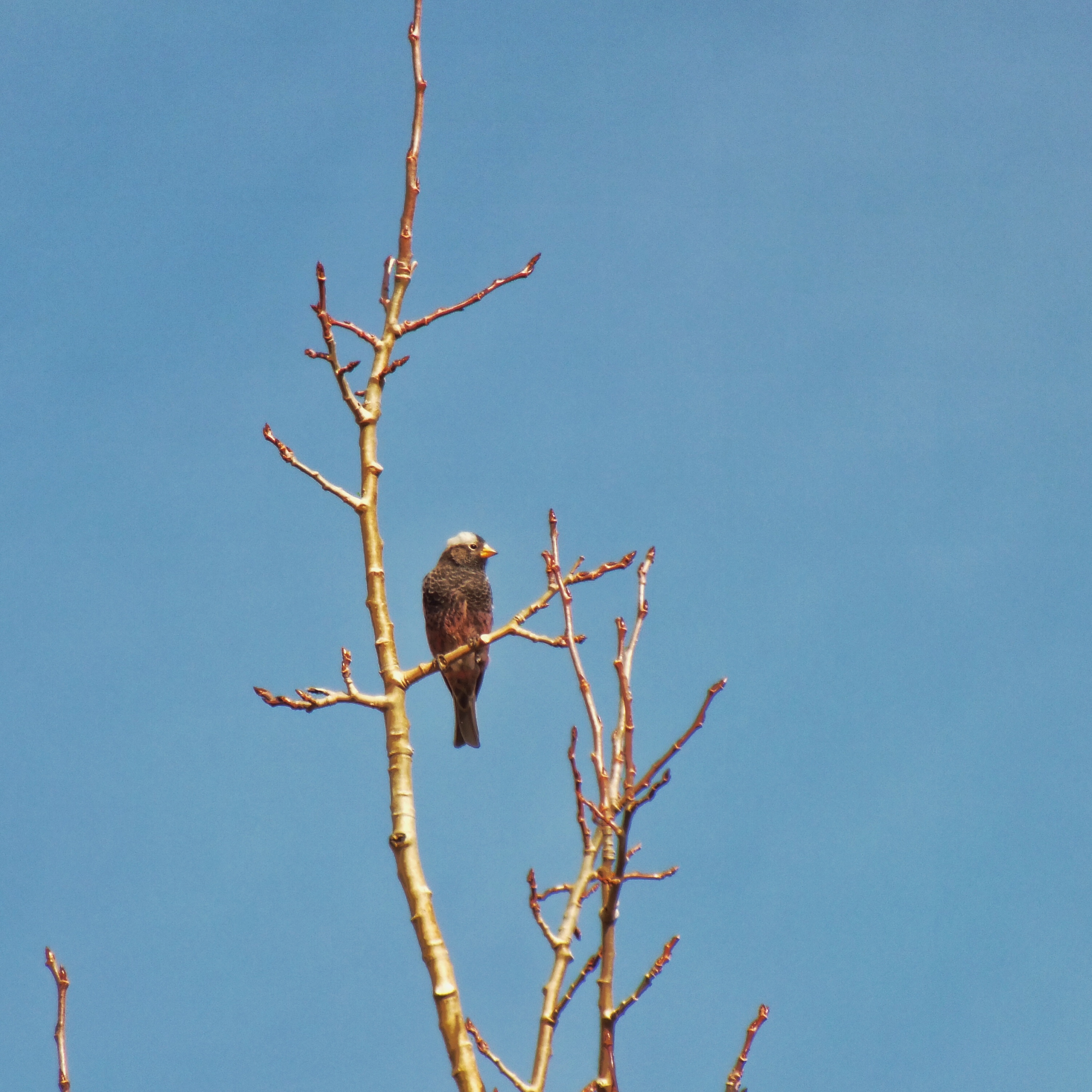
Anyway, even from a distance I could see that several of the birds were Black Rosy-Finches.

One with a crow for handy size comparison.

The adult males were definitely black. The females or first-year birds were grayer.

The flock spent most of the time in the tree. Once in a while most of them would fly down to the roof of the blue house, then down to the ground under the feeders. But they never stayed there for long. Something, or nothing, would spook them and they’d all take off and head back into the tree. A couple times, when a particularly loud pickup truck went by, they all took off and disappeared over the town, returning five minutes or so later.

When I first got there, the flock had 25-30 birds — mostly Blacks but with a few Gray-Crowns (also a lifer, next post) mixed in. When the flock took off yet again, I went into town to eat an early lunch at a bakery. I went back later. The flock had grown to over 70 birds with a lot of Brown-caps mixed in. Still, whenever part of the flock landed under the feeders, they were mostly Blacks.

Posted in Wildlife | Comments Off on Bird #484 — Black Rosy-Finch