dendrocygna (from dendron, tree, and cygnus, swan) autumnalis (belonging to autumn)
Wednesday, January 15, 2020 — 7:23 am
Winter Garden, Florida — Newton Park on Lake Apopka
I was hoping to see these ducks, but eBird sightings at Newton Park are spotty. No worries — there were a couple of retention ponds within a couple miles of the park where the ducks have often been seen lately. My plan was to go to Newton Park and see the Snail Kites and look around, then head for the retention ponds.
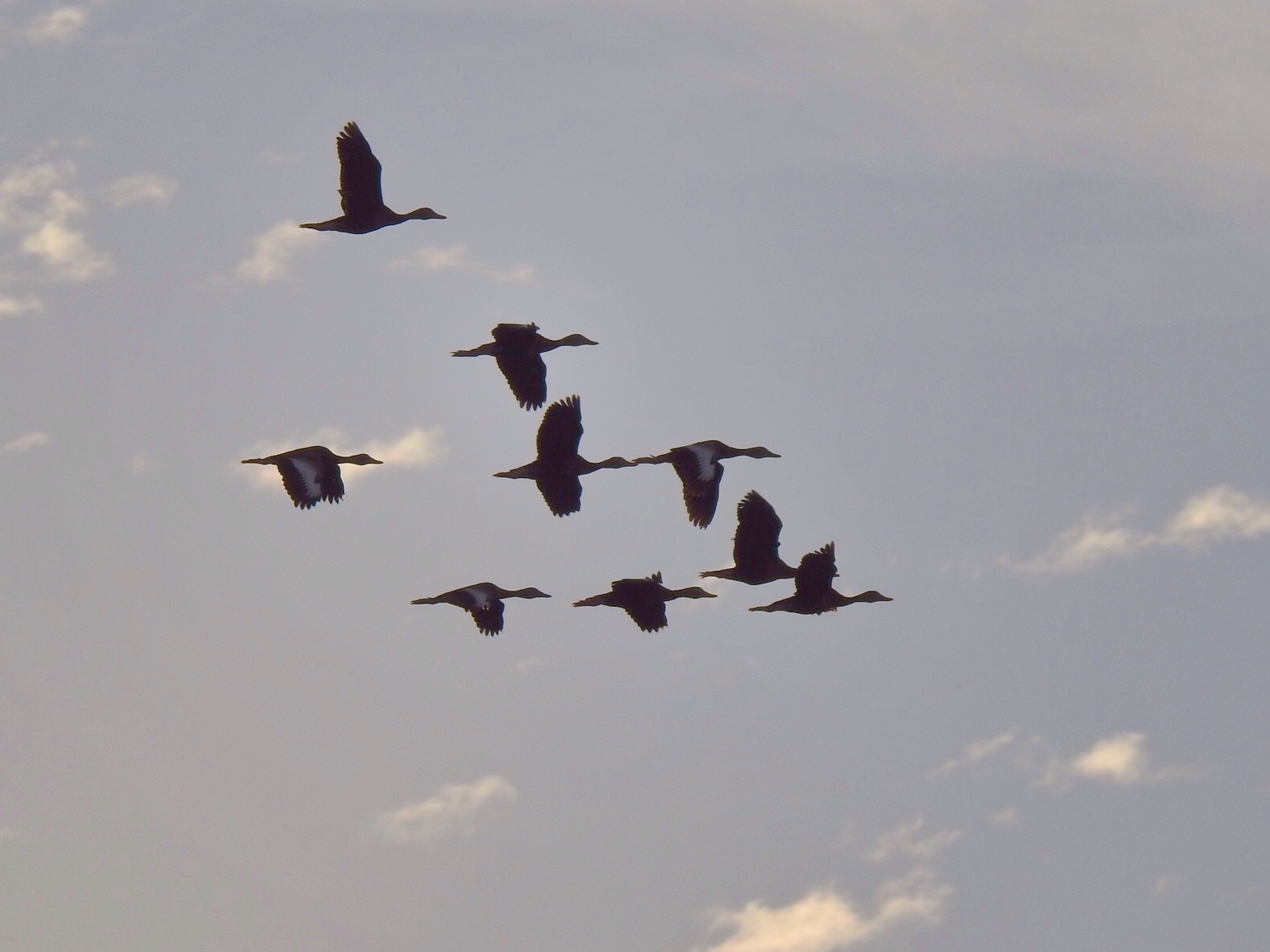
But maybe 15 minutes after I spotted the Snail Kite, I heard a flock of ducks go over making a high-pitched whistling sound. The ducks were silhouetted against the rising sun, but with my binoculars I could see enough to identify them as Black-bellied Whistling-Ducks. There were perhaps 12 in the flock. A few minutes later, a second flock passed over. I managed a lousy photo as they went by.
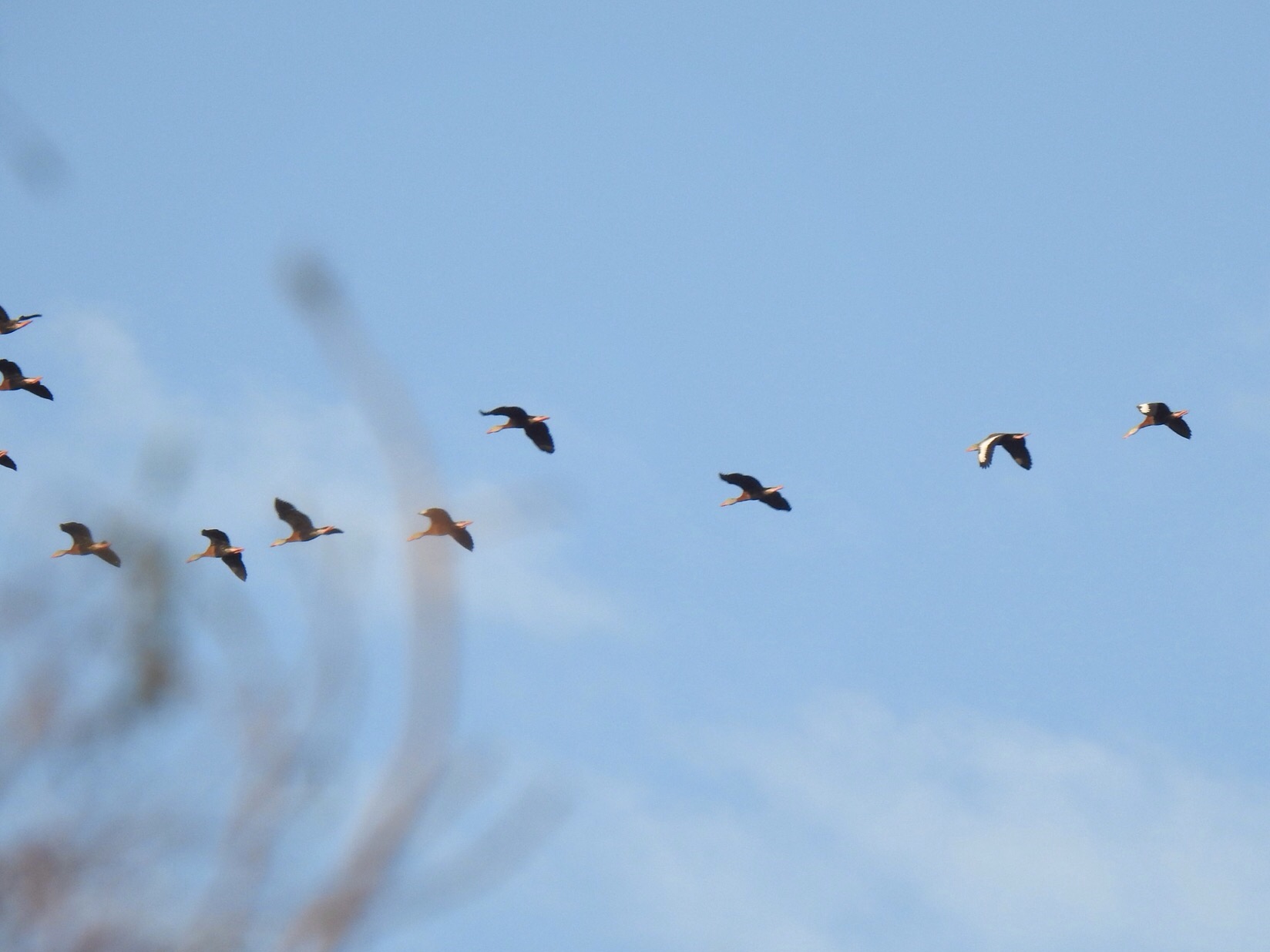
I had my lifer, but that photo wasn’t at all satisfactory. I didn’t have long to wait for another chance. I did a little better this time. It’s still a lousy photo, but at least this one is diagnostic. The ducks are lanky, with long necks, bold white wing patches, and red bills.
Finally a flock went over that gave me one brief chance to take a better photo.
And that was it. I gave myself enough time to check out the retention ponds because I really wanted to see them on the ground or in the water, but the ponds were empty today. If I had an hour or so, there’s a good chance I could have driven around the neighborhood and found them somewhere, but I had to get back. At least I saw them and got a diagnostic photo.
Historically, Black-bellied Whistling-Ducks were only found in the U.S. along the Mexican border. In recent years, their numbers have been increasing and their range has been extending north. They nest and roost in trees. This was probably one of the most common North American birds I hadn’t seen yet.
Posted inWildlife|Comments Off on Bird #553 — Black-bellied Whistling-Duck
rostrhamus (from rostrum, beak, and hamus, hook) sociabilis (sociable, gregarious)
Wednesday, January 15, 2020 — 7:06 a.m.
Winter Garden, Florida — Newton Park on Lake Apopka
I traveled to Orlando with a group from my work for a conference. In a moment of weakness, I decided not to stay an extra day to bird. Instead, I’d get up early one morning and drive half an hour north to the Lake Apopka Wildlife Drive where I had a very good chance of seeing four lifers. But then I realized that would only give me about 40 minutes to bird before I had to leave to get back to the first session of the conference. I pretty much gave up on birding. But then my boss greeted me one morning by giving me permission to skip the first session on Wednesday. That meant I’d have two hours to bird. I started getting excited again — until I did some research and found out the wildlife drive is only open on weekends. I sighed and looked for a plan B.
I found Newton Park, a small strip of lawn and playgrounds on the edge of the lake in the town of Winter Garden. The whole park is maybe 15 acres, all of it groomed. But the lake is shallow and weedy and local birders regularly reported a large number of birds. One of these was a Snail Kite, which would be a lifer. With a chance at a second lifer nearby (next post) it seemed worth my while. I rented an economy car from the Enterprise booth in the hotel I was staying at. Or at least I thought I did. When I went to pick it up, I discovered that I’d stupidly made the reservation for the following week. The kind young woman behind the desk explained to me that they don’t keep cars there. When someone makes a reservation, they order a car from the airport Enterprise. But they did happen to have a pickup, and they would give it to me for my economy car rate. Which was very nice of her.
That’s why I found myself driving through the early morning darkness to Winter Garden in a Dodge Ram 1500 for two hours of birding. It got light enough to actually see birds at 7:00, which was when the park opened. I arrived at 6:57. I parked the truck, gathered my camera and binoculars and headed across the parking lot.
I hadn’t been birding five minutes when I saw a Snail Kite land on the railing of a short boat-launching dock and begin feeding on an apple snail. I was maybe 50 feet away. Finding this lifer was that easy. It was still very early and not yet very light. My camera compensated and that’s why the photo is a bit blurry. Notice also the second Snail Kite out over the lake in the background swooping for a snail. Both of these are females. There was a slate-gray male flying over the lake on occasion, but I never managed a photo.
For the nearly two hours I was there, at least one Snail Kite was almost always in view. This is the same bird as the one above about an hour later, after the sun was up. It was perched in a tree right next to the dock where I first saw it. I know it’s the same one because I can read the numbers on the leg bands.
I saw it again later on the end of a second, longer dock. My guess is that the Boat-tailed Grackle was hoping to steal the snail.
The snails in the first and third photos are apple snails, pretty much the exclusive diet of Snail Kites — hence the hooked bill. The kites are common in Central and South America, but only reach the U.S. in Florida where 1,000 or so live. Their wings were broad and they flew with loose, floppy wing beats fairly close to the water. When they spotted a snail, they flopped down and grabbed it with their talons, then carried it to a perch to eat it.
Posted inWildlife|Comments Off on Bird #552 — Snail Kite
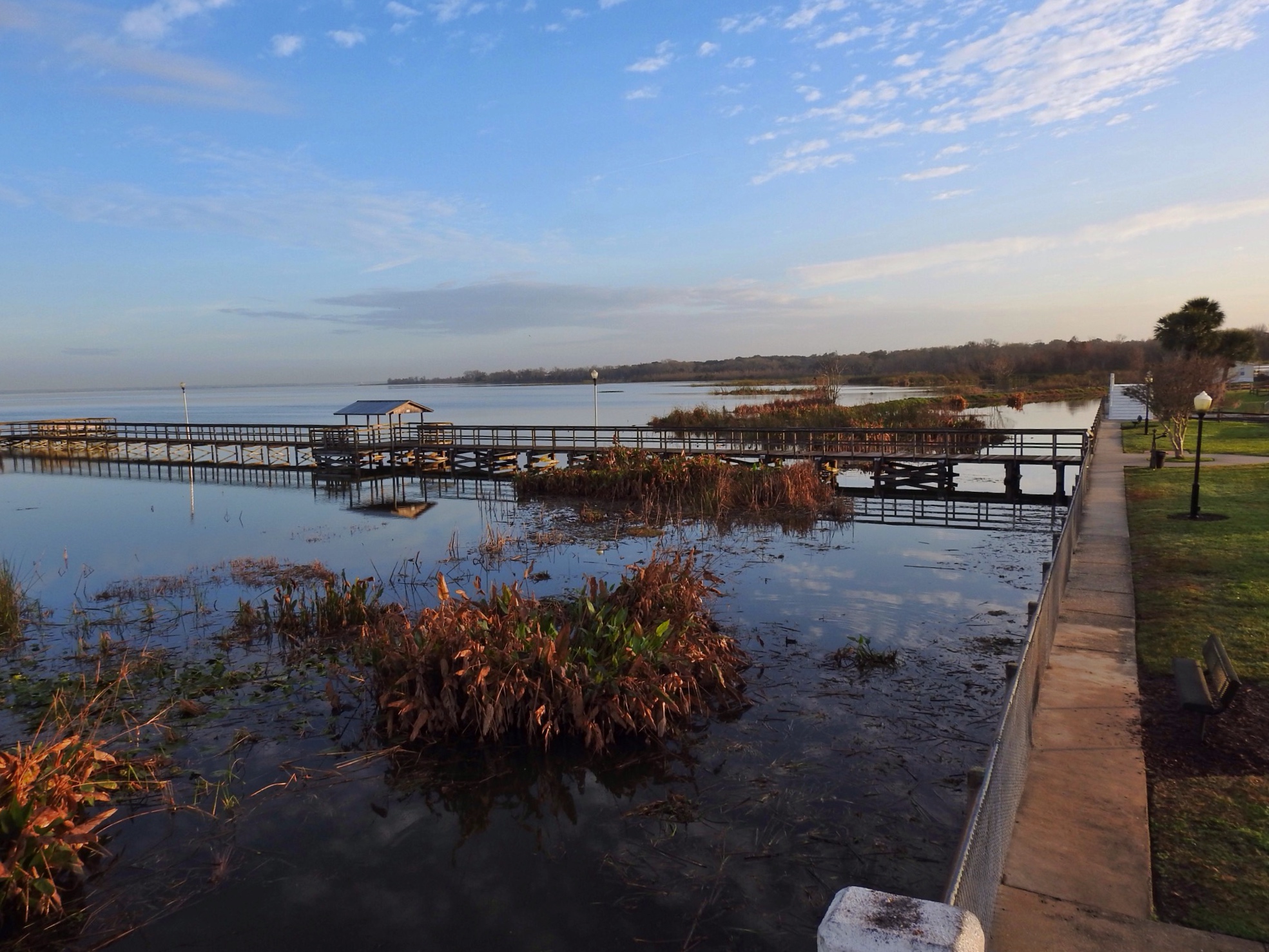
When I arrived at Newton Park on Lake Apopka, the sun hadn’t risen and things were quiet. Very shortly thereafter, it got light enough and birds began materializing out of thin air. Or so it seemed. They were everywhere. I saw the two lifers I was shooting for (next two posts) within minutes of arriving, so I had plenty of time to wander back and forth along the sidewalk that bordered the lake. The park was only about 1,500 feet from end to end. I walked back and forth three or four times, walked out to the end of the fishing pier, and even walked a block into the mobile home park next door to get a view of the lake further down. I only saw 28 species in the almost two hours I was there, but there were hundreds of birds around.
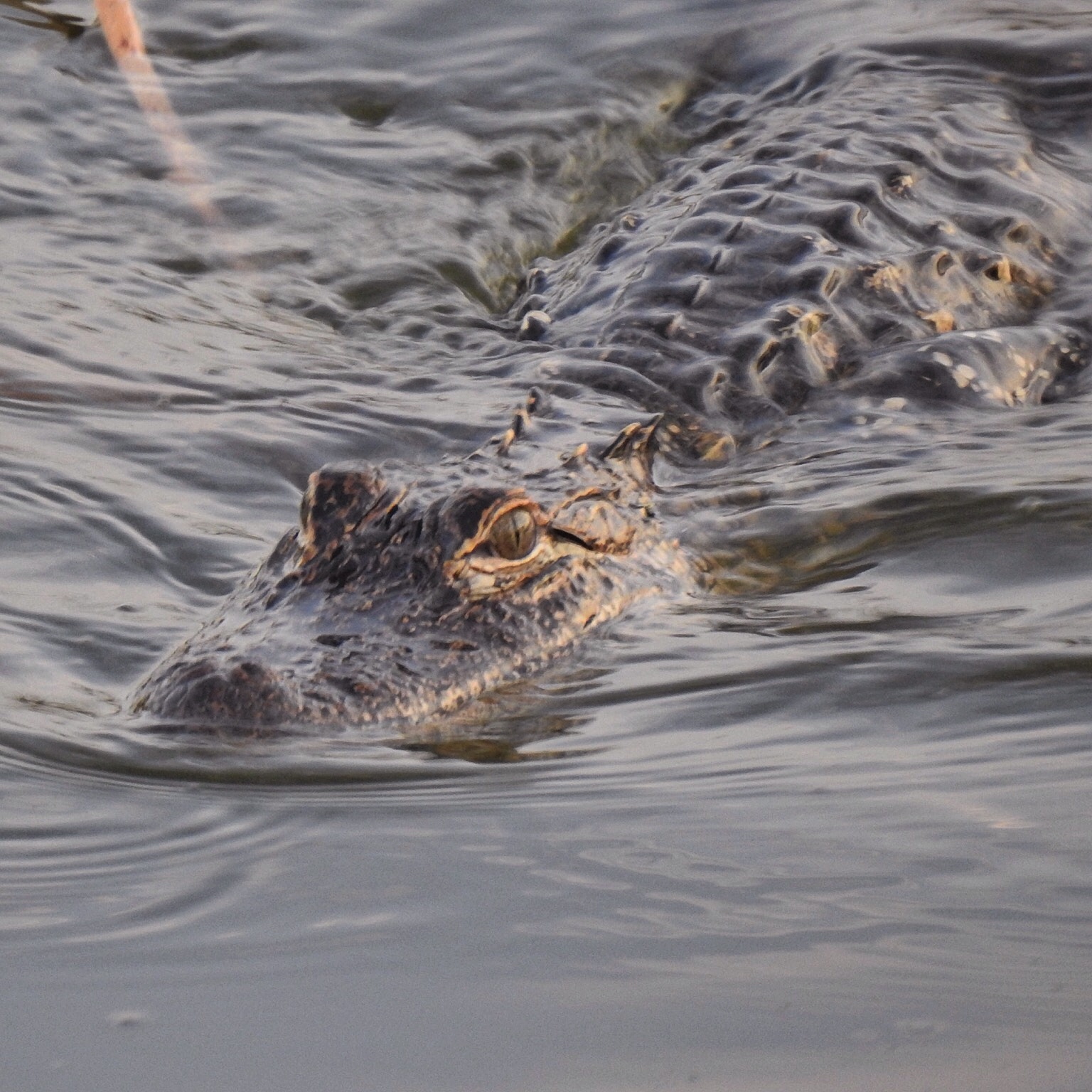
This alligator looks ferocious but it was only about three feet long.
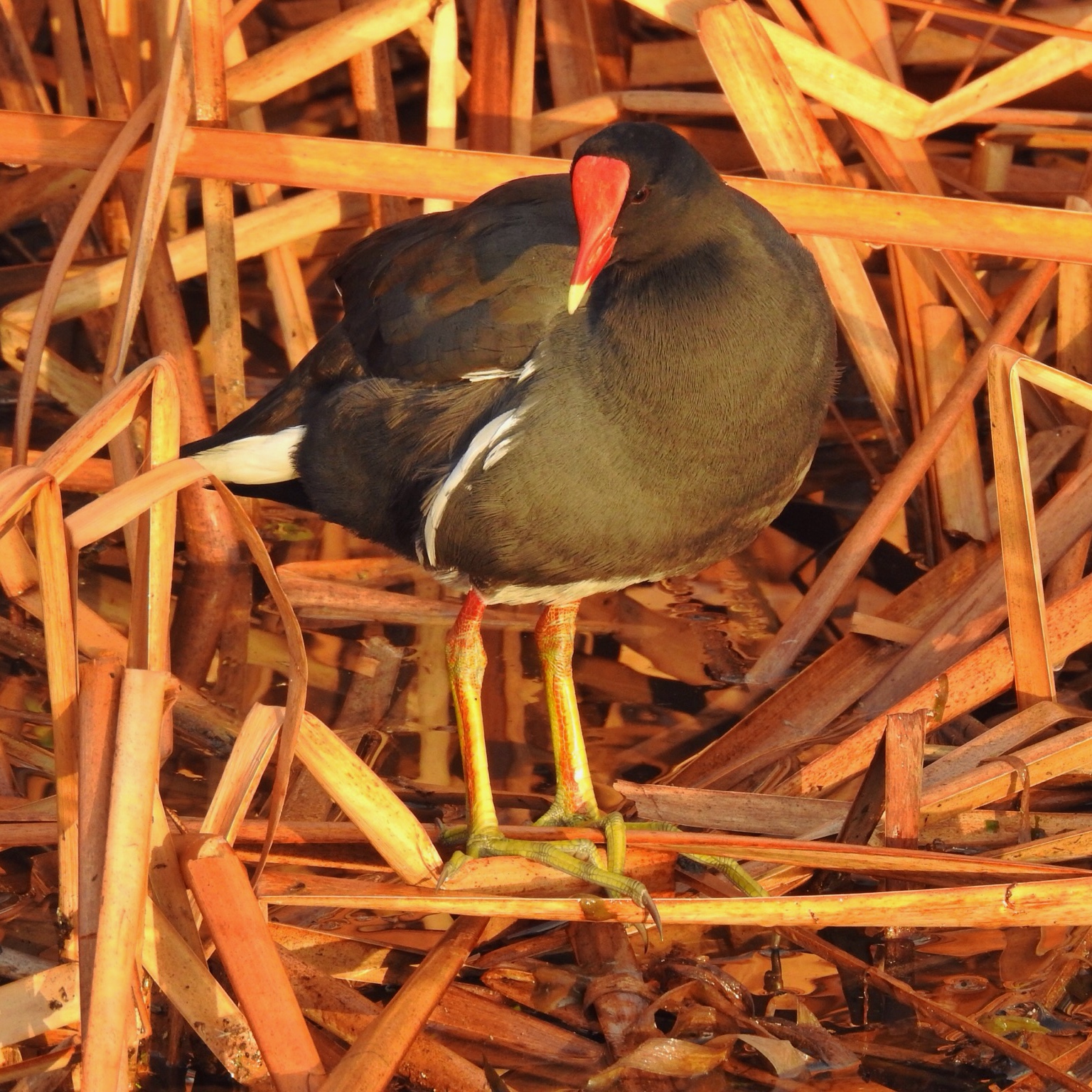
Common Gallinule. One of probably 100 in the area.
Glossy Ibis
Male Boat-tailed Grackle (I promise you that I did absolutely nothing to this photo except crop it.
Limpkin
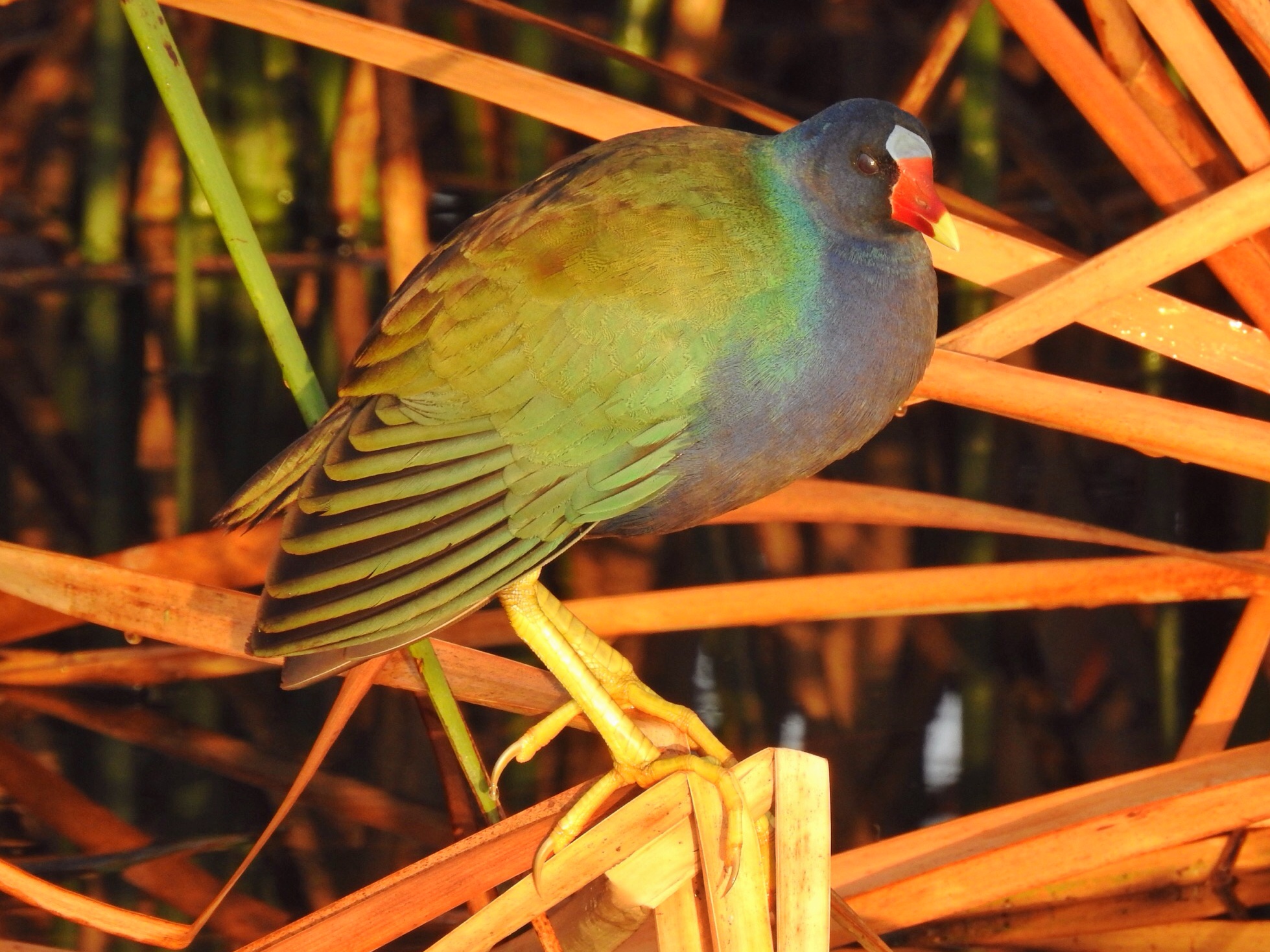
Purple Gallinule
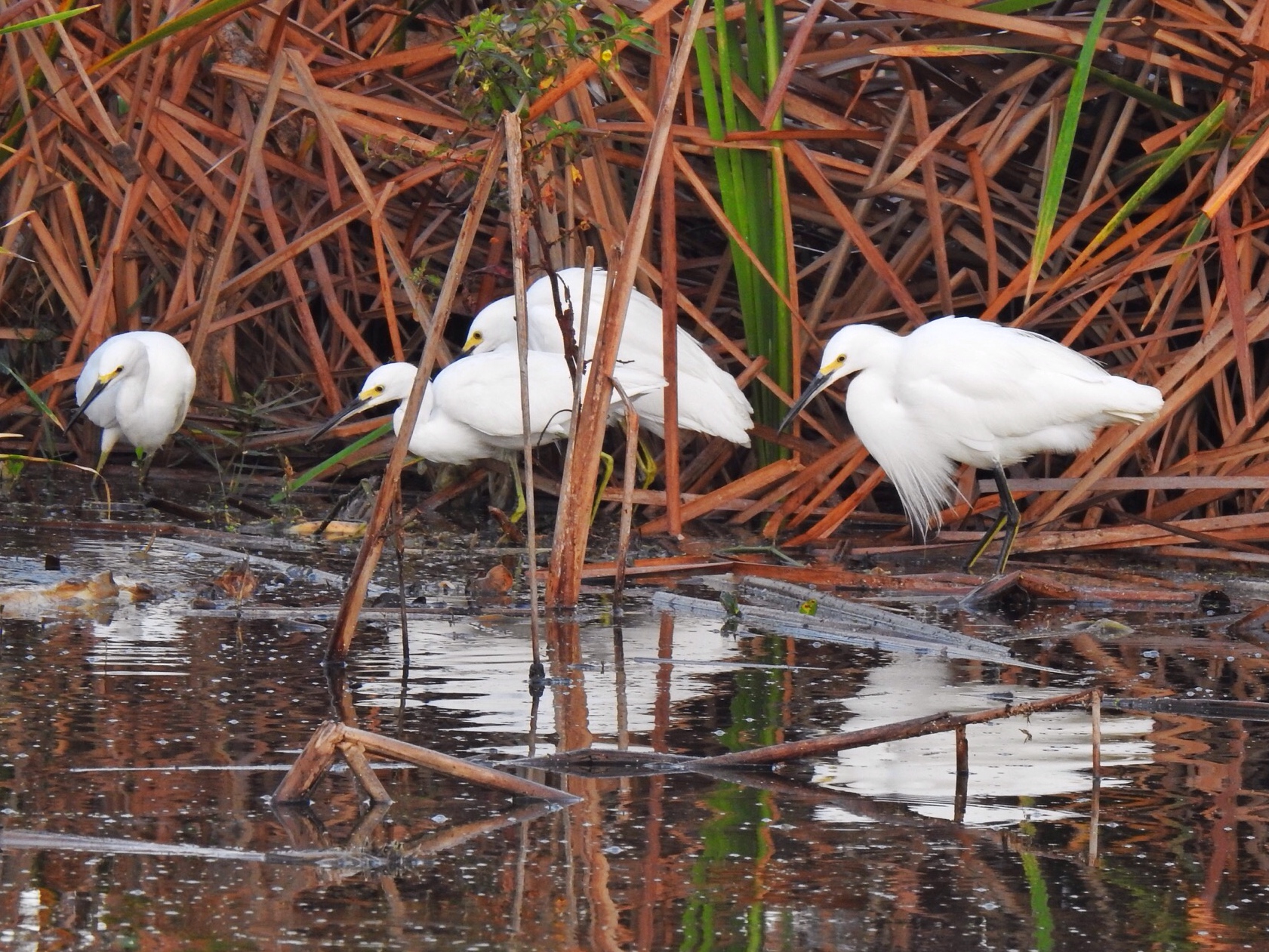
Snowy Egrets
Tricolored Heron. This bird has a terrible name.
There were Anhingas all over the place.
Posted inWildlife|Comments Off on Morning at Newton Park
While I was birding in Pueblo yesterday, exciting things were happening at Memorial Park in Colorado Springs. Birders were reporting Barrow’s Goldeneye, Greater Scaup, and Redhead. I drove down midday and walked around the lake. Much of it was frozen, but there were three patches of open water.
I walked around the lake so I could look at and photograph the birds in each patch with the best possible light. The ones I was looking for were all on the west side, opposite from where I parked.
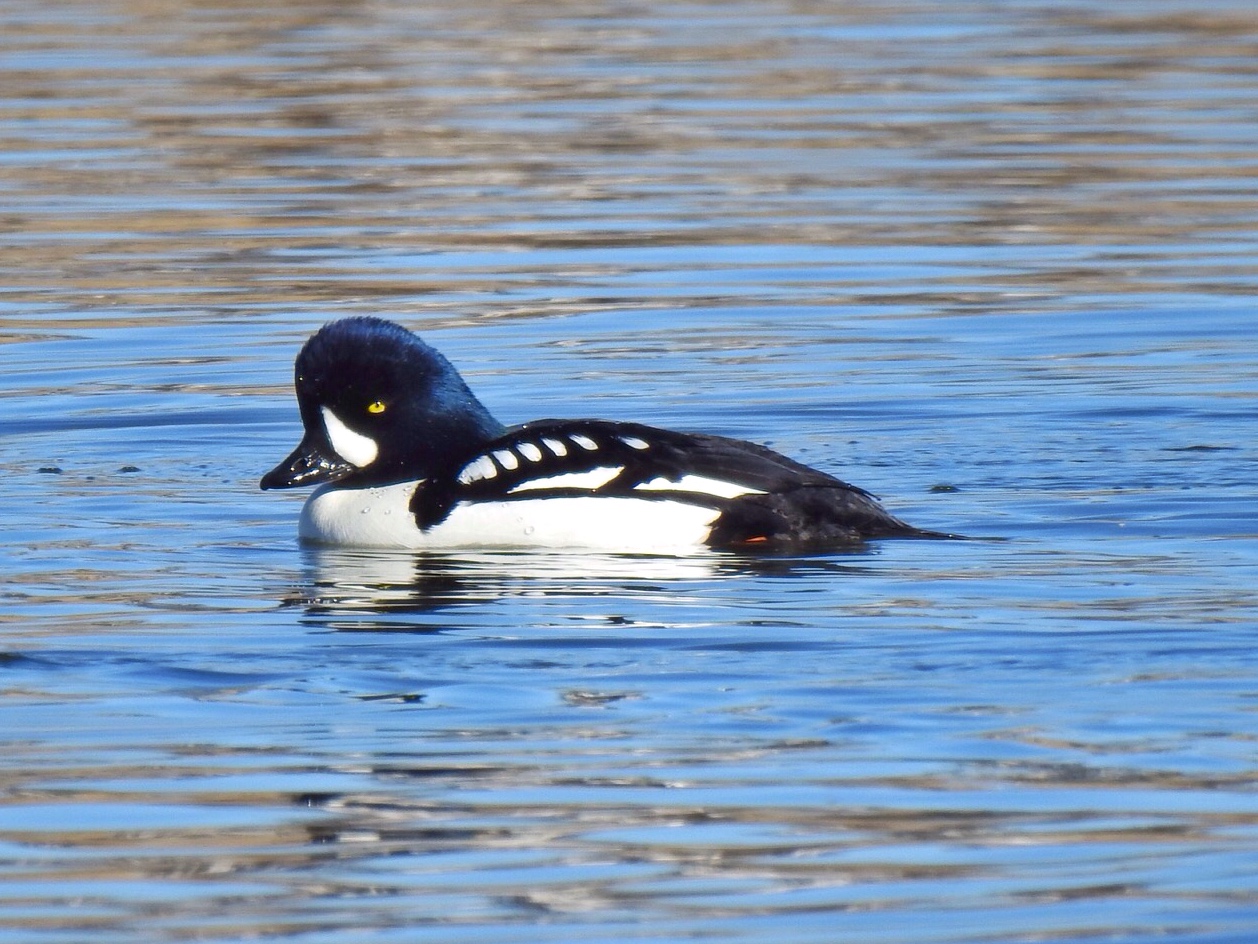
I found the Barrow’s Goldeneye almost immediately. It was diving along the edge of the ice about 40 yards out from shore. It and several Common Goldeneyes swam across in front of me, about 25 yards out. The sun was high, but this time of year it’s far enough in the south to give me fair light. That’s the Barrow’s on the left. You can see that it has more black on the back, a black “spur” that points down the side, a different head shape, a different-shaped head patch, and a different color sheen on the head feathers. The sheen isn’t always a noticeable, or reliable, mark. But in this case, with both species in the same light, it’s diagnostic.
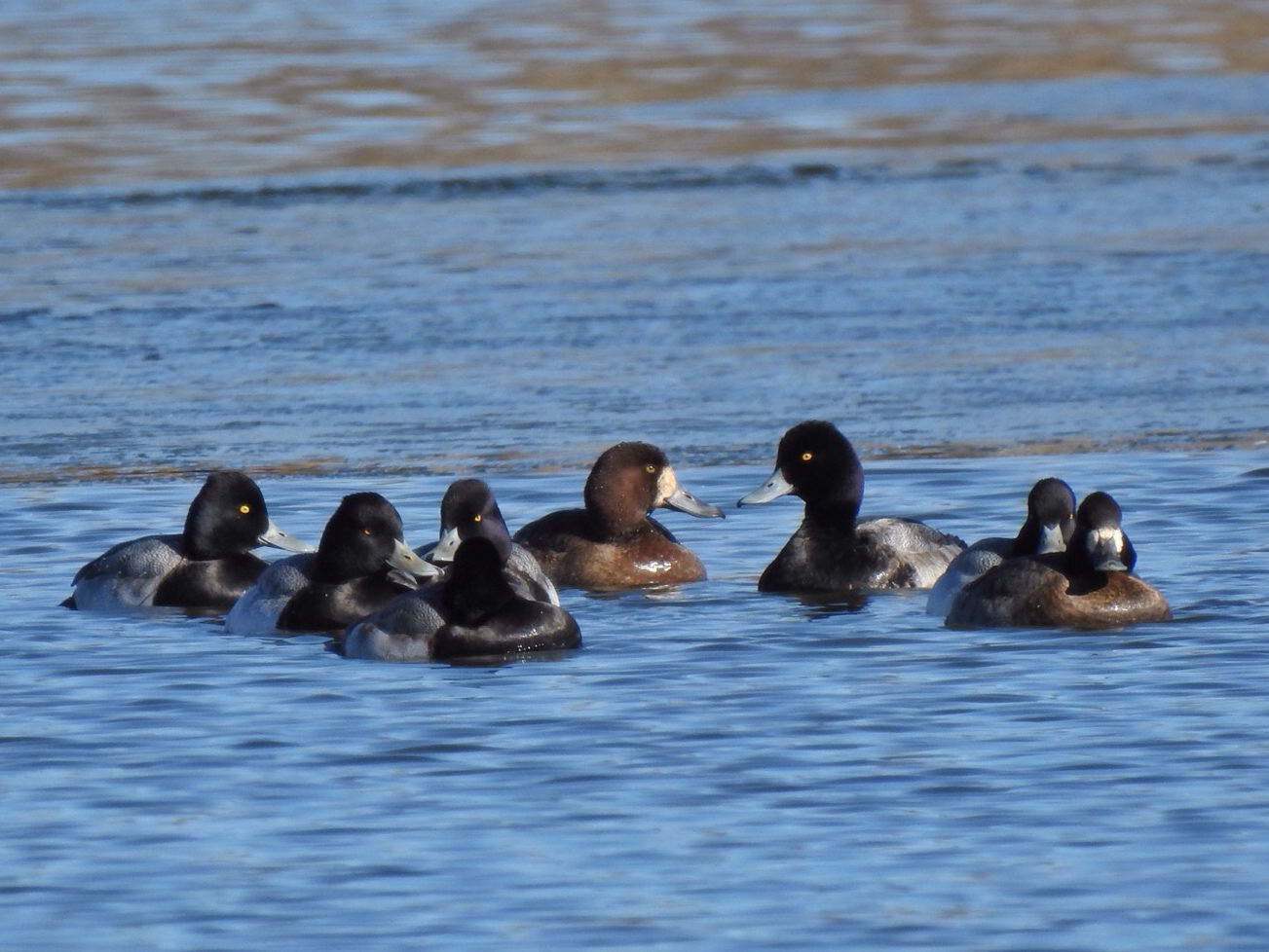
A small flock of scaup were also in the area. I spent a lot of time on them and finally found the female Greater Scaup hanging around with the Lesser Scaup. In this photo, it’s the brown female in the middle. You can tell from this angle that its bill is larger/thicker and its head is rounder, without that little peak/crest that can be seen on the back of three of the male Lessers.
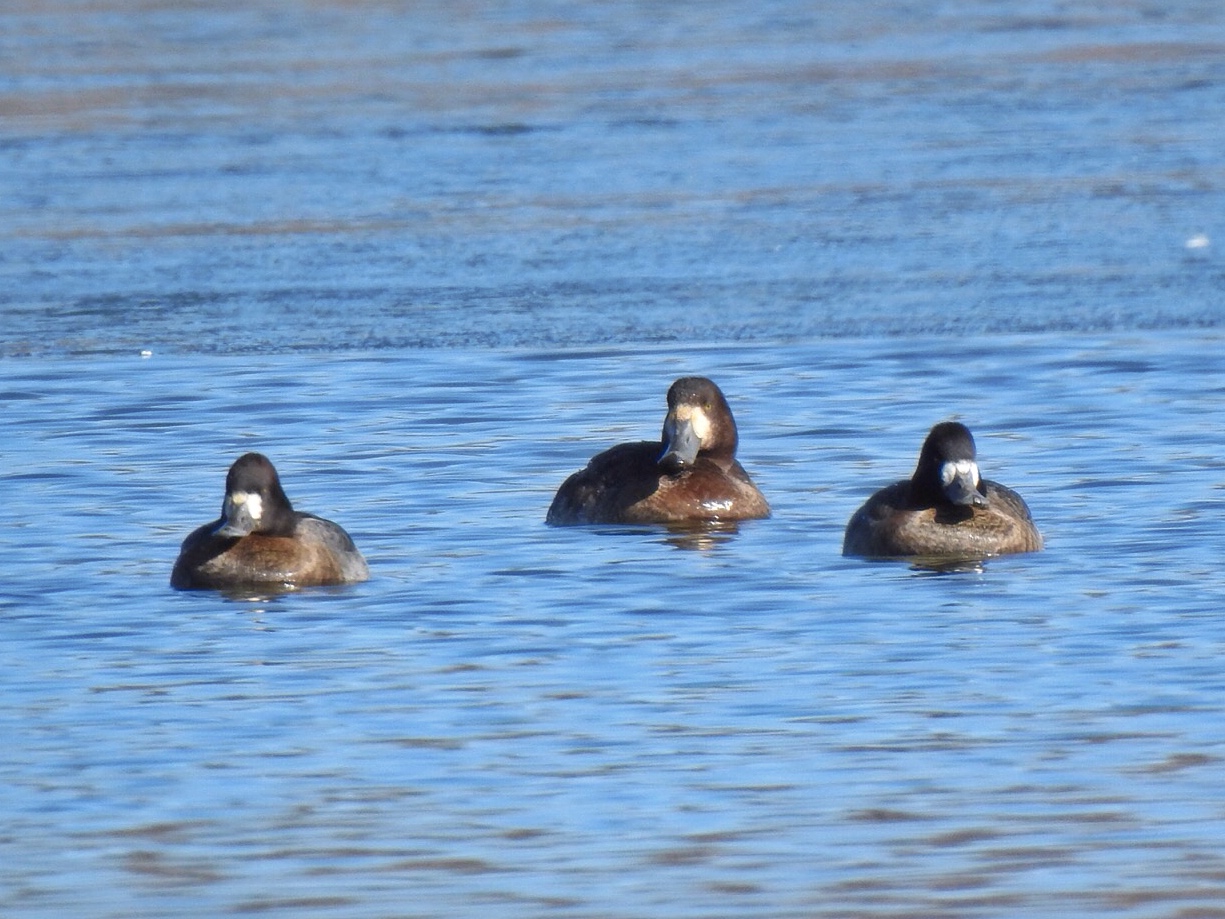
Here’s another shot of it swimming between two female Lesser Scaup. The Greater is simply bigger, a difference you can’t tell when the two species aren’t side by side, but obvious here. The Greater’s bill is wider and has a larger black “nail” on the tip. The Greater is also warmer brown than the Lessers here, but I don’t know if that’s a consistent field mark.
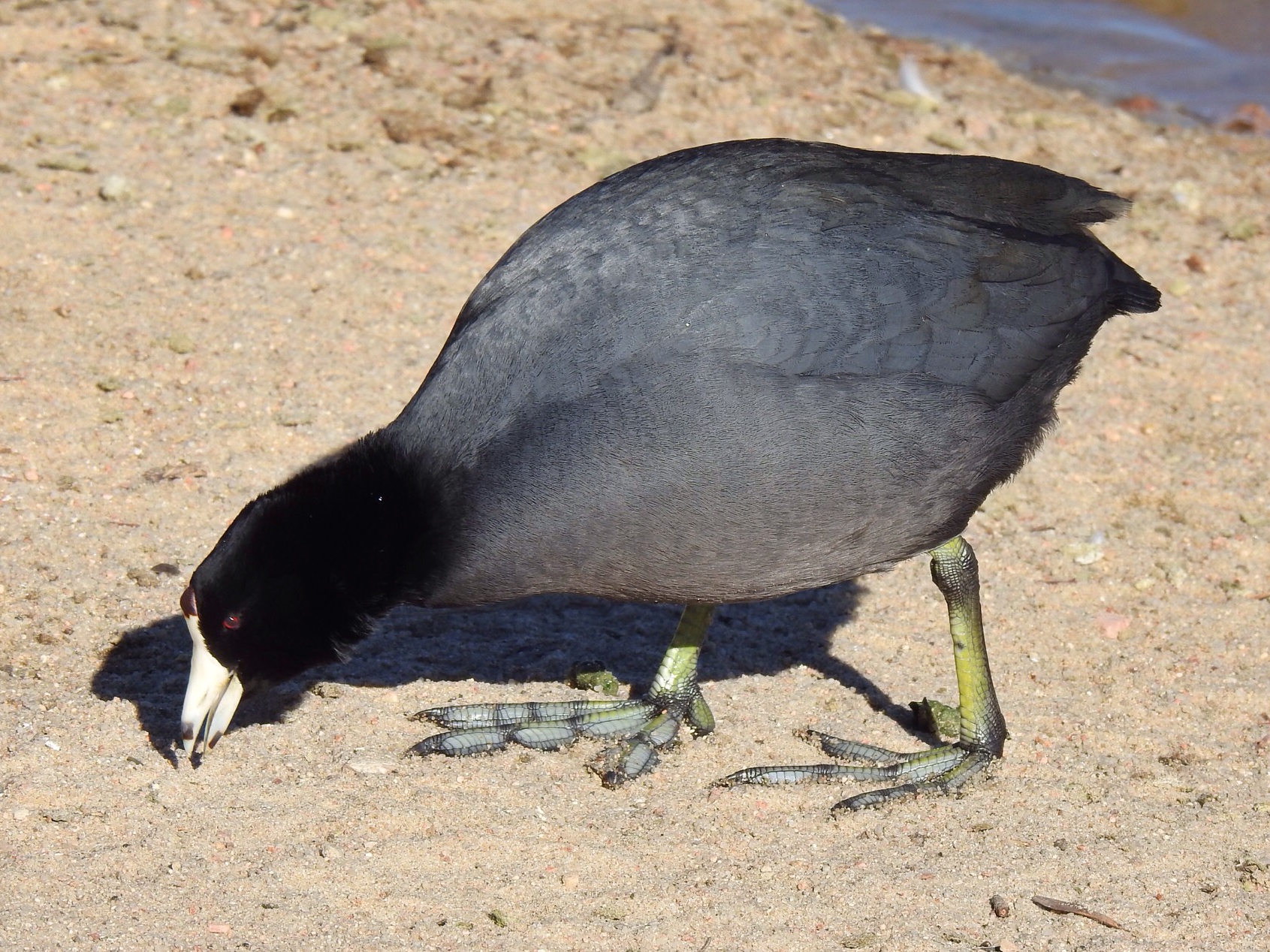
Another small patch of open water right along the shore was filled with geese, Mallards, American Wigeons, and American Coots. I waited until one of the coots climbed out on shore to get a photo of its feet.
The first clip on the video shows the two species of goldeneyes swimming and diving with a female Common Goldeneye and a male Bufflehead. Please note that Let it Snow was playing on the Memorial Park carillon in the background. The next two clips show the scaups. The last clip is of a swimming coot.
Memorial Park is the largest body of water in Colorado Springs, so it’s the go-to place for ducks, geese, and birders. But it’s in a somewhat sketchy part of town. There are homeless people, panhandlers, and guys having lengthy conversations by the open trunks of their cars. I stay aware of my surroundings when I’m there, checking to see if anyone is approaching or finding me particularly interesting. I’ve never had any problems, although there have been a few times when I thought it wise to move along. I had no problems today either, but I did have something odd occur. I was writing down the birds I saw in my notebook. A scruffy looking man with a scruffy beard who was driving a scruffy car on the road next to the park rolled down his window and called, “Hey, quit writing those birds down.” From his tone of voice, I’m pretty sure he was intending to be humorous, but still it was an odd thing to call out to a stranger.
Anyway, this brings my list for 2020 up to 81 birds, and the year’s not even two weeks old yet. If I continue seeing an average of 6.75 new birds a day, I’ll have 2,470 on my list by the end of the year.
Postscript: I received an email from the local eBird monitor about the Greater Scaup. Usually when this happens, it’s a request for me to provide more information on a rare bird — field notes, a description, an explanation of how I eliminated the possibility that the bird in question wasn’t a similar-looking species. Not this time. The monitor emailed me just to say, “Great shot of the Greater Scaup. I thought it was a really good photograph.”
A friend and I stopped at Clear Springs Ranch to look (in vain) for the screech-owl. We weren’t seeing much of anything until we got back to the parking lot. A male Northern Harrier was standing in the middle of the field next to I-25. He flew around a bit, then landed again. A Prairie Falcon flew over and landed in a cottonwood about 70 yards away. Within seconds, the harrier was chasing the falcon away. I managed to get two quick shots of the short confrontation.
We spent the morning at Lake Pueblo State Park where we walked the loop along the Arkansas River below the dam and then checked out the gulls at the South Marina. On a rock bar in the river, I picked out this lone Least Sandpiper. Some birder reported on Sunday that, because of this photo, which I posted on eBird, he and another birder walked along the river and found two Least Sandpipers, which are pretty rare in Colorado in January.
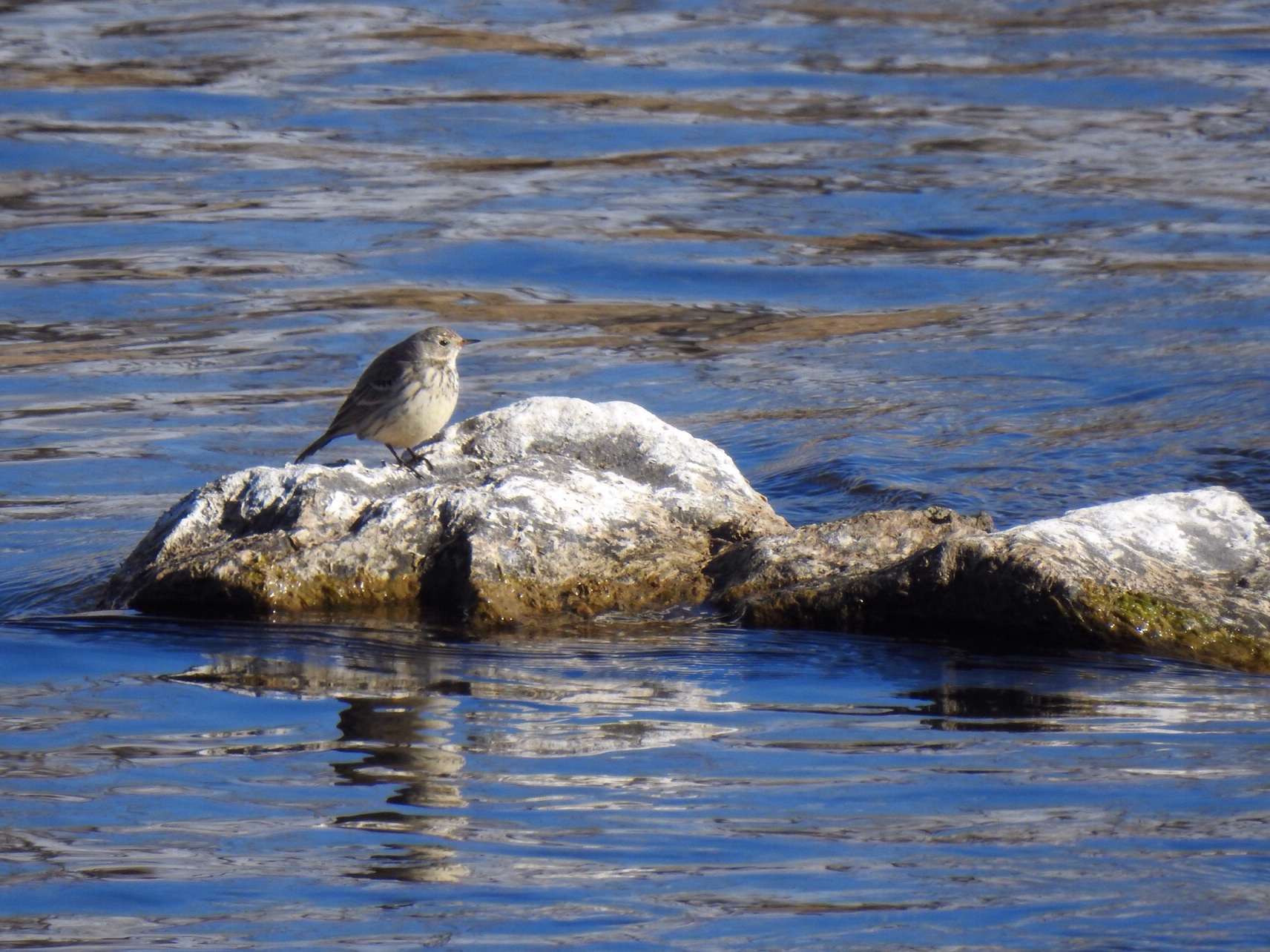
An American Pipit
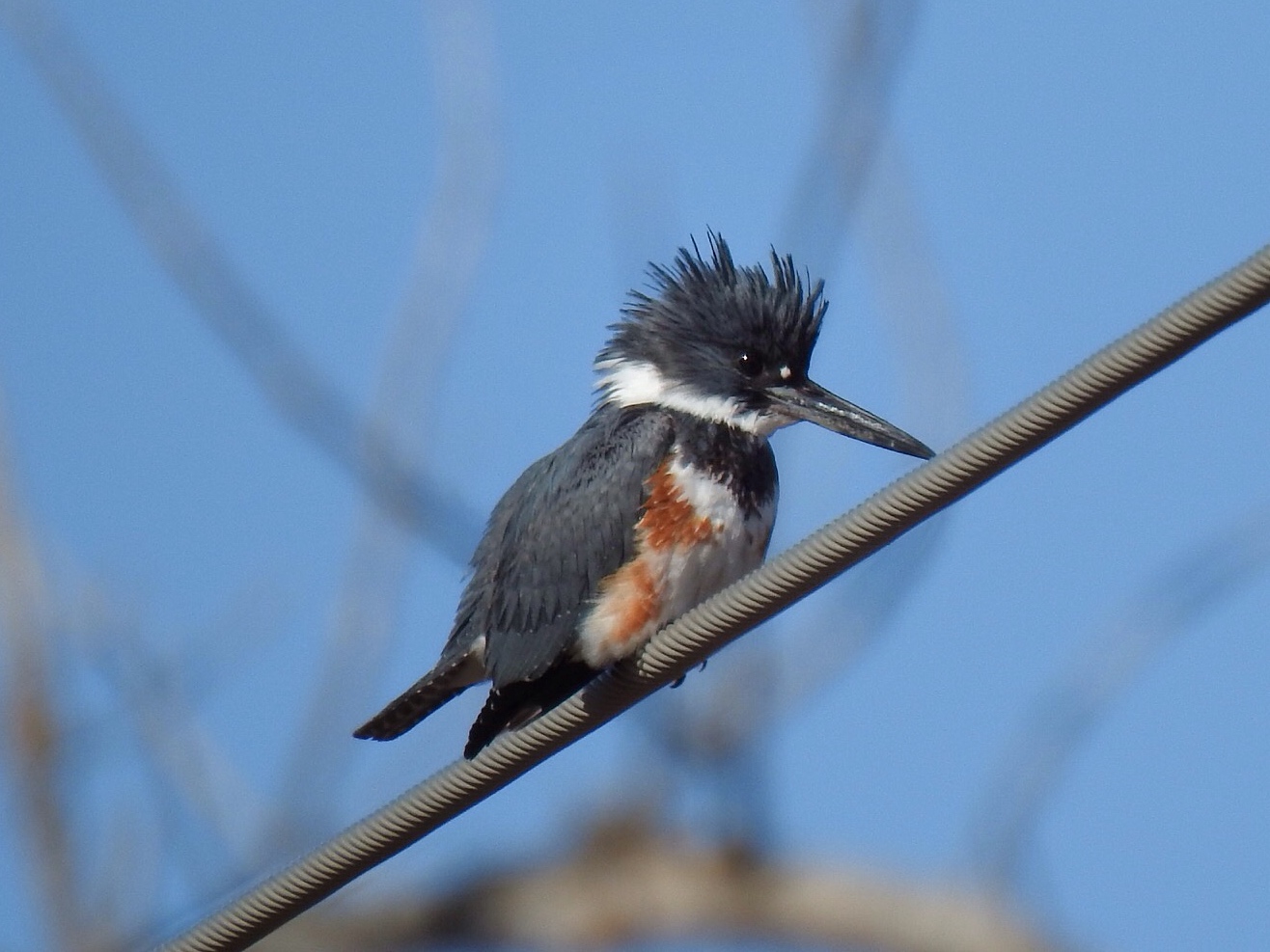
And a female Belted Kingfisher
In all, we saw 40 species, including two Dunlin on the tires at the South Marina, a Pacific Loon swimming near the dam, and all three mergansers at once at Valco Ponds.
At the marina, we ran into a 16-year-old kid who was birding with his parents. I’d met them briefly in Arvada last week when I was looking for the Brant. Apparently birding is a family affair for them, which is cool. They were very nice and pointed out some birds for us, including a flyover Bald Eagle.. I was able to point out the Dunlins and the Pacific Loon for them.