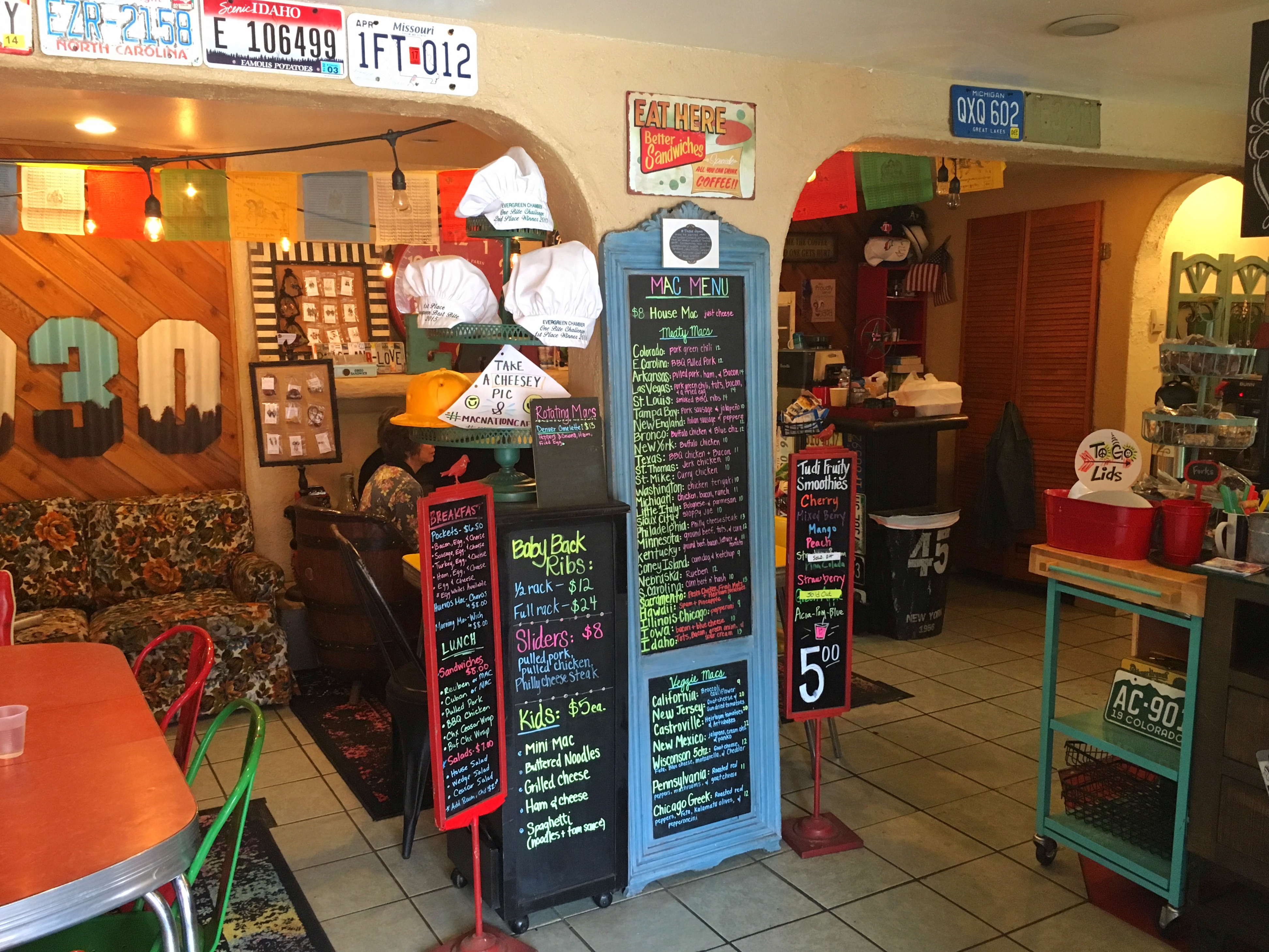
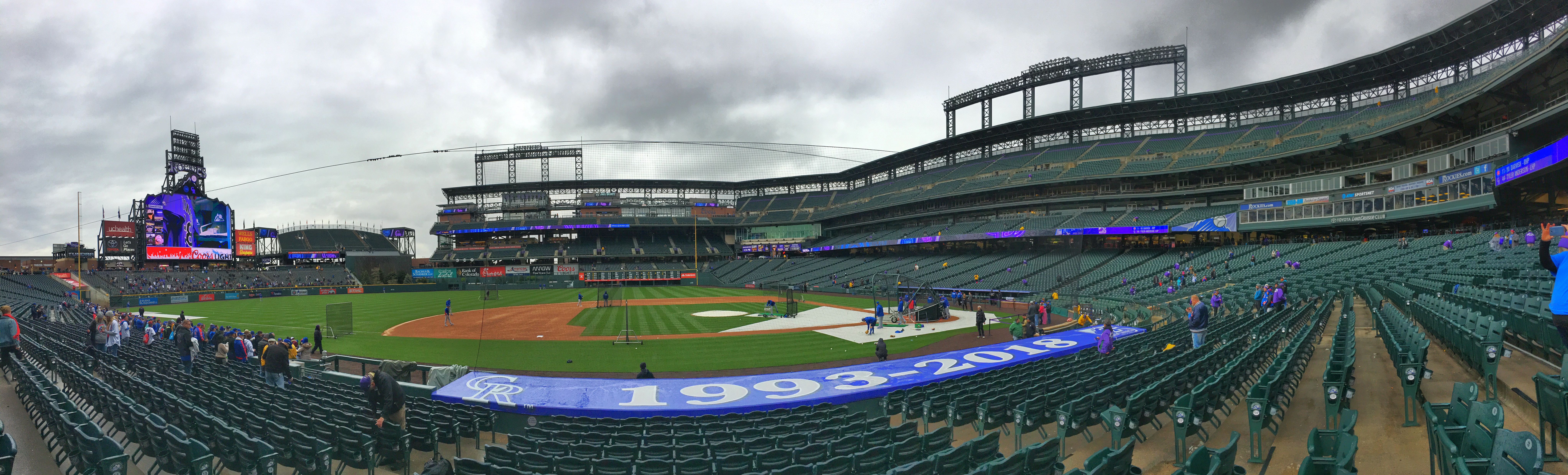
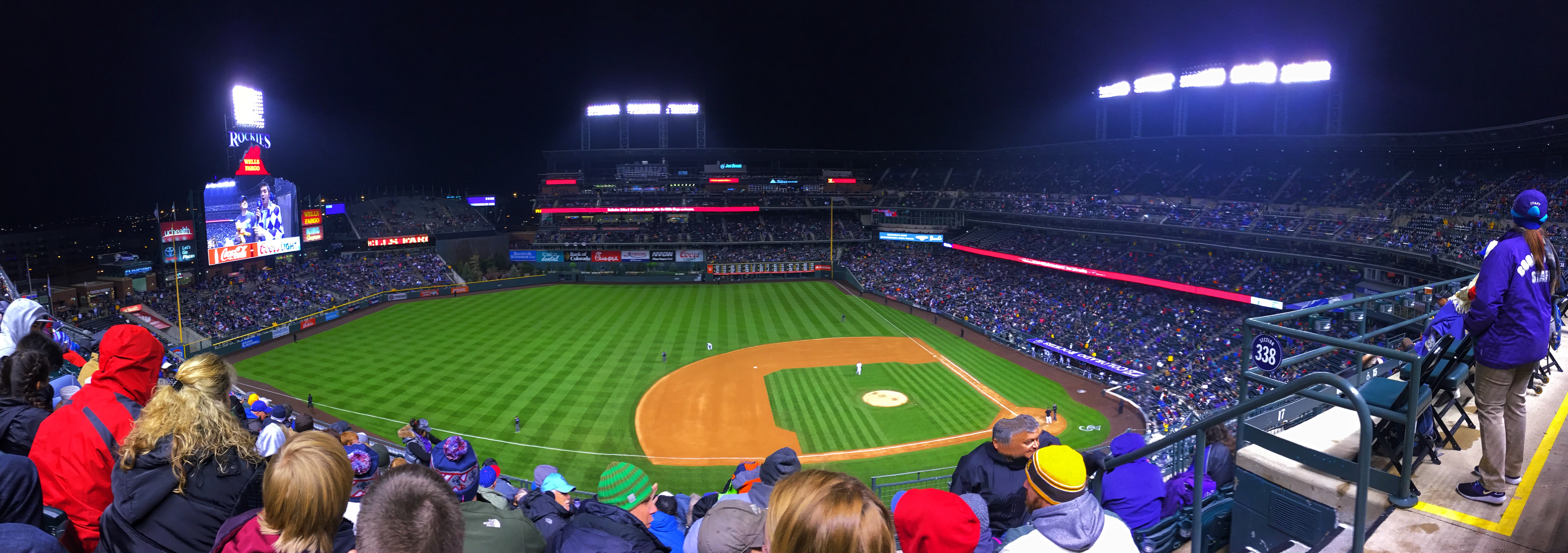
This tiny museum is crammed into a storefront kitty-corner from Coors Field. The collection features artifacts from MLB ballparks built between 1909 and 1923 — or so the woman at the desk informed me. In fact, there was stuff from Coors Field, from the Minor League Denver Bears, from the Seattle Pilots, and from several other newer fields. But most of the displays were on the older stadiums — Crosley Field, Forbes First, Wrigley, Fenway, Yankee Stadium. It’s all the personal collection of some local guy.
Admission was $10, which was pretty steep for the size of the place. There were three small rooms and a hallway or two. Most of the stuff was unlabeled, although much of it was self-explanatory. The focus of the museum was seats from various stadiums.
The next three photos show about 70% of the museum. The pennants on the seats were from the home teams of the stadiums the seats came from.
The Cubs logo on the floor is an on-deck circle from Wrigley Field.
The cement ornament and the arched window are both from Forbes Field in Pittsburgh.
Souvenirs from 1969, the Pilots lone season in the Major Leagues before moving to Milwaukee.
The woman at the desk told me that this uniform was owned by a player who was drafted by the Browns but never made it to the team because he was also drafted by the Army. When WWII was over, the guy decided to head to medical school and only played baseball in the summers.
The museum probably isn’t worth a special trip, but as a way to kill 45 minutes before a Rockies game, it was cool.
Posted inBaseball|Comments Off on National Ballpark Museum
centrocercus (from kentron, spur, and kerko, point) minimus (least)
Thursday, April 19, 2018 — 6:33 am
Gunnison County, Colorado — County Road 887, Waunita Watchable Wildlife Site
The Gunnison Sage-Grouse has only been considered a separate species since 2000. Pretty much as soon as it was distinguished from the Greater Sage-Grouse, it was put on the endangered list. There are an estimated 5,000 birds in seven populations in central Colorado and extreme eastern Utah.
There are only two ways to see a Gunnison Sage-Grouse. Drive around randomly in remote areas of central Colorado and hope to spot one that happens to be crossing the road, or go to a lek where they do their courtship dances in April and early May. But since the bird is so rare, the leks are protected. There is only one lek that is viewable by the the public, and even it may not remain open much longer. I decided to go see the bird while I could.
I took two days off work. On Wednesday, I birded my way west through Canon City and Bighorn Sheep Canyon and stayed overnight in Gunnison. On the way on Wednesday afternoon, I stopped by the small parking area near the lek to see what it looked like and to make sure I could find it in the dark the next morning.
On Thursday, I woke up at 3:45 and drove 20 miles in the dark to the spot. This was fairly brave of me because I was headed to the middle of nowhere with two warning lights lit up on my dashboard. It wouldn’t have been a good place to break down. I was the first one at the site — it was 4:38, but within five minutes, two more vehicles parked behind me. A while later, a group came in a van and filed into a trailer next to my car. The trailer can be rented for $100 and would be much more comfortable than sitting sideways in a car.
A college girl pulled up and walked to each of the vehicles. She gave us instructions and had us fill out a survey. The questions were mostly about where we’d stayed and how much money we’d spent in the area — obviously gathering info to show the locals that birders help the local economy.
I sat in my car and watched the morning dawn. It was in the mid-20’s before the sun came up. When I first arrived, the night was pitch black except for about a million stars. Slowly the nearby hills were silhouetted, then the vegetation faded into view. I was there for almost two hours before I saw my first grouse.
It was down on the flats about halfway to the ridge. It stood so still that, in the dim light, I wasn’t sure if it was really a bird. I scanned the area with my scope, then looked back. The bird was still there, still motionless, but about two feet to the right of where it had been. Seconds later, it took off and flew out of sight to the north. So I had my lifer, but it wasn’t a very satisfying look.
A few minutes later, I saw a grouse on top of the ridge about half a mile away. I could only see it through my scope — it was too far away to pick out with the naked eye. The first one was soon joined by another. One of them walked down the slope a short way. Both were males, and both were doing their courtship dance. This consists of ruffling up the chest feathers, throwing the head back, and forcing air into the pouches on the chest. These two pouches look much like sunny-side-up eggs — yellow against a white background. Apparently female sage-grouse go for this. Here’s a photo I stole off the Internet that will explain what I’m talking about and help make sense of the video below.
For the next hour, I watched as best as I could. I saw some grouse walk up the ridge to the lek and others dancing at the crest. The most birds I counted at any one moment was eight, but I think there were a lot more. The males were easier to spot, of course, with the sun lighting up their spread tales and neck feathers. Later, I saw eight fly off to the north, and there were still at least four on the ridge, so I’m saying I saw 12 of them. The actual number was probably closer to 20.
As the sun rose higher, it backlit the birds but also made it very difficult to watch them without going blind. It got to the point when the only way for me to view them was to hold my phone up to my scope and watch the screen while ducking out of the glare.
When the eight birds flew off to the north at about 7:30, the group in the trailer filed out and the girl in the Jeep motioned the rest of us to leave, even though there were still grouse on the ridge. Apart from having to get up ridiculously early, there wasn’t much challenge to adding this lifer. It wasn’t a great view, but it’s the only way to see a Gunnison Sage-Grouse, and one does what one must.
Here’s a mash-up of the video I took.
Posted inWildlife|Comments Off on Bird #490 — Gunnison Sage-Grouse
I took two days off work and drove to Gunnison. Colorado to see the Gunnison Sage-Grouse (next post). I left home about 7:30 and headed to Canon City. A Lewis’s Woodpecker has been hanging out in a residential neighborhood, but I couldn’t find it. I walked the Arkansas River Trail in town for a couple hours and saw four new birds for the year including an Eastern Phoebe.
After lunch at Jimmy John’s, I headed west through Bighorn Sheep Canyon. Two Golden Eagles were soaring over the road near Parkdale. I managed to find a place to pull over to get a better look. I stopped at almost every parking area in the canyon, scanning the river for dippers or anything else I could find. I even drove up to Hayden Creek Campground where I birded back in 2012, but unlike that time, there were several people camping there, so I didn’t stay.
I drove over Monarch Pass and down into Gunnison. After checking into the Holiday Inn Express ($144), I drove further west to Curecanti National Recreation Area. I hiked a trail along the Gunnison River. It wasn’t long and it wasn’t maintained. I did see my first dipper of the year, but not much else. I drove further west to the first bridge over the reservoir. A large flock of ducks were along the shore, so I grabbed my scope and walked to where I could get a good look.
When I got back to Gunnison, I headed south on a dirt road into sagebrush country just on the off chance that I might see a sage-grouse wander across the road. I didn’t see any grouse or much of anything else. I did see the engine light lit up on my dashboard, and didn’t want to get too far out into the middle of nowhere.
I bought supper at McDonald’s and headed to my room. I only stayed up a short while. I hadn’t slept much the night before and had to get up very early the next morning, so I was in bed by 8:30.
After I saw the grouse on Thursday morning, I headed back toward home. I saw a herd of Elk just west of Monarch Pass. I stopped in Salida for second breakfast (I’d had a couple Pop-Tarts at 4:30), then drove back to Canon City. I drove over Skyline Drive, parked, and walked around a little while. I saw my first Colorado White-winged Dove.
The Lewis’s Woodpecker had been seen the previous afternoon, so I went back to look for it again. This time I found it. It was still early, so I went back to the Riverwalk and retraced my steps from yesterday. I added my first Colorado Evening Grosbeaks and Black Phoebes. I struck up a conversation with a birding couple who just moved out here from Racine. I mentioned Wind Point and they laughed and said they birded there often.
I drove through Florence, then headed home after two fun and bird-filled days.
Or as bird-filled as Colorado ever gets. I ended with 68 species, including one lifer, 15 new birds for the year, and seven new birds for Colorado. Those seven birds push Colorado past Wisconsin into second place on my state lists.
Here’s a video compilation of things I saw over the two days.
oreoscoptes (from oros, mountain, and scoptes, mimic) montanus (mountains)
Saturday, April 7, 2018 — 11:20 am
El Paso County, Colorado — Meridian Road
It was only a matter of time with this bird. It’s the last of the really easy ones around Colorado Springs.
Several have been seen in the cholla flats on the southern edge of the county recently. I’ve made a couple trips to the area to look for them. Last Sunday, I’m almost certain I spotted one, but I was on a road that had sparse but fast-moving traffic, so I had to pull over. When I looked again, what I saw was a Curve-billed Thrasher. I’m pretty sure I was looking at two separate birds, but I couldn’t count a lifer under those circumstances.
I almost didn’t go out today. It was damp and cold and the entire county was covered with a layer of frost. Even the dry desert was white.
I had just spotted two Canyon Towhees when I saw another bird fly low and land on a cholla. I stopped and looked — and knew immediately it was a Sage Thrasher.
It flew down to the ground and foraged around. At times it would stand in plain view, but often only its head was visible. It went from place to place by running quickly on the ground.
It flew to the top of a cholla stalk where my camera refused to focus. After a couple minutes, it flew back down to the ground and disappeared in the scrub.
About two hours later and 20 miles away, I found another one on Bar 10 Road. This one was in a more open area. Perhaps that why it spent more of its time running quickly from cover to cover. It did fly up to a fence post for a minute. Again, my camera wouldn’t cooperate. This is the best shot I could get.
Posted inWildlife|Comments Off on Bird #489 — Sage Thrasher
My plan for Saturday was to head south to the cholla flats to make yet another attempt to see a Sage Thrasher. But when I woke up shortly after dawn and looked outside, I saw that the world was cold and gray and damp. I almost went back to bed. But there was a layer of frost on our one tree that gave promise of wonder in more scenic places.
I altered my plan and drove east to Black Forest. I’ve blogged about this park before. At least half of it was burnt in the 2013 fire, and the dead trees are macabre even in normal conditions. On this morning, it was surreal.
I wandered aimlessly for about half an hour, delighting in the beauty while shaking with the damp and cold. My hands, by the time I left, were numb.
I stopped at Panera for breakfast, then headed south. I decided that Sage Thrashers would probably be as easy to see later in the day, so I headed to Fountain Creek. I expected that there wouldn’t be much frost south of the city, but there was, and the fog that created it still hung low over the ponds.
An immature Harlan’s (Red-tailed) Hawk sat in a tree above the visitor center. Another visitor with a camera kept telling me how wonderful our photos would be. He also said he wanted to get a photo of the hawk flying out of the tree.
I moved on, and seconds later, the hawk flew. I think the guy scared it on purpose.
It flew low over my head, made a half-hearted pass at a cottontail, then landed in a tree that had no branches large enough to support it.
It didn’t stay there long. It soon flew to another tree right along the trail and there it was still perched an hour later when I left.
There weren’t a lot of birds out and about. I did find a pair of Cinnamon Teal.
A very tame Raven.
And three Yellow-rumped (Audbon’s) Warblers. They were moving fast and keeping to the other side of the trees, but I did manage one photo.
This is a Northern (Red-shafted) Flicker.
I also saw an Eastern Fox Squirrel.
When I got to the cholla flats, I found the frost blanketing everything there too.
It didn’t take me long to find my lifer Sage Thrasher. I also saw a couple Canyon Towhees. (It really irritates me that my camera never focuses on my subject if the background is at all busy.)
And a Red-tailed hawk. (I also saw and heard a small flock of Scaled Quail, but I didn’t get a photo.)
When I got to the small community of Hanover, the sun was trying to come out. The frost was evaporating from the grass in waves of humidity.
In Hanover, I found a Burrowing Owl in a Black-tailed Prairie Dog village. I didn’t get any photos worth sharing, but here’s one of the prairie dogs.
I headed north on back roads and got a great shot of a circling Swainson’s Hawk and the rare American Kestrel that was actually willing to stay put long enough for me to get a photo.
I found a second Sage Thrasher, but not much else, so I headed back toward home. On the way, I passed a small puddle that contained a Blue-winged Teal and nine American Avocets.
At the end of the day, I’d only seen 36 species, but one of them was new, and no day that includes a lifer at this point in my birding career is a bad day. But in addition to the birds, the frosty scenery was stunning. I’m very glad I didn’t go back to bed.
Posted inWildlife|Comments Off on Of Frost and Feathers