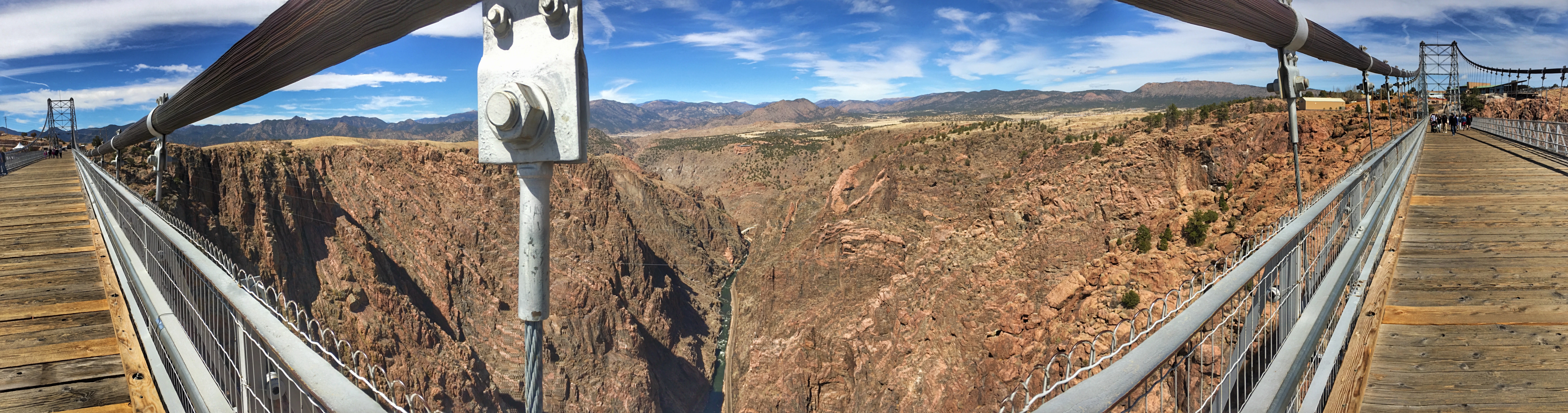
Even when the wind rose — and there is almost always a wind in the valley in the afternoon — all this sea of rolling dunes remained hushed. I strained to catch the slightest sound. I strained in vain. As I stood there, my head cocked on one side, concentrating on a search for even the tiniest sounds, I recalled a rather famous American ornithologist of an earlier time. In his later years, not realizing he was growing deaf, he wrote a paper on “The Alarming Decrease in Small Singing Birds.” Hastily I put my wrist watch to my ear and was reassured by the small but steady sound of its ticking.
from Wandering through Winter, by Edwin Way Teale
The name “Colorado Springs” had the vaguest of origins, having been applied for some years to the whole area around the Ute Pass soda springs, including the Garden of the Gods, Colorado City, and the Monument-Fountain Creeks junction. Fitz-Hugh Ludlow, author of The Heart of the Continent, used the name as early as 1867. When Palmer bought the soda springs, he tried to give the site a touch of elegance by calling it “La Font.” For the larger site on the plains he offered the words “Monument Dells,” which had been suggested to him in England by the good Canon Kingsley, apparently visualizing a Sherwood Forest sort of place with waterfalls and cool mossy glades.
General Cameron avoided this horror and when Pabor composed his flowery prospectus he called the town site “Colorado Springs” because it had a nice rich eastern spa sound. He did it on the sly, fearing that Palmer would object, since the only springs were the soda springs five miles away at the foot of Ute Pass. Palmer did object feebly, but by that time “Colorado Springs” was entered in Irving Howbert’s county transfer books and, besides, Palmer was beginning to like the clear brave ring of the name.
from Newport in the Rockies by Marshall Sprague
There were day-time picnics for young people in the Garden of the Gods with games like the one “Chumley” Thornton was said to have invented at Manitou Park called “a snake scramble.” This game required the young ladies to scramble through the scrub oak and when they saw a rattlesnake they had to scramble back to their starting place. The last girl in had to kiss somebody.
from Newport in the Rockies by Marshall Sprague
I will tell you a secret. I have never read King Lear, and have purposely refrained from doing so. If I were ever very ill I would only need to say to myself, “You can’t die yet, you haven’t read Lear.” That would bring me round, I know it would.
from The Haunted Bookshop, by Christopher Morley
“All right,” said the bookseller amiably. “Miss Chapman, you take the book up with you and you read it in bed if you want to. Are you a librocubicularist?”
Titania looked a little scandalized.
“It’s all right, my dear,” said Helen. “He only means you are fond of reading in bed.”
from The Haunted Bookshop, by Christopher Morley
In northern Manitoba a man saw a great bald eagle — hanging from its neck, teeth locked in skin and feathers, the bleached skull of a weasel.
from A Year’s Changes, by Jim Harrison
A bore is a man who deprives you of solitude without providing you with company.
a quote by Gian Vincenzo Gravina
It was frequently said that the Scots-Irish in Tennessee feared only God himself. And yet another adage about these early pioneers suggested that they kept the Sabbath, as well as anything else they could get their hands on.
from David Crockett, by Michael Wallis
During months of traveling from one small settlement to the next and making joint appearances, the candidates became well acquainted with each other’s standard speech. Crockett cleverly seized on this at one of the many stops and instead of giving his talk last as he always preferred, he agreed to speak first and allow Butler to have the last word. Crockett rose and proceeded to deliver Butler’s stock speech almost verbatim, which, of course, left the flustered doctor scrambling for something else to say when his turn came to speak.
from David Crockett, by Michael Wallis
Such infinitesimal concerns lead to existential caverns. If we can’t explain how time advances from moment to moment, how do we account for change, novelty, creation? How does something emerge from nothing? How does anything — Creation, time itself — begin? The very self comes into question; how am I the same individual that I was a moment ago, or last week, or last year, or as a child? How do I change yet remain continuously me? In a comic Greek play that predates Zeno, one man approaches another to recover some money that he’s owed. The debtor says, in effect, “Oh, but you didn’t borrow from me! I’m no longer the same person I was then, any more than a pile of stones from which we’ve added and removed some pebbles is the same pile of stones.” At this, the first man strikes the second in the face. “Why did you do that?” the second man asks, to which the first replies, “Who, me?”
from Why Time Flies, by Alan Burdick
Matell is quick to emphasize that whatever the neural basis for timing may be, it’s not the same as having an organ for sensing time. The ears detect sound waves, the eyes detect light waves, the nose interprets molecules. “Unlike with other sensory systems, there’s no ‘time material’ that we have a detector for,” Matell said. “Clearly the brain does sense time and controls our behavior, but what the brain is measuring is not objective. It’s subjective time. The brain is paying attention to its own functioning in order to derive some temporal landscape.” As far as human perception is concerned, time is the brain listening to itself talk.
from Why Time Flies, by Alan Burdick
Subsequent studies would clear cyclamates of their cancer connection, and it remains in use in some parts of the world, but in America the sweetener that sparked the creation of diet soda was gone. The cyclamate ban was just the first hit. In early 1970 another study funded by the Sugar Research Foundation came out, this time linking saccharin to bladder tumors in rats, raising the prospect of a ban of the last remaining artificial sweetener approved for use in food and drink. Again the tests involved rats consuming saccharin at levels that would be equivalent to a human guzzling their way through eight hundred diet sodas a day, but the Delaney Clause didn’t deal in gray: substances either caused cancer or they didn’t in its world.
from Fizz: How Soda Shook Up the World, by Tristan Donovan
In May 1975 the first Pepsi Challenge TV commercial aired in the Dallas-Fort Worth area. It showed a loyal Coke drinker testing two unidentified colas, only to be shocked when he opted for the taste of Pepsi. “Pepsi-Cola,” he exclaimed. “Well, I’ll be darned.” More ads followed in Houston, where again Pepsi lagged far behind Coke and Dr. Pepper. Again the Coca-Cola drinker picked Pepsi. The ads, with their spontaneous tone, local sights and people, and suggestion that viewers try the challenge for themselves, caused Pepsi sales to rise.
Coca-Cola was outraged at the aggressive campaign and at the claim that people preferred Pepsi over Coke. The company ordered its researchers to carry out its own taste test, only to find — to its horror and surprise — that Pepsi came out on top.
from Fizz: How Soda Shook Up the World, by Tristan Donovan
“Now, it is a verifiable actuality that any two men can talk politely and even become friends, given the chance; but put them in different uniforms, or train them in the use of different tools or philosophies or shaving soap, and you will have two men who are sure that the other lives primarily to contradict him. I did know a fellow once who insisted that reasonable men can disagree, but somebody knocked him cold with a cast-iron frying pan just then and I never did hear the remainder of his hypothesis.
from Cordelia Underwood or the Marvelous Beginnings of the Moosepath League, by Van Reid
The right to one’s own interpretation [of Scripture] is treated almost as a civil right, a basic human freedom.
from How to Ask Great Questions, by Karen Lee-Thorp
Everyone reads a text through the lens of his or her own culture and experience, but when the rules of logic, the common meaning of words, and the original context of the writing are all thrown out the window, people usually hear only what they want to hear.
from How to Ask Great Questions, by Karen Lee-Thorp
In the case of a biblical text, it’s important to consider what the passage meant in its original context — what the writer might have meant to say to the original audience — before we jump into applying it to our modern situation.
from How to Ask Great Questions, by Karen Lee-Thorp
If the role of opinion in Bible study is much understood, the role of feelings is almost never discussed. Feelings are factors in interpretation that occur whether we approve of them or not, so it makes sense to tap into the benefits they can offer while navigating around the pitfalls they can present.
from How to Ask Great Questions, by Karen Lee-Thorp