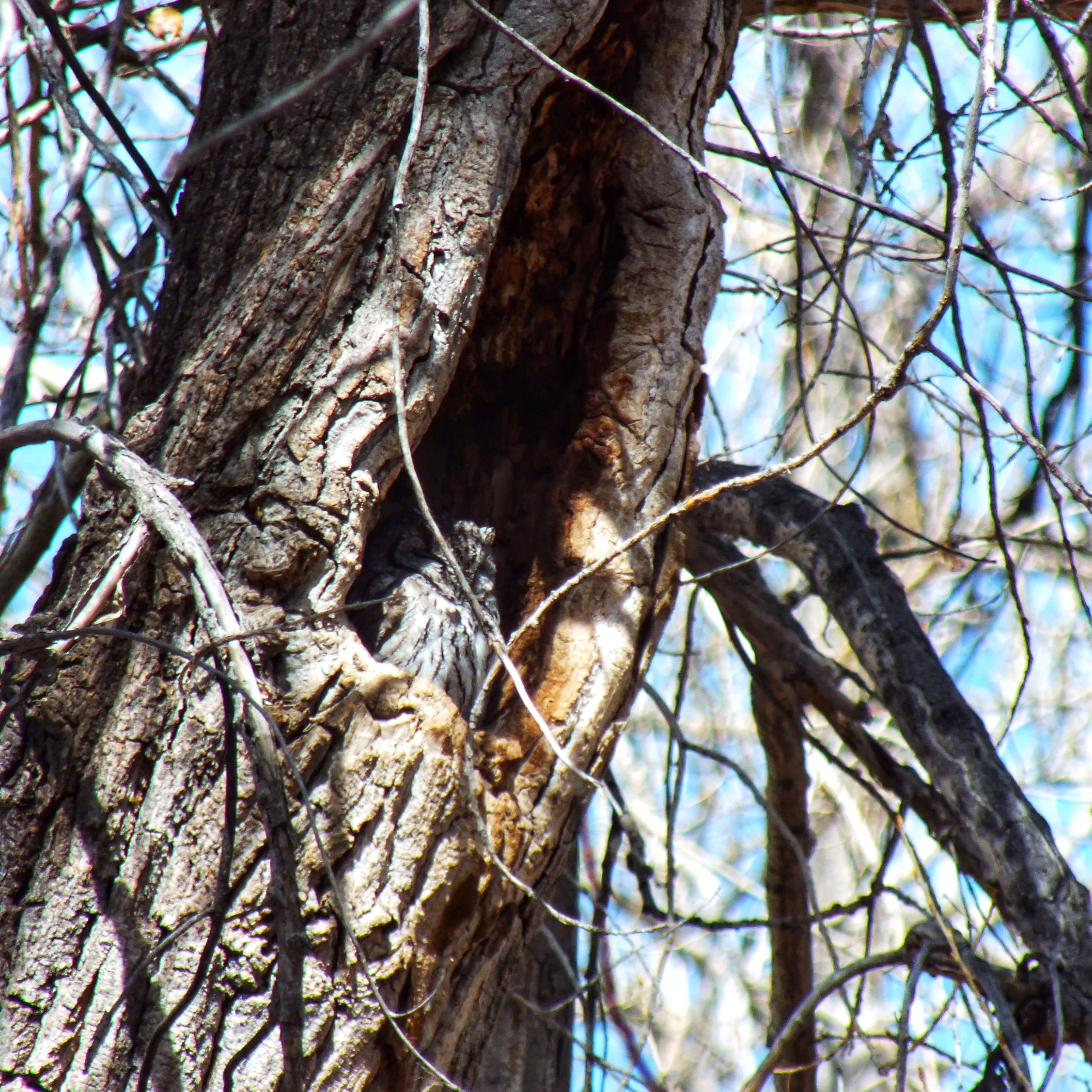
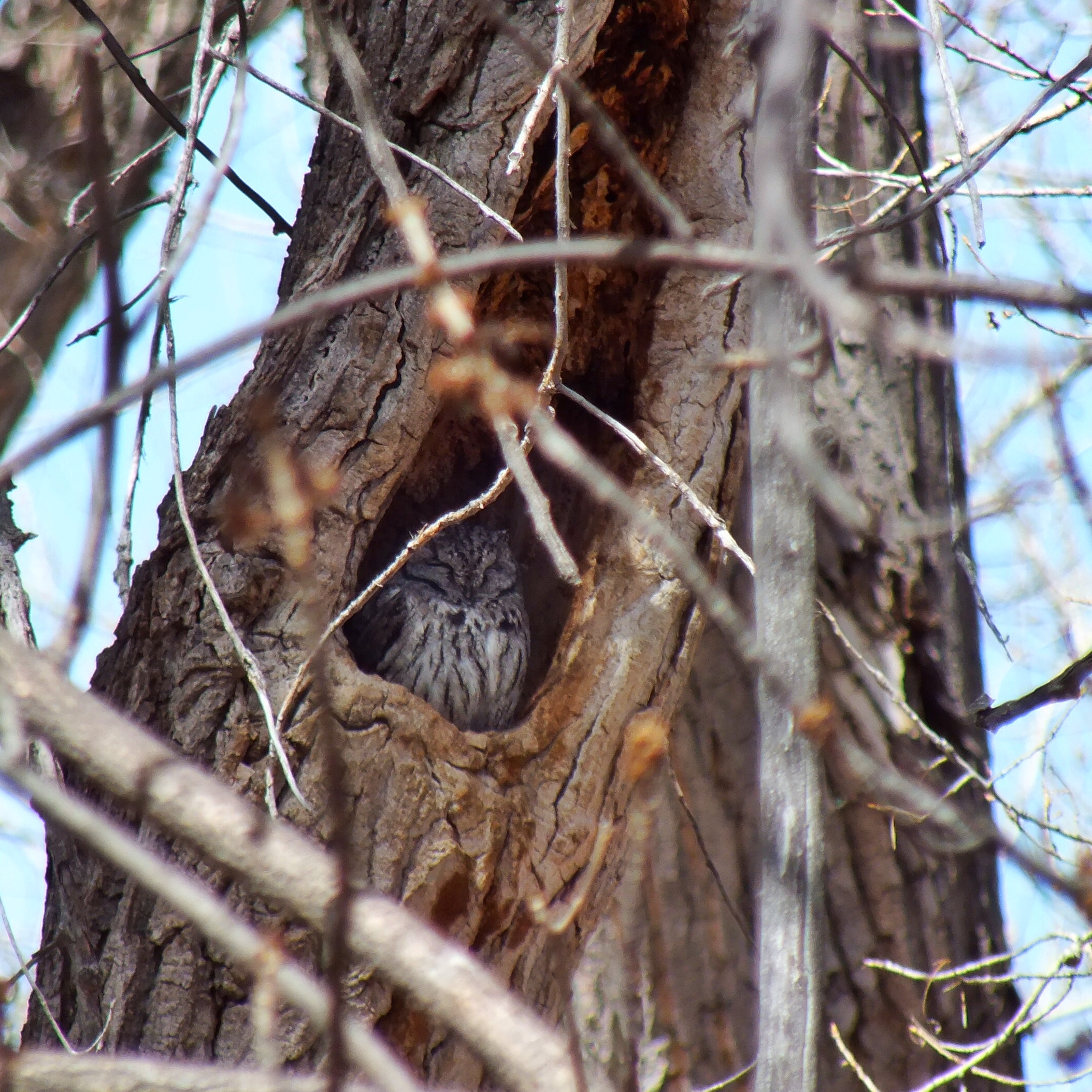
Great Sand Dunes National Park

Almost everywhere we went in the San Luis Valley, we could see the huge sand dunes piled up against the Sangre de Cristo Mountains. From a distance, they were dwarfed by the mountains.

They got impressively larger as we drove north along the entrance road into Great Sand Dunes National Park, but I was distracted by a flock of Pinyon Jays and didn’t take any photos. We stopped in the visitor center, then parked in the lot nearest the dunes.

A sign informed us that High Dune, the tallest dune on the first ridge, was 699 feet high and a mile and a half away. Star Dune, the tallest in the park, is 56 feet taller, but it sits at a lower spot and so the top isn’t as high. It’s also a mile and a half farther into the dune field. Reaching either of them looked like a lot of work. People on top of the ridge looked like ants.

Medano Creek ran shallow and partly frozen across the flats between us and the sand. I waded across. I only intended to walk to the base of the dunes. The sand, even on the flats, was loose, which made for hard slogging.

When I got to the base of the dunes, I decided to hike a little farther to get better photos.

Then I decided to hike to the top of a dune about a third of the way up. Each step was a labor, with my feet sinking and slipping back constantly.

Before I reached the top of that dune I noticed that there was nowhere to go from the top except down. If I decided to go farther, it would make more sense to skirt the dune and avoid any descent. If I decided to go farther. Which, apparently, I did. I tacked across the side of the dune and reached the next slope.

I struggled up a steep section, passing a young woman who was on the way down. I told her it seemed easier in the direction she was going, and she laughed and agreed that that was the case.

There were sections of sand that looked damp. I tried walking on them to see if I could get more purchase. I couldn’t. I angled over to one of the patches of grass to see if they gave me a better grip. Nope. Then I somehow figured it out. If I walked in the paths where everyone else walked, the sand was loose and walking was miserable. But if I got away from those paths, the surface of the sand was rippled.

Somehow I figured out that if I kept as close as I could to a 90° angle to the creases and walked flat-footed, my feet wouldn’t slip most of the time. Occasionally a step would sink in and I would lose momentum. It was like walking on crusted snow only to have a boot break through every seven steps. But most of the time, it was pretty easy.

Once I figured out how to walk, I decided to climb to a lower part of the first ridge.

When I reached my goal, I was still about half a mile from the top of High Dune. Between me and the summit was a narrow ridge covered in footprints, but it was relatively flat, so walking wasn’t too difficult. And since I’d gone that far …

And finally, I was on top with a handful of people, all of whom were quite a bit younger than I.

The parking lot looked tiny.

To the west, the dune field went on and on.

The tallest dunes are over there somewhere. That’s Mount Herard in the background. The summit is at 13,345 feet, about a mile higher than the dune crest.

The mountain in the distance is Blanca Peak, at 14,351 feet above sea level.

I only stayed on top for a couple minutes, then headed back down. My objective was to go fast and not wander into any bowls that I would have to climb back out of. Before long I came to a very steep slope. I hesitated, then started down. My feet sank a few inches into the sand, making it very easy to keep my balance on a slope I could never walk on otherwise.

A short time later, I came to another slope. This one was just as steep and a lot longer than the first. Instead of walking, I ran down it, taking long, leaping steps of ten feet or more. It kept going and going — I’m sure at least a third of the total descent. I know I’ve never covered so much ground so quickly under my own power. If I can consider gravity my own power.

When I got back to the car, my wife asked if I’d made it to the top. I said I had, and that I could prove it. I pulled out a water bottle filled part way with some sand I’d collected at the very top. She said that didn’t prove anything. Skeptic. I took a quick red chair photo and a photo of where I’d just been.

The dune in the middle of the photo, below the summit, is the one I walked down. The one I ran down is just out of the photo.

We took a two-mile hike in the woods at the base of the mountains. For much of the way, we could see the dunes across the valley.

The visitor center is in the middle distance. The San Juan Mountains can be seen in the distance across the San Luis Valley.

Along the trail, we happened upon a small, tame flock of Mule Deer.

And that was that. We bought drinks at the visitor center, then headed west, then north up the San Luis Valley toward home.

Posted in Hikes, National Parks, Red Chair, Scenery | Comments Off on Great Sand Dunes National Park

Bird #483 — Pinyon Jay

gymnorhinus (from gymno, naked, bare, and rhinos, nose) cyanocephalus (from cyaneus, dark blue, and cephala, head)

Sunday, October 29, 2017

Great Sand Dunes National Park, Colorado

We were driving into the park with the Sangre de Cristo mountains on our right and the arid flats of the San Luis Valley on our left. The dune field was just a few miles in front of us. Shortly after we passed the park entrance sign, the road climbed into the edge of the pinyon and juniper zone. I spotted a couple medium-sized birds flying into the scattered trees at the very edge of the zone. I stopped the car and grabbed my binoculars. I saw the birds were blue, with short tails and long bills and figured immediately that they were Pinyon Jays.

I’ve been keeping my eyes open for Pinyon Jays every chance I’ve had to bird in the west. They are notorious for being hard to find. They almost always travel in flocks and they keep moving, so their presence one day doesn’t mean they’ll be around the next. Their diet consists almost entirely of pinyon pine seeds.

I pulled the car off the road and got out for about five minutes. The flock — there must have been somewhere between 40 and 50 of them — was rolling through the trees and grass. Some would land in the pinyons, others would land on the ground. None of them stayed in one spot for more than 10 or 15 seconds. The birds at the back of the flock would fly over those that had landed and alight further along — over and over. I followed them for about 50 yards, then went back to the car. As we drove, we kept pace with the flock for maybe another 100 yards. The birds then crossed the road and disappeared uphill. One did land in a bush about 15 feet from my wife’s side of the car, giving her a great view, but it was gone before I could get my camera pointed and focused. The entire time they were in view, the flock kept up their constant, odd laugh-like calls. We saw no other sign of them during the four hours we were in that park.

Posted in Birds | 4 Comments

Colorado Gators Reptile Park

This is an odd place. It began back in 1977 when a family opened a tilapia fish farm. The water in the San Luis Valley is heated to 87° by geothermal springs, making it possible to raise the African perch in Colorado.

Ten years later, the owners bought 100 baby alligators to eat dead fish and fish parts. The warm water and rich diet caused the gators to grow faster than they would in the wild, and some of the original babies are still there and huge.Locals kept asking to see the gators, so in 1990, they opened the farm to the public.

It’s not a fancy place. There’s a decidedly primitive, rinky-dink feel to it all. Brilliantly, they play up the danger everywhere.

In the gift shop, there’s a photo display of the time one of the workers lost a finger to a gator. And there’s this.

The first building housed a whole bunch of snakes, lizards, turtles, frogs, etc., most of which had been turned in by people who once thought they would make good pets but found out otherwise. We had to keep stepping over “tortoise fences,” boards that stood all over the place to keep tortoises from wandering outside.

A guy came over to us, reached into a bin and pulled out a three-foot gator named Ali. He explained to us that a gator that size couldn’t bite through a bone, but it could tear off all the skin on a finger down to the bone. Then he asked me if I wanted to hold it. About this time, a second guy walked in and told us that the first guy didn’t work there.

After he took our photo, he gave us a Certificate of Bravery, although my wife’s name shouldn’t be on it because all she touched was the tail, which wasn’t really all that brave. The guy made Ali bite down on the certificate to make it official.

A tank of tilapia and other fish. The second guy came over and explained that they had created a new type of fish, a white tilapia. He said that the “rich people in Aspen like the white meat better, although he couldn’t tell the difference.” I wondered how he knew I wasn’t a rich person from Aspen.

He also told us that gator wrestling class was going on outside if we wanted to watch. We headed out and found this.

None of the participants — tourists, staff, or alligator — seemed to be enjoying it all that much. The class cost $100/person. We didn’t sign up. Or watch long.

Back inside, we found the place where the tilapia are raised. A series of large tubs contained fish of increasing size. At one point, I overheard one of the staff explaining the operation to another visitor. I understood that they breed the fish, but don’t generally raise them to eating size. They sell them while they’re still small to places that keep them until they’re large enough. But I could be mistaken.

Outside the building, a trail led around several pens. This is Elvis, one of the original alligators brought to the farm as a baby. He’s larger now.

It was every bit as ramshackle outside as it was inside. There were places where it seemed like a self-respecting alligator could have gotten through a fence. But perhaps they know when they have it good.

We happened upon two pens containing emus, and my wife was befriended by a turkey.

This is Morris “The Movie Star Alligator.” He was in several movies, including Happy Gilmore, Dr. Doolittle II, Interview with the Vampire, Alligators I and II. He also appeared in the TV show Coach. His career ended in 2006 when he got too large and dangerous. He’s thought to be about 50 years old and weigh about 450 pounds.

A Nile Crocodile

Albino alligators. They don’t survive to adulthood in the wild. If predators don’t get them, sunburn does.

Posted in Red Chair, Zoos, Aquariums and Animal Parks | Comments Off on Colorado Gators Reptile Park

Fort Garland

Fort Garland, in south central Colorado was an active military post for 25 years, from 1858 to 1883. It was built to protect settlers from Indians. Nothing much happened there.

The highlights, such as they are:

  • In March, 1862, Colorado Volunteers trained at Fort Garland, then marched south to join the New Mexico Volunteers. The combined force defeated Confederate forces in the Battle of Glorieta Pass, ending the Confederate’s attempt to invade the southwest.
  • Kit Carson, famous mountain man and scout, was the commanding officer in 1866 and 1867.

The post was so boring that one of the chief activities of the soldiers was tracking down deserters.

Five of the 23 original buildings remain. A sixth building has been rebuilt. All of them house exhibits on life at the fort, the Civil War, and Kit Carson.

We had the place pretty much to ourselves the entire time we were there.

Cavalry Barracks

Outside the Officers’ Quarters when the post was active.

The Main Gate in 1874. Twice.

The Infantry Barracks, with dioramas of the history of the San Luis Valley.

The Sergeant’s Room at the end of the Infantry Barracks.

The view from in front of the Officers’ Quarters.

The fort from in front of the Officers’ Quarters. The Infantry Barracks are in the center.

The Commandant Quarters. Kit Carson lived here with his family. The Sangre de Cristo Mountains rise in the background.

Inside the Commandant Quarters. None of the furniture in the fort is original. There was a case with a few items used by Kit Carson at some point.

Posted in Forts, Red Chair | Comments Off on Fort Garland

Weekend Trip

We decided to get away for a few days and explore a part of Colorado we hadn’t yet seen. After stopping at the local Panera for bagels, we drove south on I-25 to Walsenburg. The tire light on the Honda’s dashboard was lit up, no doubt because temperatures had dropped considerably overnight. We stopped at a truck stop and paid $1.50 for five minutes of air. I didn’t use it all, but I was tempted to stand there holding the nozzle until our time ran out. Why should they get to keep air I paid for?

We headed west on Route 160, past the Spanish Peaks. It is a notable feature of this part of the state that the peaks rise suddenly out of the flat plains.

We toured the Fort Garland Museum in the morning. The town of Fort Garland was a surprise to me. I don’t know why, but I expected an actual town — like Monte Vista or Alamosa, which we drove through later. It was, in fact, a tiny place. I drove from end to end in less than a minute. After we finished at the fort, I pulled off at a rather ramshackle gift shop/tourist trap. The grounds were covered with a dilapidated attempt at recreating an old-fashioned western town. We wandered around inside the gift shop for a bit. I asked the woman who worked there the price of some Navajo rugs. She told me the small one was $800 and the larger one $1,400. She took my question as intent to buy and followed me around for several minutes and pointed out other items and telling me the price. She impressed upon us that her prices were much lower than we would find in Taos, and that people from New Mexico come to her. Perhaps. It didn’t appear that much of anybody had come there in some time. We didn’t buy any rugs, but it made me rethink our decision to let our cats tear apart the ones we inherited from my folks.

It was lunchtime, so we drove about 30 yards to the only restaurant in town, the Old West Cafe. We had cheeseburgers, which weren’t bad. The other diners were obviously locals. Our waitress had on a T-shirt that she was very proud of. It said, “Sometimes I laugh so hard the tears run down my leg.” When I asked, she told me where we might see wild horses in the area, but we didn’t see any. We did see Blanca Peak, a 14er in the Sangre de Cristo Mountains.

We spent the afternoon at Colorado Gators Reptile Park.

In the late afternoon, we visited Monte Vista and drove the short auto tour at the Monte Vista National Wildlife Refuge. But this wasn’t the prime time of year to visit. Most of the water had been drained and the “wetlands” had been control burned recently.

There were a couple puddles, and we saw a handful of ducks and a flock of Long-billed Dowitchers, the first I’ve seen in 17 years. I don’t think we were in the refuge for a half hour. We did see a large flock of Sandhill Cranes in a mowed field just east of Monte Vista.

Our plan was to eat dinner at a highly-rated BBQ place called Smokin’ Johnnies, but when we found it, it was out of business. It was next door to a Best Western and a drive-in theater. The Best Western advertised that you could watch movies on the outdoor screen from their rooms. But we thought the whole set-up looked like a setting for a horror movie.

Since BBQ was out, we decided to go to a burrito joint in Alamosa, but it was also closed. We ended up at Chili’s where we ate too much. When we were done, it was only 6:00 or so, and we had only an evening in a Hampton Inn room to look forward to. To pass the time, we wandered around Wal-Mart. Really.

This was the view from our motel room the next morning. We had looked at the movies showing at that theater the night before. They were so unappealing that we preferred sitting in our room.

We drove to Alamosa National Wildlife Refuge first thing, hoping to see something interesting. The tour road there wasn’t long either. We did see some ducks, two Sandhill Cranes, and a Coyote.

The Sangre de Cristo Mountains loomed large to the northeast. The highest point is Blanca Peak.

After touring Great Sand Dunes National Park, we headed north to Salida (which Siri interpreted as “Saliva”). We were hungry. For lunch, we’d only had bagels that we’d purloined from the hotel breakfast.

But we weren’t this hungry.

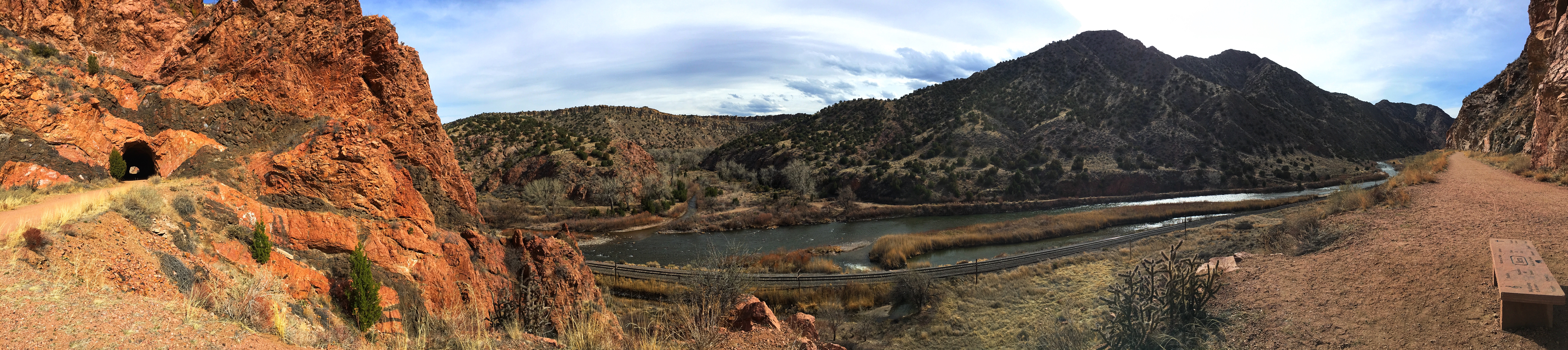
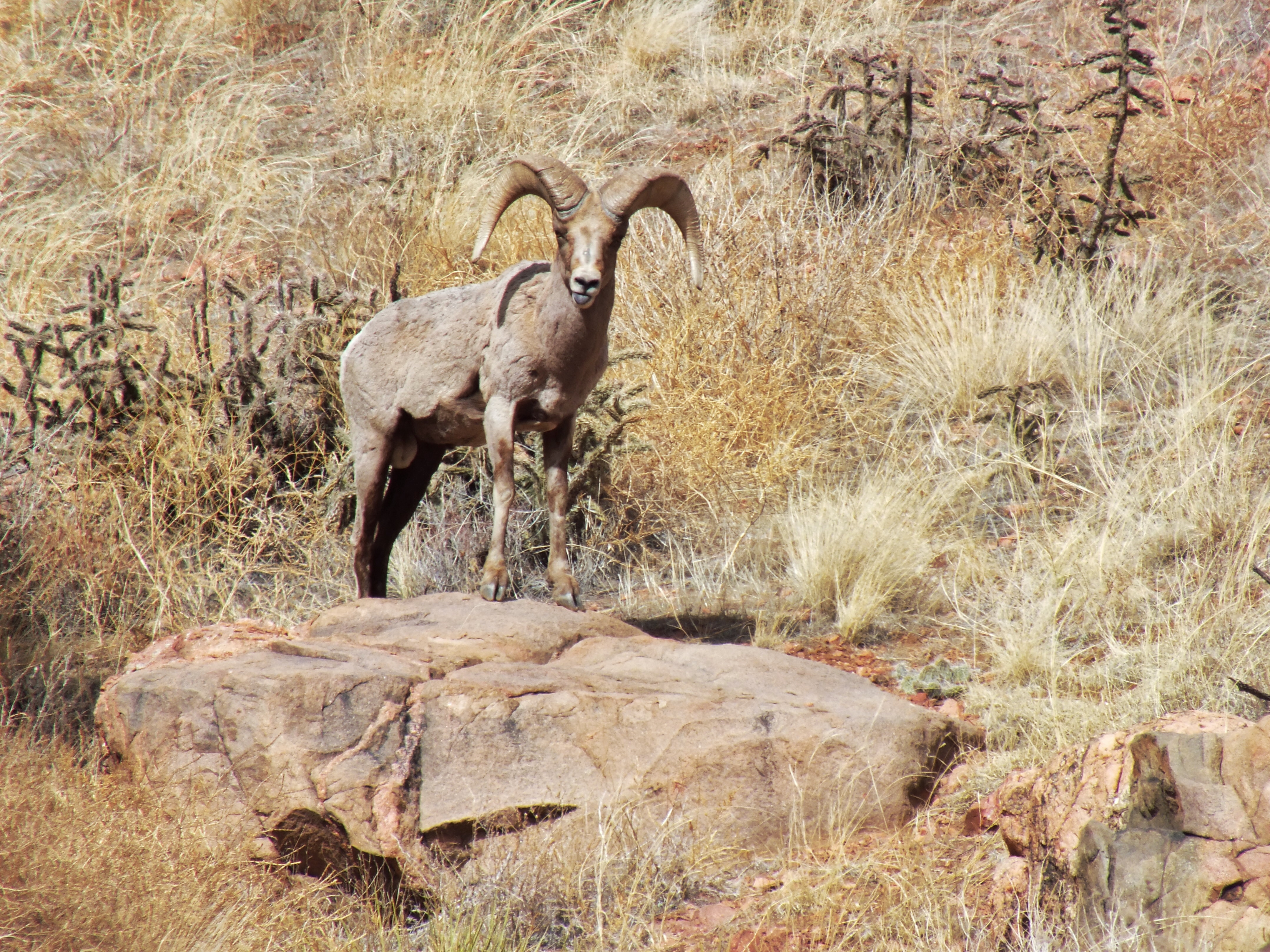
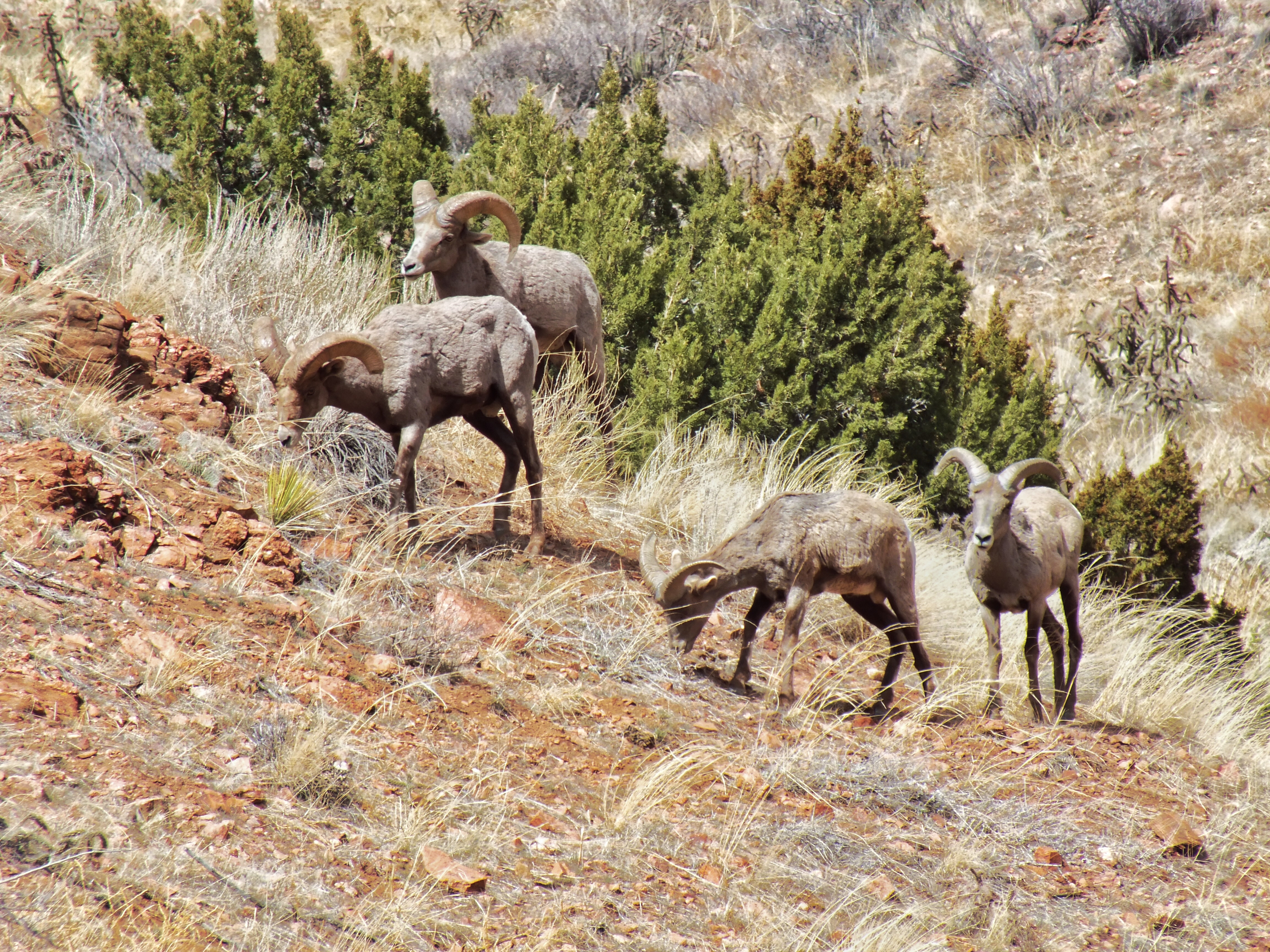
After driving through Bighorn Sheep Canyon, I took my wife to see Route 11 up to Cripple Creek. I’d happened upon the road back in 2012 when I was out here for a convention and thought it was beautiful. As we drove through Cripple Creek, the sun set. For a couple minutes, the sky was orange and the mountains were deep purple. We got home at 7:00 after two filled and fun days.

Posted in Birds, Road Trips, Scenery | Comments Off on Weekend Trip