Fort Laramie National Historic Site

I arrived  at Fort Laramie around 1:30 on a warm, sunny afternoon. I stopped to see the old Army Bridge over the Platte River, built in 1875. At that time, the river was much wider and so the bridge is now much longer than the river is wide. The bridge was impressive, but the chief attraction was the huge flock of Cliff Swallows that nested under the modern bridge 30 yards or so downstream.

The fort itself was a mile or so further on. There were other visitors, but it certainly wasn’t crowded. I over-thought and parked in a picnic area which meant that I had a longish walk across hot parking-lot pavement to get to the fort. I was hoping the large cottonwoods would cast shade over my car before I returned. It didn’t happen, so I had a second long walk and a hot car at the end of my visit.

The first fort here — Fort William — was built as a trading post in 1834. It was replaced by a larger adobe fort — Fort John — in 1841. in 1849, when the Army decided it wanted a fort on this spot, it bought Fort John, renamed it Fort Laramie, and expanded it. It remained an active fort until 1890 when the Army moved out and sold the buildings at auction. Many of the original buildings are gone. Eleven remain and have been restored next to the ruins or foundations of several others. It was a large fort, so seeing it all involved a lot of walking. I spent two and a half hours, visited every building, read every sign, watched the video in the visitor center, bought some stuff in the gift shop, and, in short, did everything there was to do.

The Commissary Storehouse, built in 1884 and now housing the visitor center. The building in the right distance is the New Guardhouse. The flagpole is in the center of the parade ground.

The Cavalry Barracks, built in 1874. The soldiers slept upstairs. Mess rooms and kitchens were downstairs.

General Sink (latrine) ruins. It was built in 1886. The sewage drained into the Laramie River in the background.

Looking back from the New Guard house toward (l. to r.) the Cavalry Barracks, the Commissary Storehouse, the Old Bakery (built in 1876), and the ruins of the New Bakery (built in 1883). The trench is the remains of the old irrigation system that carried water from the river.

New Guardhouse, built in 1876.

In the photo above, you can see a chained off area to the left of the guardhouse. That’s the foundation of an older guardhouse (below). That small area contained five cells which were five feet high, five feet long, and (I’d estimate) about two feet wide.

Foundation of the Infantry Barracks, built in 1867. The buildings are (l. to r.) the Magazine, the Post Surgeon’s Quarters, the Lt. Colonel’s Quarters, and the Post Trader’s Store.

Old Guardhouse, built in 1866. This is the back view — the side facing the river. The cells were downstairs. The quarters of the guards were upstairs. The upper floor is now an exhibit of wagons and artillery.

Captain’s Quarters, built in 1870. Two guys on cranes were scraping paint off the upper story while I was there. The second photo is the view from the front porch looking out toward the ruins of the Administration Building (built in 1885).

Ruins of Officers’ Quarters with “Old Bedlam” (bachelor officer’s quarters) in the background.

Bachelor Officers’ Quarters, built in 1849. It was known as “Old Bedlam” after the insane asylum in London. It is the oldest standing building in Wyoming, although before it was restored, it was barely standing.

Post Surgeon’s Quarters (1875), Lt. Colonel’s Quarters (1884), Post Trader’s Store (1849), and the Cavalry Barracks. The first three buildings are also in the next photos.

The Post Trader’s Store is only open when a ranger is present, but I happened along at the right time. (I didn’t want him in the photo, so after chatting with him for a few minutes, I walked out a second door. He walked out the first door on the other end, and as soon as he did, I immediately turned around and took the photo. When he realized that I was back inside, he hurried back in to make sure I didn’t steal anything.)

Behind the store was an 1883 addition housing the officers’ club and an enlisted men’s and civilian’s bar. I stopped and bought a birch beer.

Ruins of the Post Hospital (1873). Beyond it were the ruins of a barracks for non-commissioned officers.

Toward the end of it’s run, after the Indian threat was gone, the railroads were carrying most westbound traffic, and the Army didn’t have much to do, Fort Laramie took on the feel of a town. In three places — the visitor center displays, the orientation video, and on one of the signs on the grounds — I was informed that the fort had street lights and even birdbaths! Whoever was in charge of interpreting the fort for visitors evidently thought this was significant.

After I left the fort, I stopped at an antique store in the town of Fort Laramie. The woman who ran the place had a strong German (I think) accent. When she found out I was from Colorado Springs, she told me she used to live there but moved to Wyoming because there was no traffic. Her store was a random collection of mildly interesting junk with no price tags. She wanted to deal, but I couldn’t find anything I wanted. But her store was a palace compared to my next stop.

I stopped at another antique store in the small town of Lingle that turned out to be one small room. It looked like it hadn’t been cleaned or tidied in the last 30 years. In the four minutes it took me to see there was nothing I wanted, the woman who ran the store told me about an autographed cowboy hat. She obviously wanted me to buy it but I hadn’t heard of the guy who autographed it. When she saw I wasn’t interested, she began giving me an item by item inventory of her shop. I escaped quickly, but not before she told me there was another antique store right down the block. I think it might have been run by her husband. When I walked inside, the lights were off. A drunk-looking guy slipped something into a cooler as I walked in. I made a quick survey of the two aisles in the dark while he stared at me. This store too was filled with total junk that hadn’t been tidied or cleaned — ever. I was a bit relieved to escape with my life.

It took me the better part of two hours to get to Cheyenne on nearly empty roads. My plan was to stay the night and then go birding at a prairie in extreme north Colorado in the morning. But Monday had been hot and Tuesday was supposed to be the same. I decided to hit a couple Cheyenne museums instead. I found a Panera and ate supper while making plans. Then I looked for a hotel. My first choice was filled. I sat in the lot and looked for other options. Everything was filled or very expensive, except for La Quinta, which received terrible reviews. Since Cheyenne is close enough to be a day trip, I decided not to force things. I headed home. This was a little challenging because I had already mentally shut it down for the night, but I played my music loudly and sang along and made it safely  home around 9:30 after three extremely interesting and fun days.

Posted in Forts, National Parks | Comments Off on Fort Laramie National Historic Site

Oregon Trail

From the mid-1830’s through about 1870, immigrants and gold miners followed the Oregon Trail west along the Platte River. Traces of the trail can still be see near the town of Guernsey.

At Oregon Trail Ruts State Historic Site first, a short looped path runs along the trail. Over the years, the iron rims on wagon wheels cut a trench in the limestone on a low hill above the river.

Even where there was no limestone, a depression marks the route of the old trail.

The park was also notable for one of the most over-written signs I’ve ever read.

It took me perhaps 15 minutes to see all there was to see. I drove a couple miles to another site called Register Cliff.

This was a popular camping ground for immigrants on the trail, and many of them carved their names into the limestone cliff face. Hundreds of others have since carved their names too, and it was difficult in some places to find the old ones. But the state had protected one section of cliff with a fence, and here I could see many names carved in the 1850’s.

After traffic on the trail declined, settlers built their homes next to the cliffs. One homesteader dug a cave into the cliff for cold storage. You can see it just to the left of the sign in the panorama photo above. Hundreds of Cliff Swallows were flying in and out of nests everywhere the cliff provided any cover from the weather.

The Platte River is perhaps 150 yards from the base of the cliff. Near the parking lot, I found a Pony Express Trail marker along the bank.

I ate lunch in Guernsey at a small cafe called Twister Eatery. It wasn’t fancy, but my ham and cheese sandwich was delicious and the wait staff was friendly.

Posted in History | Comments Off on Oregon Trail

Guernsey State Park

I spent three and a half hours on Monday morning birding in Guernsey State Park. I picked it primarily because it was there. I got out of my car several times, but I never wandered far from it. The park surrounds a man-made lake. The central feature is a hill-top overlook high above the reservoir. By the end of my visit, I’d seen 35 species, including a rare-for-the-area Eastern Bluebird.

Three Turkey Vultures perched on posts along the reservoir next to a boat ramp. They were disinclined to leave as I walked by, and one of them decided to brave it out. I’m not sure if this is a threat display or what, but I appreciated it.

There were campers in scattered sites around the park, but otherwise very few people. It was a beautiful place and a pleasant way to spend a morning.

Posted in Birds, Scenery | Comments Off on Guernsey State Park

Adventures on a Sunday Afternoon

I drove back roads south into Wyoming and stopped in Sheridan. In preparation for a long stretch of driving, I bought a drink at the same Qdoba where I’d bought supper the night before. Once I cleared Buffalo, about 35 miles south of Sheridan, there were no services until Casper, 112 miles away.

I-25 wasn’t busy. There were stretches of half an hour or so when I neither passed or was passed by another vehicle. I was relaxed and looking for Pronghorns along the highway. It occurred to me that I have undoubtedly seen more cows than any other animal. But I got to thinking about wild animals. I have probably seen the most White-tailed Deer, but after living in the west the past three years, I’m guessing Pronghorns are a close second. I was seeing individuals and and herds almost every mile.

I was looking at a herd of Pronghorns on the east side of the highway. I looked up in time to see a doe Mule Deer strolling casually across the pavement in front of me. Deer aren’t usually active in the heat of the afternoon, so I wasn’t anticipating it. I had just enough time to swerve around behind it at 80 mph. It never quickened its pace. I probably missed it by four or five feet. Aloud I said, “That would have been a stupid way to die.”

My original plan was to spend the night in Casper, but I decided at some point to continue south another 45 minutes to Douglas where I’d noticed on my trip north that there was a Hampton Inn. But there was a restaurant in Casper I had been planning on visiting, and that was still in the cards.

The place was called Sanford’s Grub and Pub. It was most famous for its decor.

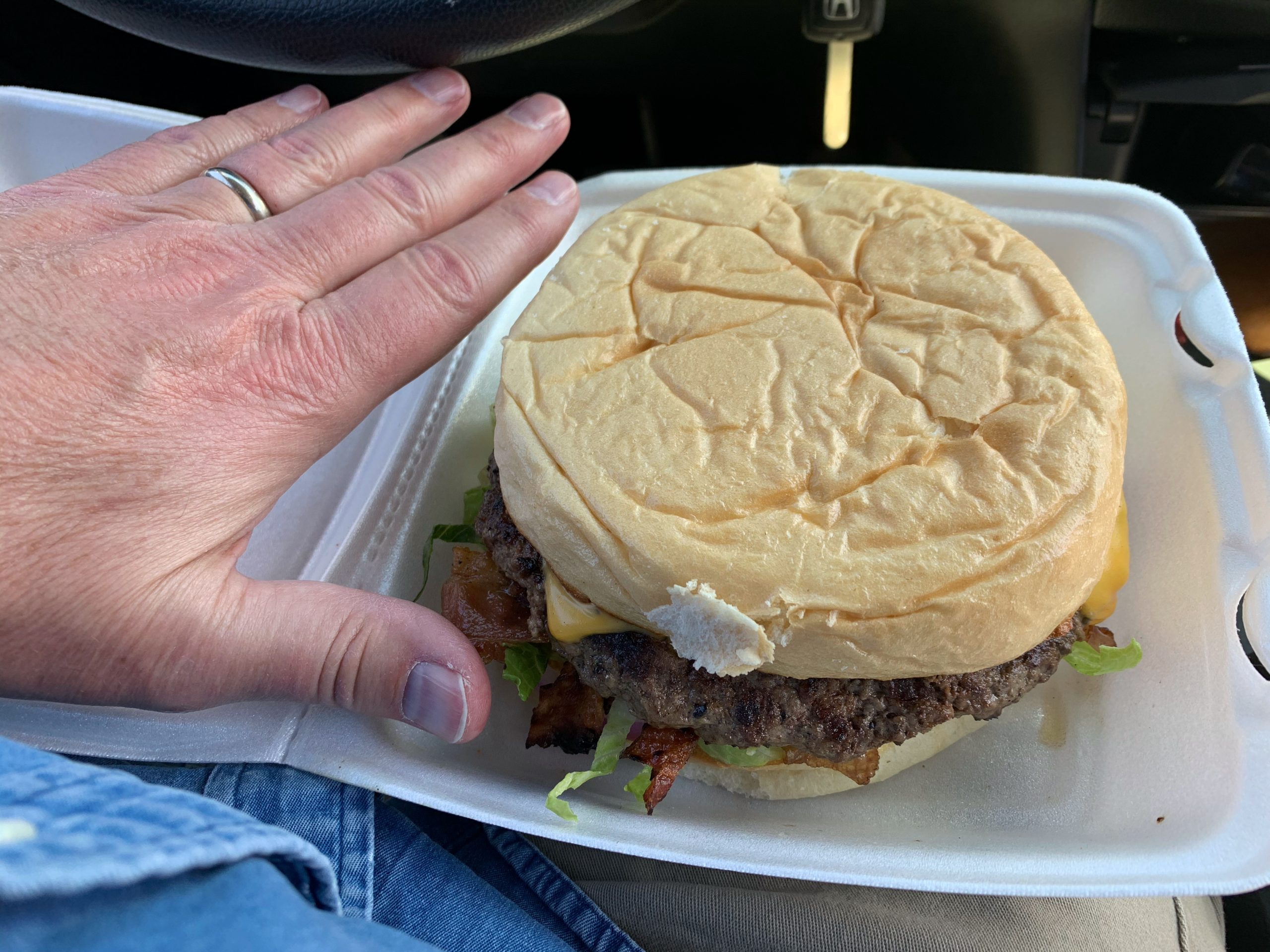
A friendly young woman took my order — a medium cheeseburger and onion rings. I waited and waited. And waited. After an hour, I was pretty irritated. The people who were seated just before me were also complaining. The people who came just after me were so upset that they announced that they were leaving. Their food magically appeared moments later. My burger finally came a hour and 20 minutes after I ordered. And it was decidedly well done. The server was very apologetic and offered to make me another one, but I told her I didn’t have another hour and a half to wait. To my surprise, the burger was pretty tasty, as were the rings.

When I finally escaped, I decided to get gas at the Pilot station next door. As I was pumping gas, I got a notice from my bank asking if I had charged $151 worth of gas and automotive at that same station. I hadn’t of course. Some clown in another car was skimming my card as I pumped gas. I got back on the road and chatted back and forth with my wife about it for a while, then pulled off and called Visa. They guy I spoke with was helpful, although he was very difficult to understand. The charge was erased, but I decided I wasn’t a big fan of Casper.

I got a room at the Hampton Inn in Douglas, but it was expensive — $150 plus taxes. I spent the evening logging my bird lists from the trip and planning Monday’s adventure.

Posted in Food, Road Trips | Comments Off on Adventures on a Sunday Afternoon

Rosebud Battlefield

The Army campaign of 1876 was intended to move the Indian tribes of the northern plains onto reservations. Unwilling to go, the Indians had banded together into a force of about 1,500-2,000 warriors. The Army’s strategy involved an encirclement of the Indian camp by three columns: Gibbon from the west, Terry (including Custer and his men) from the east, and Crook, with the largest column, from the south. Crook left Fort Fetterman on May 29.

On June 11, Crook’s army stopped to rest along Rosebud Creek. The Indian scouts who were employed by the Army raced into camp chased by hostile Indians. For the next two or three hours, soldiers and Indians maneuvered, taking advantage of any opportunity to attack weak spots. There weren’t really lines of battle. The soldiers looked for any substantial group of warriors to fight while the Indians moved around and fought from every direction.

Crook had been misinformed and thought there was a large Indian village nearby. He sent eight companies of cavalry to attack it. The Indians thought the Army was retreating and left the field. Crook had expended so much ammunition and supplies that he felt that he had to return to Fort Fetterman to resupply. That meant that he wasn’t able to meet up with the other columns, which may have been a significant factor in Custer’s defeat seven days later and about 30 miles to the northwest. Crook had 10 men killed and 21 wounded at the Rosebud, and it’s estimated that Indian casualties were about the same.

I drove though the beautiful Montana countryside to the battlefield, located on a dirt road a long way from anything resembling a town. There were a few other people at the entrance but once I headed further into the park, I only saw one moving car and one parked car and nobody else on foot.

The tour road was two dirt tracks divided by tall grass. My Honda Accord scraped the grass the entire time, but the road was otherwise in good shape and I had no problem.

Because of the fluid nature of the battle, there weren’t really battle-related things to see. A few sight posts were scattered about with holes through which I could look to see particular landmarks. The Indian name for the battle is “Where the Sister Saved Her Brother,” named for an incident that happened during the day. A Cheyenne warrior had his horse killed under him. He became a target for the soldiers until his sister, Buffalo Calf Road Woman, rode up on her horse and carried him to safety.

At the beginning of the road, I saw a female Pronghorn and her calf running away from me.

At the top of the hill in the above photo, there was a place to pull over. I parked and walked a trail across the hills. I spotted the Pronghorn calf poking its head up above the grass about 40 yards away.

I walked a couple hundred yards further and heard an odd huffing sound I didn’t recognize. It was the female. She was maybe 80 yards away, staring at me. Every minute or so, she’d make the noise. After a little while she ran up the ridge and disappeared. I’m guessing she was trying to attract my attention away from her calf which was hiding nearby. I didn’t see either of them again.

I walked with care up a grass-covered trail in an area where rattlesnakes are common. I was 40 miles from Sheridan, Wyoming, the nearest place where I was likely to find a hospital. I probably strolled a mile up toward Crook’s Hill, where the general had his headquarters on the day of the battle. There were very few birds, and no battle markers. But it was a beautiful day and the surrounding country was also beautiful. I enjoyed myself tremendously.

I didn’t go all the way to the top of Crook’s Hill. The trees on the hill may look close in the photo above, but the crest was deceptively far away. I took the video below from the place where I turned around. It was the heat of the day. There wasn’t really anything different I could see by going further — just more of the same scenery. I had gotten up early and had a long drive ahead of me. I would have definitely kept going if the reward had been worth the effort. But I suppose a contributing factor in my decision was that I’m not used to be quite this alone. I was a mile or so from my car, which was a mile or so from the park entrance, which was three miles from the nearest paved road, which was 40 miles from the nearest town, which was 480 miles from the nearest person I knew.

I drove the rest of the tour route without stopping or getting out of my car. By the entrance, I spotted a marmot on a rock outcropping. I was surprised to see one at this low an elevation.

Posted in Battlefields | Comments Off on Rosebud Battlefield