I hiked to Catamount Reservoir from Green Mountain Falls — a hike I’ve made twice before with coworkers and friends. It was a beautiful day, although a bit warm, and the trails were crowded. A touch of altitude sickness prevented me from spending as much time by the reservoir as I wanted, but I survived to tell the tale.
Band-tailed Pigeons were in their usual spot along the road to the trailhead.
The Garden of Eden Meadow is pretty but overrated. I can think of several dozen prettier spots in the state.
Red-naped Sapsucker
Pikes Peak
South Catamount Reservoir from the dam. The shores were lined with fishermen and picnickers, and the trails were almost single-file at times.
When I looked at my Eleven Mile Canyon bird list after my last visit, I saw that I was only four birds away from being the person who has seen the most birds there. And there is a trail to an overlook I haven’t hiked. And I like the place. And I wanted to go somewhere to get away from the nonsense.
I expected it to be packed on a summer Saturday, and it was, but there were still a lot of birds around. In addition to the overlook trail, I also walked a mile down a side road called Wagon Tongue Gulch. I ended up with 38 species and now have the top spot on the list by 10 birds.
The view from the overlook.
Broad-tailed Hummingbird
I spent a long time looking for this Warbling Vireo before I realized it was singing from its nest. That doesn’t seem like a wise thing to do, but 40 minutes later, I found a second one doing the same thing.
MacGillivray’s Warbler
American Dipper. A pair were constructing a nest on the side of a rock in the middle of the river.
When I saw that Wednesday was forecasted to be clear with a high of 71°, I decided to take the day off and explore. I spent the morning in Elevenmile Canyon and then after lunch I went to Eleven Mile State Park. Here’s what I saw.
Juvenile Bald Eagle that hasn’t yet left the nest. I’ve never seen one this gray before. I even wondered if it was a Golden Eagle, but the size of the bill and the lack of white on the tail (which is clear from a photo I haven’t posted) convinced me it’s a Bald Eagle.
American Dipper. I first saw it standing on a partly-submerged log near shore, but it soon flew out into the river and walked through and under the water for several minutes.
I think this is a Least Chipmunk.
Male and female Common Mergansers. I’ve found it very difficult to catch the green on the head in photos, until this shot.
I drove all the way up the canyon, stopping wherever it looked birdy and walking. I found one trail — longer than I expected — that led uphill to an overlook. I wasn’t prepared for the walk — I hadn’t brought water — but I survived, and that’s where I saw many of the birds.
Other photos of the South Platte River in no particular order.
I ended up with 39 birds, although no new ones for the year. I was surprised to find out that today rocketed me up to second place on the list of birds seen here. If I had known that, I would have stuck around a little longer and seen four more species to take the lead. The place is beautiful, but except for on the trail to the overlook, I was never more than 20 yards from the road, and traffic is steady and dusty.
After grabbing a mediocre cheeseburger and fries that tasted like fish in Florissant, I drove to Eleven Mile State Park and explored.
On one of the larger islands of rock, there was a mixed rookery of Double-crested Cormorants, California Gulls, and American White Pelicans. I tried to get closer for better photos, but someone was camping on the point that came closest and it wasn’t all that close anyway.
This California Gull dove into the lake near the shore about 30 yards away from me and came up with a huge crayfish. It carried it up on shore and proceeded to destroy it.
artemisiospiza (from artemisio, sagebrush, from the Greek myth of Artemis, the moon goddess skilled in the use of hallucinogenic plants, and spiza, finch) nevadensis (of Nevada)
Friday, June 5, 2020 — 9:20 am
Taos County, New Mexico — County Road B-051 south of Costilla
This lifer sighting was a combination of effort and luck. The effort was the time and energy to get to the appropriate habitat. Sagebrush Sparrow is fairly common in Nevada, Utah, and Wyoming, but not in Colorado. A few are found along the Front Range during spring migration, but they’re rare enough there to make the rare-bird reports, and I’ve missed on my few attempts to see one. They breed on the western edge of the state and in the San Luis Valley. The closest area where they’re seen with any consistency is a three-hour drive from my house near Great Sand Dunes National Park. The specific location where they’ve been sighted most recently (on June 2, three days before) is 50 miles south of the park near Costilla, New Mexico. I left home at 6:00 and arrived in Costilla a few minutes after 9:00.
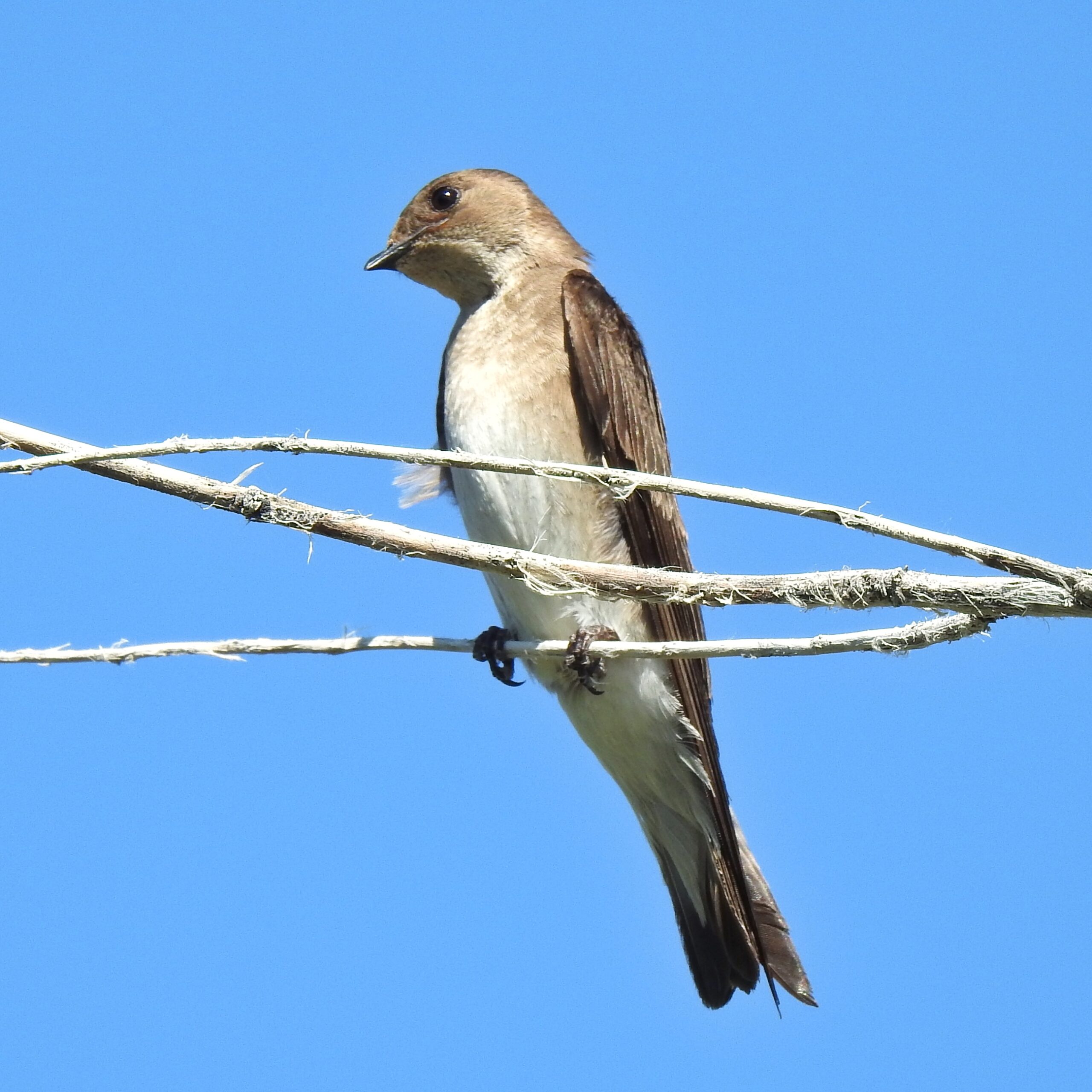
The luck was in seeing the bird at all. I found County Road B-051, a dirt road through sagebrush flats and cropland. I had the exact location where they’d been seen mapped out, but I kept my eyes open as I drove to it. I wasn’t on the road for five minutes when I saw a small bird fly about 50 yards in front of my car. Although I was still moving, I managed to follow the bird’s flight and see it land on top of a sagebrush bush. I braked and, while still behind the wheel, looked through my binoculars and knew I had my lifer. I got out for a closer look. For perhaps three minutes, the Sagebrush Sparrow flew from bush to bush, never closer to me than 20 yards away. Then it disappeared down into the brush, chasing another bird which may have been a second Sagebrush Sparrow. It paid no attention when I played its song, although its closest approach came in response to the pishing noises I made. I managed to get a few mediocre but diagnostic photos but figured I could do better when I got to the places where others have seen them in recent days.
I drove slowly and even got out and walked along the road, but I never found another one. I read later that Sagebrush Sparrows just sing early in the morning and are secretive at other times. I was lucky I spotted the one I did since it wasn’t doing any singing or even acting conspicuously. Six hours (round trip) is a long way to drive to see a bird for three minutes. But it would have felt a whole lot longer if I hadn’t seen it.
Sagebrush Sparrow and Bell’s Sparrow were considered a single species — Sage Sparrow — until 2013. I saw a Bell’s Sparrow in California in 2015. The Sagebrush Sparrow is a medium-sized sparrow with a long tail, a streaked brown back, and a gray head. It has a narrow black throat stripe, a white eye-ring, and a white spot in front of the eye. The breast and belly are white with a dark smudge on the breast. It lives in extensive sagebrush flats and spends most of its time running on the ground, generally only perching in the open to sing early in the morning.
Posted inBirds|Comments Off on Bird #554 — Sagebrush Sparrow
I took vacation days for the final three days of the week. On Tuesday evening, I walked down to Monument Branch.
Black-billed Magpie
On Saturday, We drove to Lake George and spent three hours in Elevenmile Canyon. At first, we got on the wrong road and happened upon a pond with three American White Pelicans.
When we finally got turned around, we spotted two Clark’s Nutcrackers along the road. These two shots are of the same bird.
Townsend’s Solitaire
We pulled over in a quiet stretch of the canyon and ate the picnic lunch we prepared. The top two photos are looking upstream and downstream from the spot where we ate lunch.
On Thursday, I drove to southeast Colorado, south of La Junta, to look for Gray Vireos. I’m 60% sure I saw one on County Road 197.6 (really), but it disappeared before I could get a photo or a satisfying look, so I just can’t pull the trigger and list it. The other road where they’ve been seen this spring had aggressive No Trespassing signs, so I skipped it and birded Higbee Valley. It was near midday by this time, so there weren’t a lot of birds around.
Cassin’s Kingbird
Blue Grosbeak
Lark Sparrow
Red-headed Woodpecker
I stopped at Holbrook Reservoir north of Rocky Ford on the way home. I parked on the north side and walked along the shore. There were a few shorebirds and ducks left, but not many. I missed the path to my car on the way back and walked an extra mile, but that’s OK because it led me to my first Colorado Snowy Plover.
Posted inBirds|Comments Off on The Last Week of May